AGILINK OmniHand 3 Ultra-M Brings 50,000-Point Tactile Sensing to Robot HandsAGILINK OmniHand 3 Ultra-M Brings 50,000-Point Tactile Sensing to Robot HandsAGILINK OmniHand 3 Ultra-M Brings 50,000-Point Tactile Sensing to Robot HandsAGILINK OmniHand 3 Ultra-M Brings 50,000-Point Tactile Sensing to Robot Hands
June 16, 2026
At ICRA 2026 in Vienna, Shanghai-based robotics company AGILINK demonstrated a robotic system that twisted latex balloons into animal shapes without popping them -- and the most consequential part of that demonstration was not the balloon. The real story is a sensor architecture
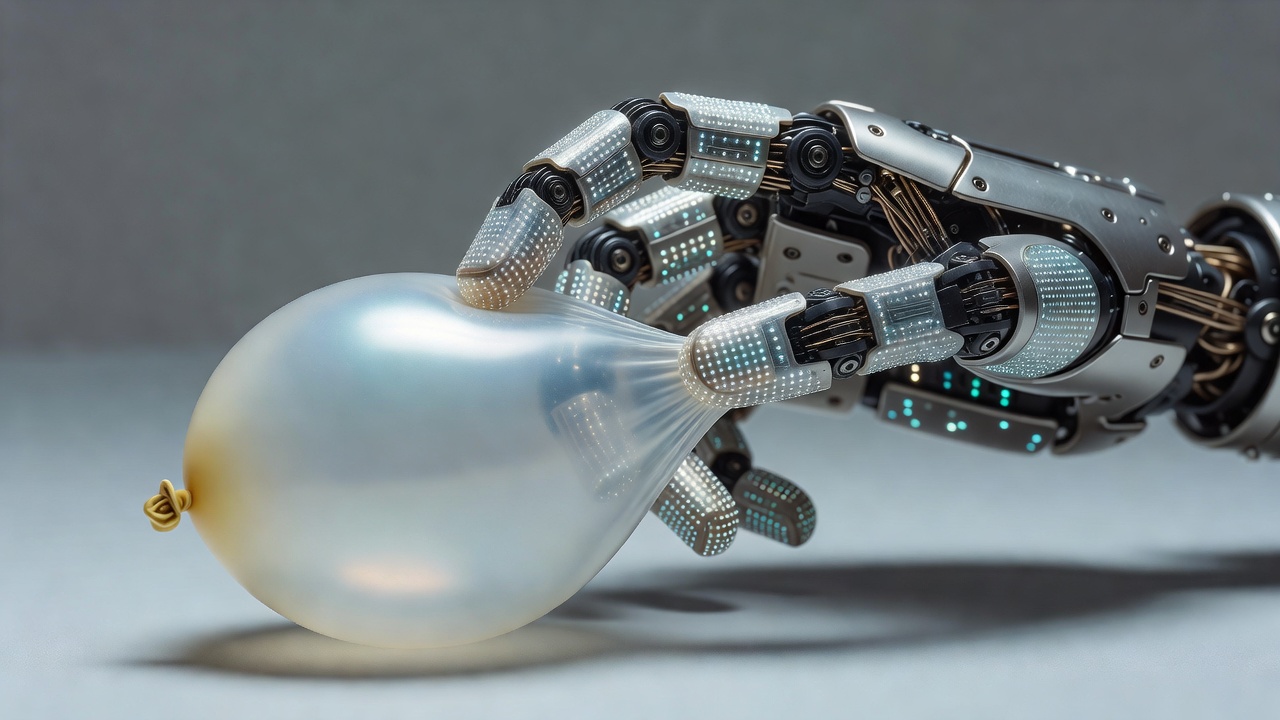
At ICRA 2026 in Vienna, Shanghai-based robotics company AGILINK demonstrated a robotic system that twisted latex balloons into animal shapes without popping them -- and the most consequential part of that demonstration was not the balloon. The real story is a sensor architecture buried inside OmniHand 3 Ultra-M: 50,000 tactile sensing points per square centimeter, distributed across a hand-sized form factor with 20 active degrees of freedom, resolving forces as small as 0.005 newtons -- roughly the weight of a sheet of paper resting on a fingertip. For an industry that has spent decades succeeding by avoiding contact, the announcement represents a direct challenge to the foundational logic of industrial automation.
The robotics field is converging on a problem that brute-force positional control cannot solve. Garment handling, connector mating, cable insertion, delicate assembly, and household manipulation -- the tasks that remain unautomated in 2026 -- all share a common failure mode: they require a robot to continuously sense and adapt to how its fingers are physically interacting with an object, not just track a target position in space. AGILINK's announcement frames this as a distinct capability class they call contact intelligence (the ability to establish, maintain, and adapt physical interaction as force distribution, friction, deformation, and contact geometry evolve in real time).
What It Does
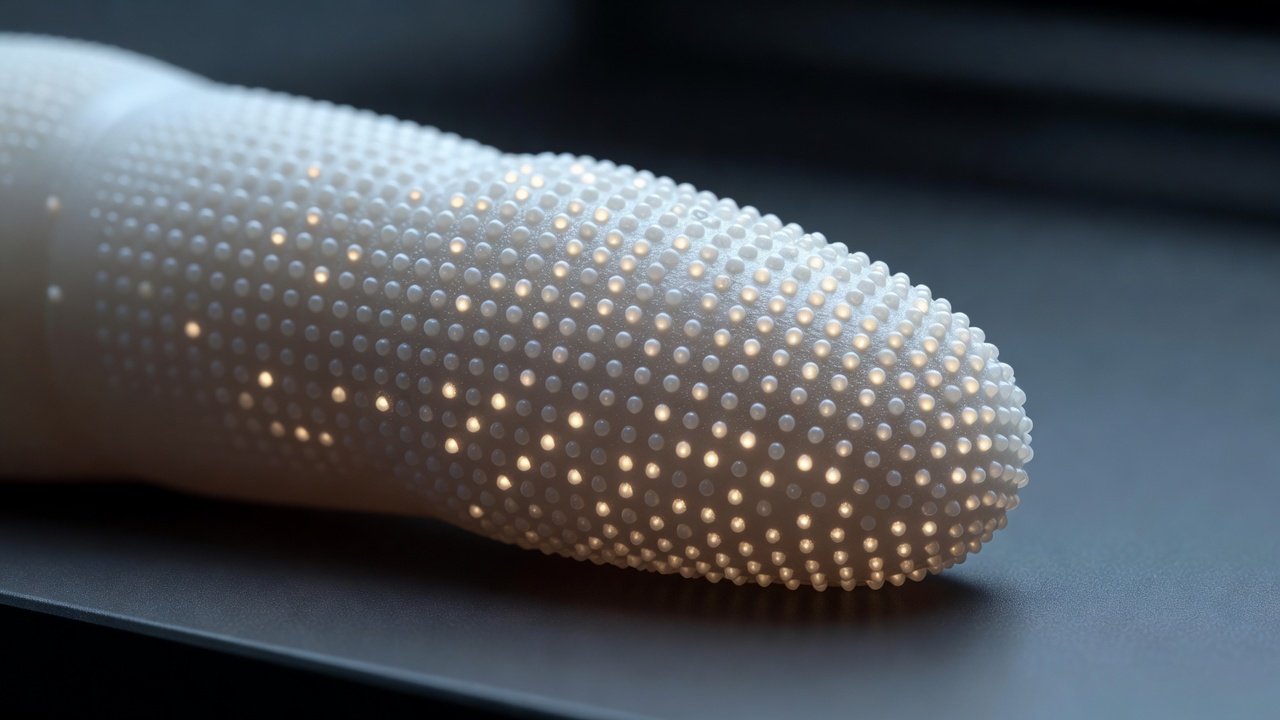
OmniHand 3 Ultra-M is roughly the size of an adult human hand. Within that form factor, AGILINK has integrated 20 active degrees of freedom (the number of independent parameters required to fully specify a mechanical system's configuration -- in a hand, roughly analogous to the number of independent joint movements available).
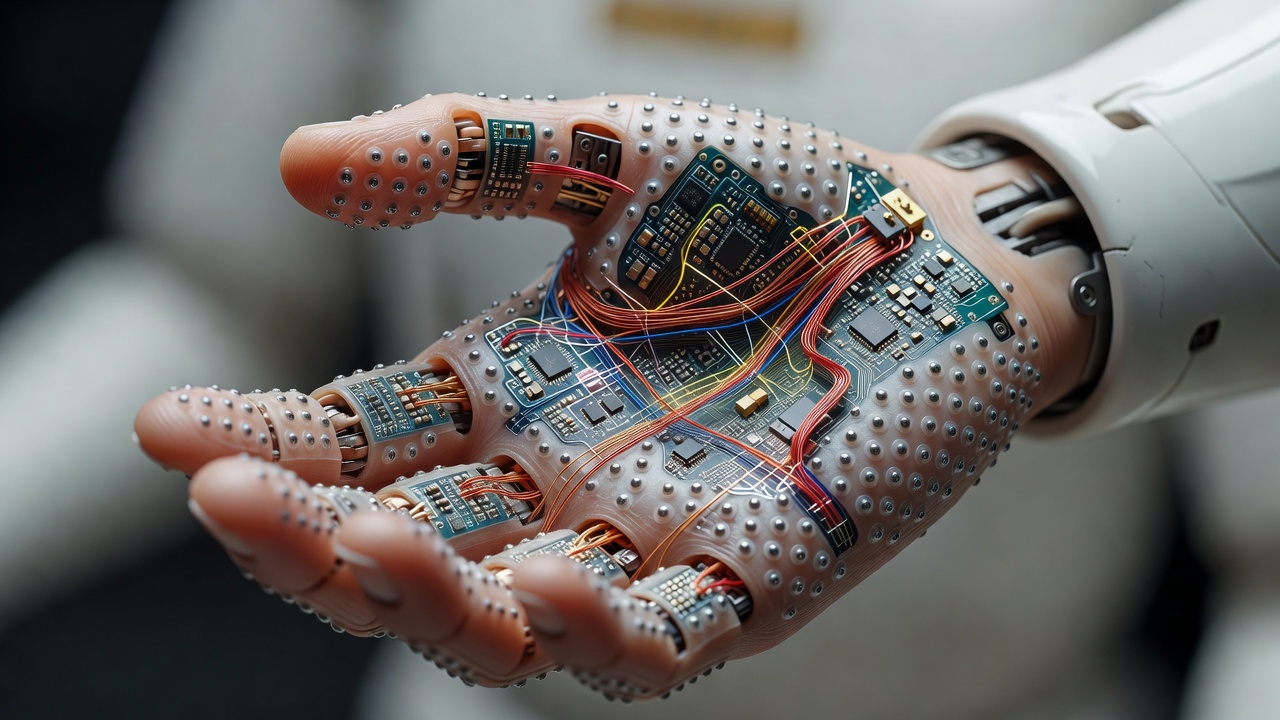
The sensing system operates across two distinct zones. Each fingertip contains a miniature vision-based tactile sensor -- a category of sensor that uses a camera behind a compliant gel layer to image surface deformation and infer contact geometry with high spatial fidelity. The palm contains more than 300 three-dimensional tactile sensing points distributed across its surface. Together, the system is designed to estimate pressure distribution (how contact force is spread across a surface area), shear forces (lateral forces that cause slipping), local deformation (how an object's surface is changing shape under contact), and slip tendencies (early indicators that a grasp is about to fail) -- all interaction dynamics that conventional position-based control systems cannot observe.
AGILINK distinguishes between two capability classes in manipulation robotics. Motion intelligence covers action generation, bimanual coordination, and extended sequence execution. Contact intelligence covers the orthogonal problem: whether the physical interaction at the point of contact is being maintained correctly as the object deforms, shifts, or changes geometry. The company's argument is that robotics has largely solved motion intelligence problems while contact intelligence remains the binding constraint on deployment in unstructured environments.
The Technical Achievement
The specifications AGILINK has published for OmniHand 3 Ultra-M are unusually granular for a conference announcement. The core sensing figures break down as follows:
| Specification | Value | Context |
|---|---|---|
| Active degrees of freedom | 20 | Within human-hand scale form factor |
| Palm tactile sensing points (3D) | 300+ | Distributed across palm surface |
| Force resolution | 0.005 N | Approximately the weight of a sheet of paper on a fingertip |
| Spatial resolution | 0.04 mm | Tactile sensing system |
| Sensing density | 50,000 points per cm2 | Across sensing surface |
These figures are self-reported by AGILINK. No independent third-party validation appears in the conference materials, and the article through which they were published on IEEE Spectrum is a sponsored placement. That context does not make the numbers implausible -- the sensing density figure is consistent with the direction of high-resolution tactile sensor research, including Meta FAIR's Digit 360 sensor, which detects spatial details as fine as 7 microns and forces as small as 1 millinewton -- but the specs should be treated as claimed performance rather than verified performance until independent benchmarks are published.
The actuation architecture is fully direct-drive throughout -- meaning motors connect to joints without intermediate gearing or tendons. Direct-drive systems trade the force amplification of geared transmissions for force-control transparency (the degree to which commanded force at the motor accurately reflects force delivered at the contact surface, without the compliance, backlash, and friction introduced by gear trains). The result is higher force-control bandwidth -- the frequency at which the system can sense and respond to changing contact conditions -- which matters for deformable objects whose geometry shifts continuously during manipulation.
Real-World Impact

The balloon dog demonstration at ICRA 2026 was not chosen arbitrarily. A latex balloon presents a specific combination of physical properties that make it a demanding test object: it is lightweight, highly deformable, slippery under contact, and sensitive to applied force. Every twist changes the object's internal air pressure and surface geometry simultaneously. AGILINK describes this as a long-horizon manipulation task (a task where each action modifies the state that subsequent actions must operate on, so early errors compound rather than self-correct).
Training the system required three distinct data sources. First, AGILINK used motion capture data from professional balloon artists to establish an initial manipulation policy (the mapping from sensory observations to motor commands). Second, that captured motion was mapped onto the robotic hand's kinematics to generate a starting policy for robotic execution. Third, human operators monitored the robot during task execution and intervened when the policy began drifting toward failure -- those intervention episodes were incorporated into reinforcement-learning cycles (a training paradigm in which the system updates its policy based on feedback about which actions led to success or failure).
The implication, if the approach generalizes, is significant. Cable insertion, garment handling, flexible packaging, and connector mating all share the balloon's defining characteristic: contact geometry changes continuously, and position-based control cannot track those changes fast enough to prevent failure.
Competitive Landscape
No directly comparable commercial peers were publicly identifiable at publication time with disclosed specifications supporting a direct comparison to OmniHand 3 Ultra-M's claimed sensing density or force resolution. The Shadow Robot Company's Shadow Dexterous Hand, in use at institutions including NASA and Carnegie Mellon University, matches the 20 degrees of freedom figure and uses Hall effect sensors in every joint for positional feedback, but is built around a different actuation philosophy -- pneumatic air muscles or DC motors in the forearm rather than direct-drive at each joint -- and no equivalent tactile sensing density figures have been publicly reported. Meta FAIR's Digit 360 sensor, capable of detecting spatial details to 7 microns and forces to 1 millinewton while processing touch information up to 30 times faster than humans, represents the direction high-resolution tactile sensing is moving at the component level.
What the ICRA 2026 presentation reflects is an industry-wide recognition that the previous paradigm -- reducing uncertainty by constraining the environment rather than sensing it -- has hit a ceiling. The unstructured environments where the remaining manipulation problems live require a different approach, and the architectural question is whether sensing density, sensing speed, or sensing type will prove to be the binding variable.
Independent analyst commentary specifically on this announcement was not publicly available at publication time.
What's Next
AGILINK has not disclosed a commercial shipping date, pricing, or target customer segment for OmniHand 3 Ultra-M. The announcement at ICRA 2026 positions the system as a research and demonstration platform; the gap between a conference demo and production deployment involves questions the company has not yet addressed publicly.
Durability is one open variable. Direct-drive actuation eliminates gearing failure modes but places higher demands on motor windings and bearings under repeated contact loads. A 50,000-sensing-point-per-cm2 tactile surface exposed to repeated manipulation tasks will accumulate wear in ways that a positional encoder in a protected housing does not. No data on sensor lifetime, calibration drift, or maintenance cycle has been published.
Scaling the training methodology is another. The balloon dog task required professional balloon artists as motion capture subjects and human operators monitoring for drift-toward-failure. Whether that approach scales economically to the dozens of distinct manipulation tasks a deployable system would need to handle is not addressed in the available materials.
For engineers evaluating whether contact-aware manipulation is approaching deployment readiness: the sensing density figure of 50,000 points per cm2 and force resolution of 0.005 N are the numbers to benchmark against. At 0.04 mm spatial resolution, surface texture, micro-slip, and deformation gradients become distinguishable signals rather than noise. The direct-drive architecture means force commands translate to contact forces at bandwidths conventional gear-train systems cannot match. Whether that is sufficient for your specific unstructured manipulation problem depends on the compliance, mass, and surface properties of the objects you are handling -- and on independent validation data that does not yet exist in the public record.
-- Zara Velez, Emerging Technology Editor
Sources: AGILINK via IEEE Spectrum, "Beyond Dexterity: Why Contact May Define the Next Era of Robotics" (sponsored, June 9, 2026); Shadow Robot Company Shadow Dexterous Hand (Wikipedia); Meta FAIR Digit 360 (digit.ml); Tactile sensor technology (Wikipedia).