Algorithmiq Raises EUR 18 Million, Beats Harvard and Stanford on Quantum Drug SimulationAlgorithmiq Raises EUR 18 Million, Beats Harvard and Stanford on Quantum Drug SimulationAlgorithmiq Raises EUR 18 Million, Beats Harvard and Stanford on Quantum Drug SimulationAlgorithmiq Raises EUR 18 Million, Beats Harvard and Stanford on Quantum Drug Simulation
May 12, 2026
A Finnish quantum software company has closed an €18 million funding round led by United Ventures and CDP Venture Capital, bringing its total capital raised to €36 million and relocating its global headquarters from Helsinki to Milan. The buried lead, however, is not the money
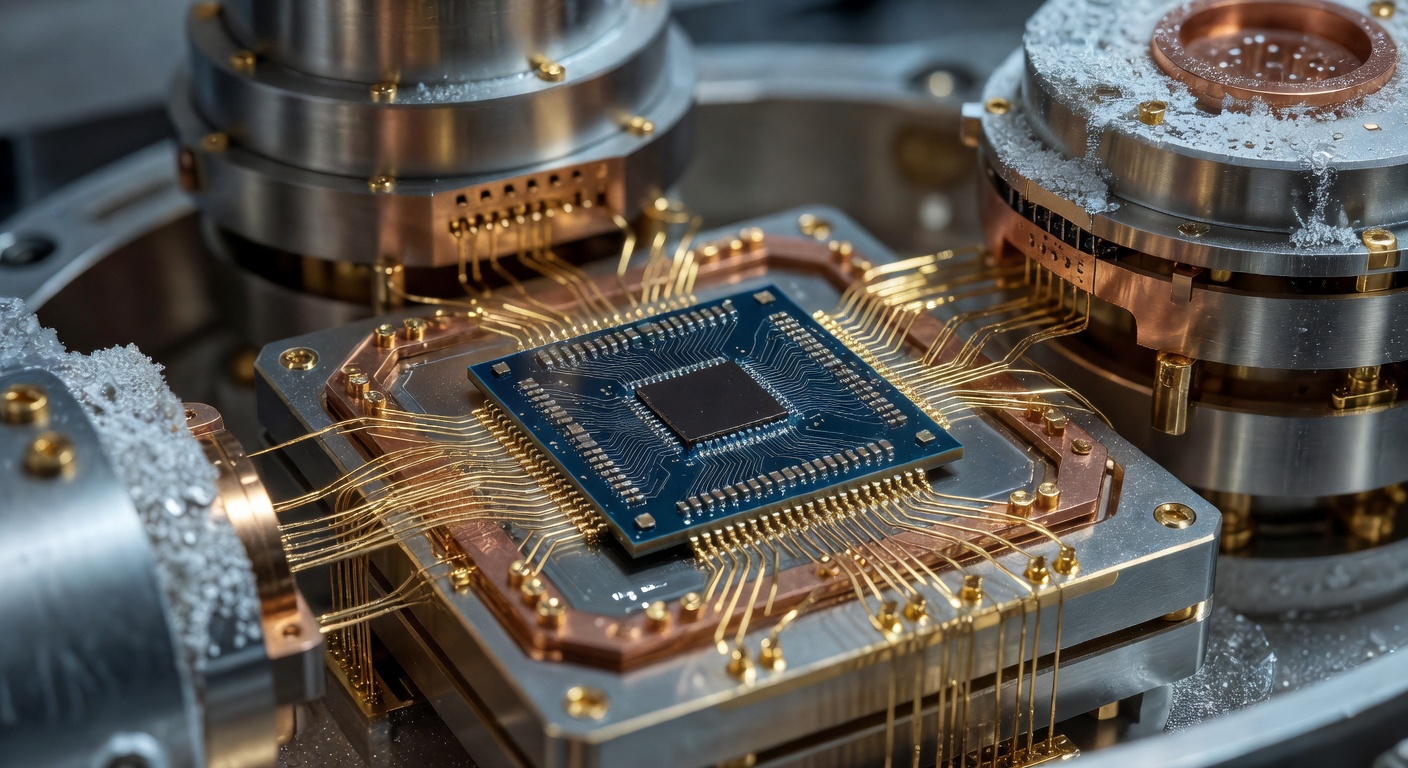
A Finnish quantum software company has closed an €18 million funding round led by United Ventures and CDP Venture Capital, bringing its total capital raised to €36 million and relocating its global headquarters from Helsinki to Milan. The buried lead, however, is not the money or the geography: it is that Algorithmiq arrived in Italy carrying a $2 million prize from the Wellcome Leap Q4Bio Challenge, awarded after the company outcompeted Harvard, Oxford, Stanford, Nottingham University, and commercial rival Infleqtion to become the first company ever to prove that end-to-end quantum-classical algorithms can simulate complex therapeutics. For enterprise technology buyers watching the quantum space, that benchmark result matters far more than the funding headline.
The round, which closes at exactly double Algorithmiq's previously disclosed capital base, signals a deliberate geographic pivot at a moment when Europe is competing to define where quantum software commercialization happens. Algorithmiq's thesis is specific: the hardware race is necessary but not sufficient, and without major advances in algorithmic efficacy, quantum hardware risks becoming impossible to commercialize. The company is betting its roadmap, its capital, and now its postal address on that conviction.
What Happened
Algorithmiq announced in May 2026 that it has raised €18 million in a funding round led by United Ventures, an Italian venture capital firm, and CDP Venture Capital, the venture arm of Cassa Depositi e Prestiti, Italy's state-backed development institution. Inventure VC, a prior investor, continued its participation in the round. The new capital brings Algorithmiq's total cumulative funding to €36 million, which the company describes as Italy's largest-ever venture capital investment in a quantum startup.
Alongside the funding announcement, Algorithmiq confirmed the establishment of its global headquarters in Milan, completing a transition from its previous base in Helsinki, Finland, where the company retains continued operations. The dual-location structure preserves existing research capacity while anchoring the company's commercial and strategic leadership in Italy.
The funding and HQ move arrive against the backdrop of Italy's National Quantum Strategy, launched in 2025, which sets national priorities for quantum research and industrial application. CDP Venture Capital's participation as a co-lead investor signals a direct alignment between private capital and state strategic intent: CDP is the institutional vehicle through which Italian public savings are directed toward development priorities, and its presence in a quantum software deal is not a coincidental portfolio decision.
The round's key participants and their roles are:
- United Ventures -- lead investor, Italian VC firm
- CDP Venture Capital (Cassa Depositi e Prestiti) -- co-lead, Italian state-backed institutional investor
- Inventure VC -- continued participation from prior round
The Technical Breakthrough

Algorithmiq operates at the algorithmic layer of quantum computing, targeting two specific problems: noise mitigation (techniques to suppress the errors that accumulate in quantum computations as physical qubits interact with their environment) and quantum-classical hybrid algorithms (computational workflows that distribute work between a quantum processor and a classical computer, using each where it holds an advantage).
These are the central engineering bottleneck between current quantum hardware and commercially useful results. Physical quantum processors operate in a regime where decoherence (the loss of quantum state information due to environmental interference) and gate errors (inaccuracies introduced each time a quantum operation is performed on a qubit) accumulate faster than most algorithms can complete. Quantum error correction addresses this by encoding logical qubits redundantly across multiple physical qubits, with efficiency measured by code rate -- the ratio of logical to physical qubits. But full error correction at scale remains a hardware challenge measured in years or decades. Noise mitigation at the algorithmic layer is the practical near-term alternative.
In 2025, Algorithmiq achieved what the company describes as a first for the field: quantum advantage for a useful scientific problem, demonstrated on IBM quantum hardware using an Algorithmiq-designed model. Quantum advantage -- the condition where a quantum algorithm produces a result that a classical computer cannot match within a practical time or resource budget -- had previously been demonstrated only on synthetic benchmarks of limited scientific value. The Algorithmiq result moved the threshold into direct commercial application: the simulation of complex therapeutics, the computational foundation of drug discovery.
The company also launched a commercially available noise mitigation algorithm product, though the full product name was not disclosed in Algorithmiq's press release.
Why It Matters for Industry
The Wellcome Leap Q4Bio Challenge provides the clearest external validation of Algorithmiq's claims. Wellcome Leap, the innovation arm of the Wellcome Trust, ran the Q4Bio Challenge as an open competition to identify whether quantum or quantum-classical computing could demonstrate a meaningful advance in biological simulation relevant to drug discovery. Algorithmiq entered as the sole winner, taking the $2 million prize.
The significance of the win lies in the field it was competing against. Among the teams Algorithmiq defeated were researchers from Harvard University, Oxford University, Stanford University, and Nottingham University, all operating leading quantum computing and computational chemistry research programs. Infleqtion, a commercial quantum company, was also among the competitors.
The phrase used in Algorithmiq's announcement is precise in its implications: the company became "the first company ever to prove that end-to-end quantum-classical algorithms can simulate complex therapeutics." The word "prove" carries weight in a sector accustomed to demonstration results on toy problems. An end-to-end simulation means the algorithm handled the complete workflow of molecular modeling, not a simplified proxy task.
For enterprise buyers in pharmaceutical research and drug discovery, this result redefines the timeline for when quantum-derived results might enter production workflows. The standard pharmaceutical industry concern has been that claimed advantages apply only to idealized problems with no analog in real drug pipelines. A competition structured around genuine therapeutic simulation, judged by Wellcome Leap's scientific panel, directly addresses that objection. Algorithmiq now holds an externally validated result that no academic institution or commercial competitor has matched on an equivalent benchmark.
Competitive Landscape
The quantum computing industry in 2026 is organized primarily around hardware platforms, with the dominant narrative built around qubit counts, error rates, and quantum volume metrics. Algorithmiq's differentiation is not in any of those dimensions. It is in the claim that the hardware race, while necessary, is insufficient without equivalent progress at the algorithmic layer -- and that the algorithmic layer is where near-term commercial utility will actually emerge.
Within the Q4Bio competition, the only named commercial competitor was Infleqtion, which Algorithmiq defeated for the sole-winner designation. Infleqtion's presence confirms that the Q4Bio challenge attracted serious commercial entrants, not just academic teams. The Q4Bio result positions Algorithmiq against a different benchmark than its hardware-focused peers: demonstrated utility on a real scientific problem, rather than quantum volume metrics or qubit fidelity scores.
Independent analyst commentary specifically on this announcement was not publicly available at publication time.
The Bigger Picture
The choice of Milan as a headquarters location is a deliberate geopolitical signal. Italy's National Quantum Strategy, launched in 2025, established national funding priorities and institutional frameworks for quantum technology development. CDP Venture Capital's co-lead position is the first concrete evidence of that strategy producing a significant venture outcome: a company choosing Italy as its global anchor specifically at the moment Italian state capital enters its cap table.
Italy's claim to physics leadership runs through Enrico Fermi and the Via Panisperna Boys, the group of physicists working in Rome in the 1930s who produced foundational results in nuclear physics. Algorithmiq's arrival in Milan positions the company within that lineage and frames Italy not as a peripheral European quantum location but as a node in the field's intellectual history being deliberately reactivated.
At the European level, the context is the EU's Quantum Flagship initiative, launched in 2018 with a budget of at least €1 billion over ten years, designed to build a quantum technology ecosystem across European research institutions, industry, and policy. Algorithmiq's Milan HQ move and CDP's institutional backing represent exactly the kind of national-level quantum commercialization anchor the Flagship framework was designed to encourage, even if the company's origins are Finnish rather than Italian.
The dominant quantum narrative of the past decade has been hardware-first and concentrated in the United States and China. A European company winning a global benchmark competition on software and algorithms, then planting its flag in southern Europe with state-backed capital, advances a different hypothesis: that the algorithmic layer is where Europe can compete, and that Italy has chosen to place an institutional bet on that thesis.
What's Next

The €18 million will fund the build-out of Algorithmiq's Milan headquarters and the scaling of its algorithmic research and development programs. The company has not disclosed specific headcount targets, customer names, or commercial revenue figures. The public roadmap rests on two validated foundations: the noise mitigation product already commercially available, and the Q4Bio win as a reference result for pharmaceutical and biotechnology enterprise buyers.
The next threshold is the transition from benchmark win to production contract. Winning a Wellcome Leap competition demonstrates algorithmic capability; converting that into recurring enterprise revenue requires integration with existing pharmaceutical informatics infrastructure, regulatory alignment for drug discovery workflows, and the vendor support structures enterprise buyers require before committing to a single provider.
IBM's role as the quantum hardware partner in Algorithmiq's 2025 advantage demonstration is a structural asset for commercialization. IBM's quantum network includes academic and enterprise partners across pharmaceuticals, finance, and materials science. An algorithmic software layer that runs on IBM hardware and has demonstrated validated advantage on IBM's own processors is positioned to enter IBM's enterprise partner ecosystem, potentially accelerating the sales cycle without requiring Algorithmiq to independently build large-enterprise relationships from a €36 million capital base.
For enterprise technology teams evaluating quantum software vendors, the specific question to ask is not "how many qubits" but "what has been validated on a real scientific problem at external competition standard?" Algorithmiq now has a concrete answer: sole winner of the $2 million Wellcome Leap Q4Bio Challenge, defeating Harvard, Oxford, Stanford, and commercial competitors on end-to-end therapeutic simulation. That answer is the asset the €18 million is now being deployed to commercialize.
The most striking aspect of this announcement is not the €18 million or the Milan address: it is that a company with a total capital raise smaller than a single U.S. quantum hardware funding round just produced the field's most credible near-term commercial result by ignoring the hardware race entirely. The algorithm was always the harder problem. Algorithmiq just proved it in open competition.
-- Aria Lin, Enterprise Technology Analyst
Sources: The Quantum Insider: Algorithmiq raises €18 million, establishes headquarters in Milan · IBM Quantum: Enabling Healthcare and Biology Research · IBM Research: Accelerating QPUs with GPUs
More on Revuzia
Quantum computer breakthrough tracks qubit fluctuations in real time
Suniva Plans 564-Job Solar Manufacturing Facility in South Carolina
India Adds 44.6 GW of Solar in One Year While US Falls Further Behind