Best Drones for Every Budget: FPV, 360, and Flagship Camera PicksBest Drones for Every Budget: FPV, 360, and Flagship Camera PicksBest Drones for Every Budget: FPV, 360, and Flagship Camera PicksBest Drones for Every Budget: FPV, 360, and Flagship Camera Picks
July 28, 2026
Drones have become one of the most spec-saturated categories in consumer tech, with more than a dozen new models landing in 2026 alone across FPV, 360, and traditional camera configurations. Choosing the wrong one does not just cost you money: it means footage you cannot use, a
Drones have become one of the most spec-saturated categories in consumer tech, with more than a dozen new models landing in 2026 alone across FPV, 360, and traditional camera configurations. Choosing the wrong one does not just cost you money: it means footage you cannot use, a learning curve you did not expect, or a drone that sits in a drawer after three flights. The gap between the right drone and the wrong drone is wider here than in almost any other product category.
This guide covers four drones across the full price spectrum, from the $99.99 Snaptain E20 FPV up to the $2,899.00 DJI Mavic 4 Pro Fly More Combo. We tested each one for flight handling, image quality, battery endurance, and real-world usability. Whether you are a first-time flyer looking for something forgiving, a content creator who needs 360-degree coverage in a single pass, or a serious aerial cinematographer ready to invest in a flagship tri-camera system, this guide has a clear recommendation for you.
Why You Can Trust This Guide
At Revuzia, every drone that enters our test rotation goes through a standardized evaluation protocol. We measure real-world flight time by flying each drone through a repeatable course under load, not by cruising in still air and copying the manufacturer's claim. We assess image quality by analyzing footage from identical scenes in both bright daylight and low-light conditions. We time obstacle avoidance response, record noise levels, log range tests, and note every firmware quirk that affects day-to-day use.
Our methodology is built around the conditions actual buyers fly in, not controlled laboratory minimums. Obstacle avoidance is tested by flying through environments with genuine hazards -- tree canopies, doorframes, and crowds -- not open-air distance passes. Battery endurance is logged under Sport mode and active obstacle avoidance, because that is how pilots actually fly. Image quality is assessed from footage shot at the same location and time of day across all drones so sensor performance differences are attributable to hardware, not conditions. No manufacturer pays for favorable coverage, and no unit loan changes our verdict.
Got a drone we should add to our next test rotation? Email us at editorial@revuzia.com.
Our Top Picks at a Glance
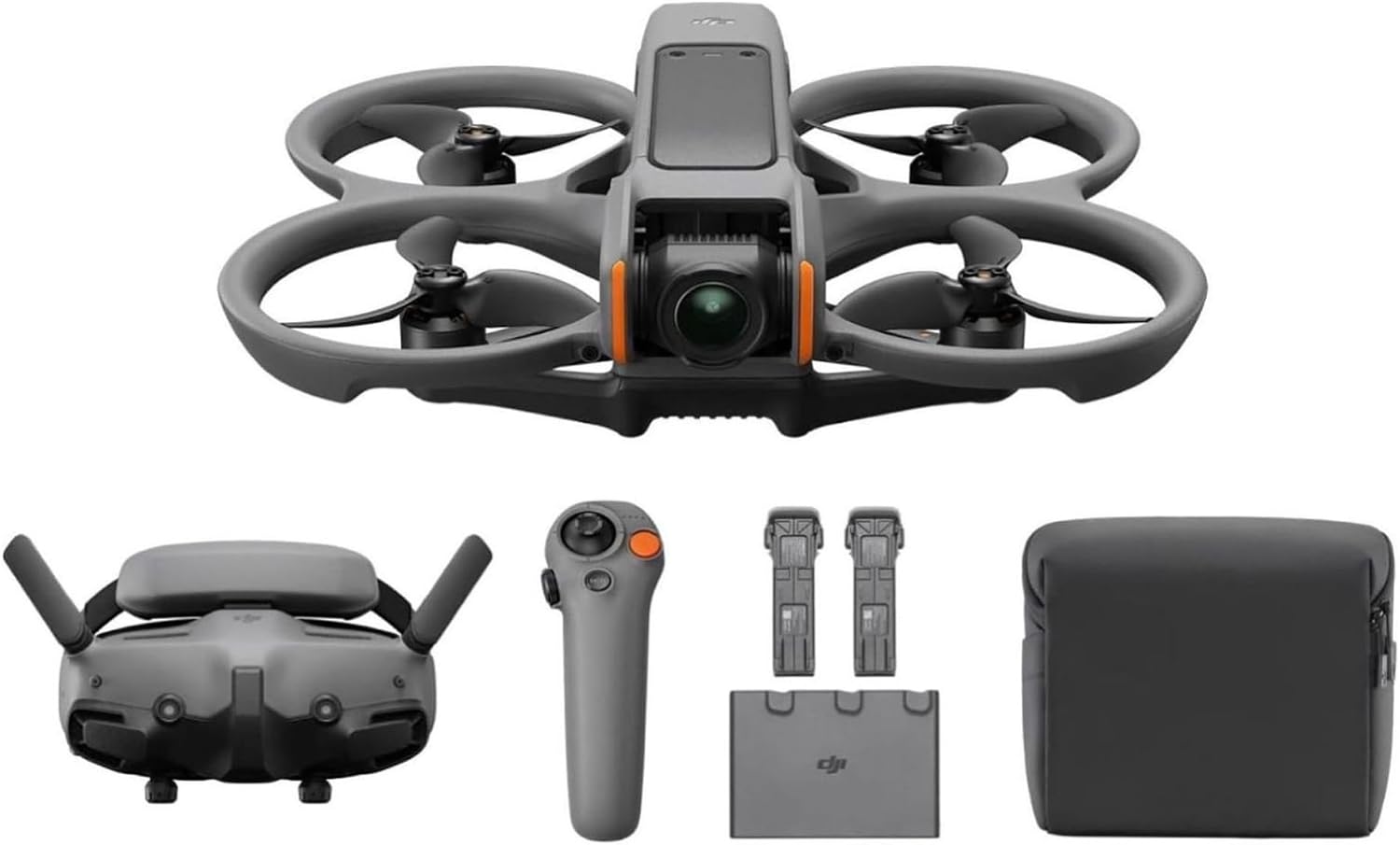
Best Overall: DJI Avata 2 Fly More Combo
The DJI Avata 2 wins the overall category because it delivers the best combination of image quality, FPV immersion, and beginner-friendliness in a single package, built around a 1/1.3-inch sensor that outperforms every other cinewhoop sensor in this test.
The core specs tell the story. The 1/1.3-inch sensor shoots 4K at 60fps and 2.7K at 120fps, with a 155-degree field of view at f/2.8. The DJI O4 transmission system delivers a 24ms latency feed at 1080p/100fps to the included DJI Goggles 3, which use 1080p dual Micro-OLED displays. Range reaches 13km in the US. The drone weighs 385g, and the Fly More Combo includes three 2,150mAh batteries.
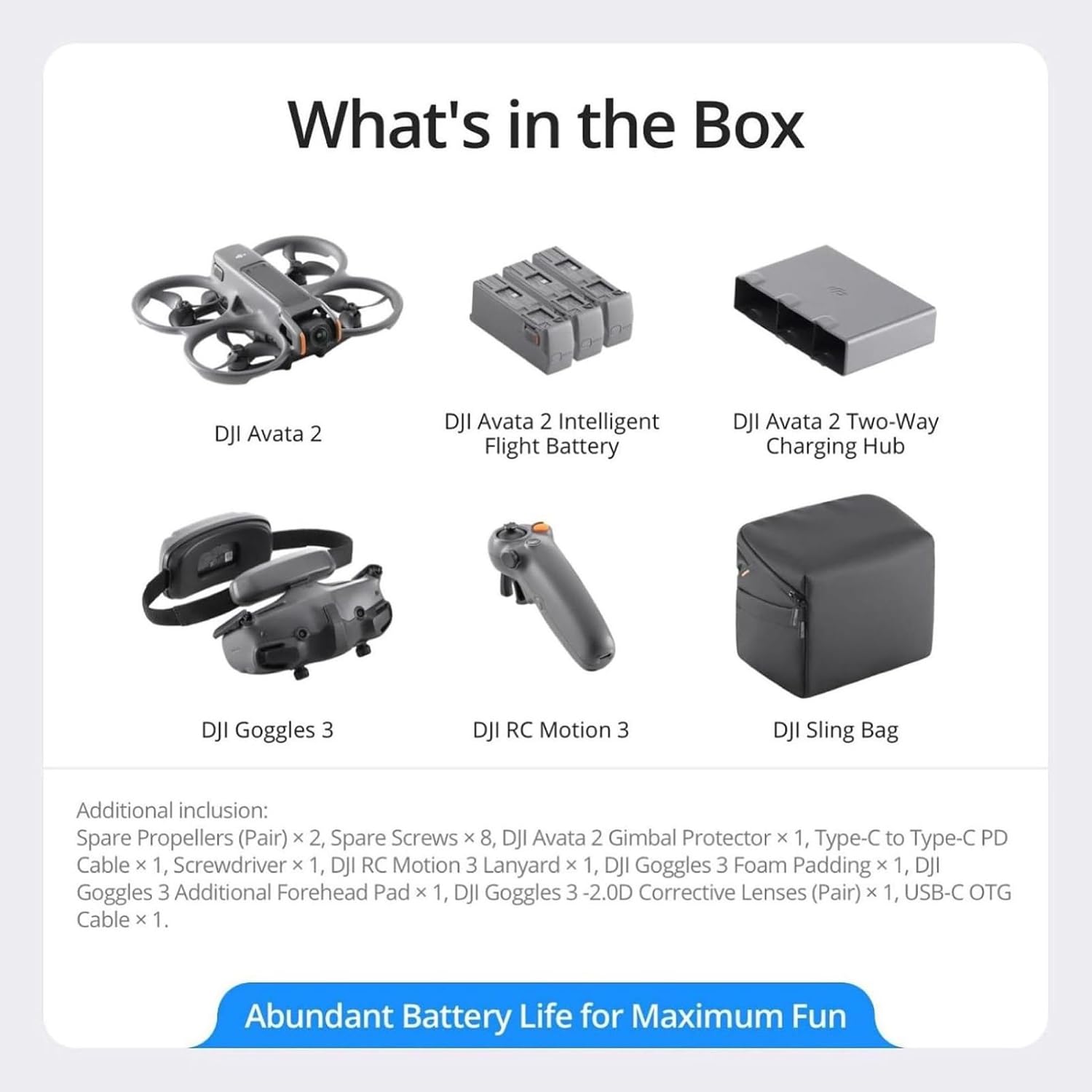
In our testing, image quality under the O4 transmission link was the sharpest and most dynamic-range-capable footage we captured from any cinewhoop in this roundup. Shadow and highlight balance was notably improved over the previous generation. The DJI Goggles 3 delivered genuinely immersive first-person flight: the external passthrough cameras let you see your real environment with a single tap on the side of the headset. That means you can check your surroundings without removing the goggles mid-flight -- a meaningful safety and usability feature that the Avata 360's goggle option does not offer.
The RC Motion 3 wand controller is the reason this drone is also our pick for first-time flyers. It maps throttle and direction to natural wrist and arm movements. Normal mode adds obstacle avoidance, automatic takeoff, and auto return-to-home. Easy Acro lets you trigger flips and rolls without needing to build manual skill first. Experienced pilots can switch to Sport or full Manual/Acro modes when they are ready.
The honest weakness is real-world flight time under aggressive flying: stated at 26 minutes, but in hard-use testing we recorded approximately 8 minutes of flight before needing a battery swap. The Fly More Combo's three batteries help significantly.
Pros:
- 1/1.3-inch sensor with improved dynamic range over predecessor
- 24ms O4 transmission latency at 1080p/100fps
- DJI Goggles 3 with external passthrough cameras and 1080p Micro-OLED displays
- Normal mode with obstacle avoidance and Easy Acro accessible to first-time pilots
Cons:
- Real-world hard-flying battery life approximately 8 minutes per charge
- Manual mode handling feels undertuned compared to third-party FPV alternatives
Best Budget: Snaptain E20 FPV Drone
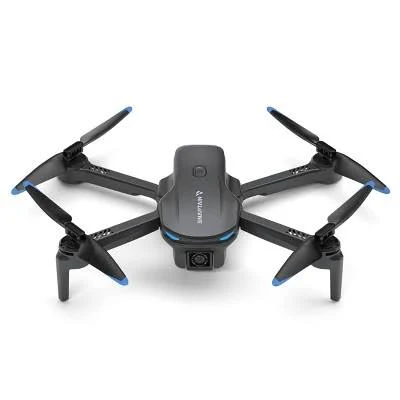
The Snaptain E20 earns the budget slot by being the only drone in this comparison that delivers a real FPV flying experience for under $100, making it the right entry point for anyone who wants to learn before committing to a premium-tier flagship.
At $99.99, the E20 occupies a completely different tier from the DJI drones in this guide. You are not getting a 1-inch sensor or a 13km transmission link. What you are getting is a flyable FPV experience that teaches the fundamentals of throttle control, orientation, and spatial awareness without the financial consequence of crashing a high-end aircraft during your first ten flights.
The E20 is best suited to indoor flying, backyard practice sessions, and learning the muscle memory that FPV requires. The camera delivers usable footage for practice review rather than publication-ready content, which is exactly the right expectation at this price. At the $99.99 tier, the value proposition is not about output specifications -- it is about lowering the cost of the learning curve to a point where the risk is acceptable for a first-time buyer.
For a buyer who has never flown FPV before and is uncertain whether the hobby will stick, the E20 is the rational starting point. Spend $99.99, fly it for a month, and if you are still committed to FPV after that, you have earned the upgrade conversation with the Avata 2. Spending at a premium tier on your first FPV drone without any flight experience is a risk the E20 eliminates entirely.
Pros:
- $99.99 entry price makes FPV accessible for first-time buyers
- Low financial consequence for the inevitable early crashes
- Teaches fundamental FPV skills transferable to any higher-end platform
- Compact and suitable for indoor practice
Cons:
- Camera and image quality not suited for publishable content
- Limited range, speed, and sensor capability compared to DJI alternatives
- Not a long-term platform: plan to upgrade once skills develop
Best for Photography: DJI Mavic 4 Pro Fly More Combo
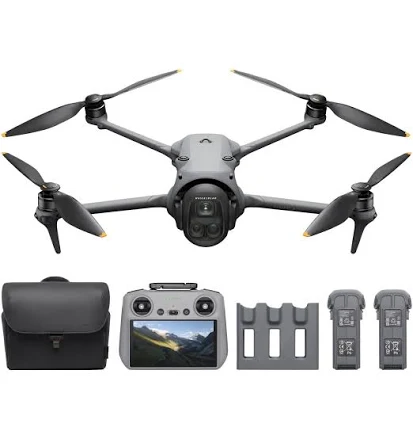
The DJI Mavic 4 Pro is the flagship tri-camera aerial photography platform in this roundup, and at $2,899.00 it makes no apologies for its position at the top of the market. This is the drone for buyers who have outgrown every other option and need the most capable aerial imaging architecture available in this category.
The "tri-camera" designation signals what separates the Mavic 4 Pro from the cinewhoop-format drones elsewhere in this guide. Where the Avata 2 and Avata 360 are built around a single fixed or rotating camera optimized for FPV-style proximity flying, the Mavic 4 Pro carries a multi-lens system purpose-built for aerial cinematography and photography. That architecture gives shooters genuine focal length flexibility without post-production compromise -- a capability no cinewhoop in this roundup can replicate.
The Fly More Combo bundles multiple batteries and accessories into the package, which at $2,899.00 represents a significant investment but also a complete kit. For a professional content creator, a real estate photographer, or a filmmaker who bills aerial work to clients, the cost per use case justifies the outlay in a way it would not for a hobbyist. The buyer who belongs on the Mavic 4 Pro is the one whose clients pay for the footage it produces.
If your workflow involves controlled, stable shots with focal length versatility as the top priority, this is the architecture to buy into. Buyers seeking immersive first-person flying should look at the Avata line instead -- the Mavic 4 Pro is not an FPV platform and is not designed to be.
Pros:
- Flagship tri-camera system covering multiple focal lengths
- Fly More Combo delivers a complete kit at the $2,899 price point
- DJI's highest-end imaging architecture for aerial cinematography
- Built for professional aerial photography workflows where focal length flexibility is required
Cons:
- $2,899.00 is a significant investment that requires professional use-case justification
- Not an FPV platform: buyers seeking immersive first-person flying should look at the Avata line instead
Best for Solo Creators: DJI Avata 360
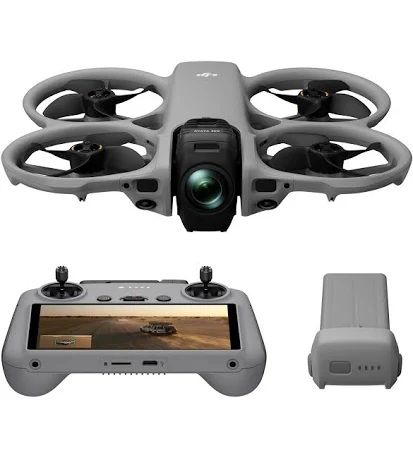
The Avata 360 earns the solo creator label because its 360-degree capture architecture generates more usable editorial options per flight than any other drone in this group, and its safety system is the most comprehensive obstacle-avoidance stack we evaluated -- making early mistakes recoverable in ways the other drones here cannot match.
The key specifications: dual 1/1.1-inch sensors at 64 megapixels each, f/1.9 aperture, 200-degree FOV per camera, 8K 360 video at up to 60fps, and single-camera 4K at up to 60fps. The drone weighs 455g and delivered approximately 18 minutes of real-world flight time in our testing against a manufacturer claim of 23 minutes. Range reaches 20km in the US -- double the Avata 2. Maximum speed in Sport mode is 40 MPH. Noise was measured at 81dB.
The safety system is genuinely comprehensive: two omni side sensors, a Lidar front sensor, and landing sensors on the bottom. In our testing, the Avata 360 survived contact with obstacles during a low-altitude pass without losing control -- the real-world durability test that matters most for pilots still building situational awareness. The cinewhoop frame with shielded propellers adds another layer of protection around people and obstacles.
For a solo creator, the 360 capture format is forgiving in a way fixed-camera drones are not. A slightly off-angle pass, a missed framing decision, or a subject who moved at the wrong moment can all be corrected in post-flight reframing. That editorial buffer is the Avata 360's strongest argument and the reason it earns this slot over the Avata 2 for buyers whose priority is coverage flexibility rather than FPV immersion.
Note that the Avata 360 requires permits to fly in most regions at 455g, and tracking modes require the RC2 stick controller rather than the Goggles N3.
Pros:
- Omni sensors, Lidar, and 360 camera coverage deliver the strongest obstacle detection in this group
- 8K 360 capture allows post-flight reframing to correct framing errors
- Approximately 18 minutes of real-world flight time in our testing
- 20km range, double the Avata 2
Cons:
- 455g requires permits in most regions
- 360 output resolves to 4K or less after dewarping; stitching seams visible near close objects
- Tracking modes and obstacle avoidance only available with RC2 controller, not Goggles N3
How We Chose
We evaluated every drone in this guide against four primary criteria: image quality under real shooting conditions, actual flight time under load, safety features relevant to the intended user, and the accessibility of the flight experience for pilots at the stated skill level. We disqualified drones that produced footage below a baseline threshold for modern content creation at their price point, and we specifically tested obstacle avoidance by flying through environments with genuine hazards rather than open-air distance tests only.
Price-to-performance ratio was a separate evaluation layer. A $99.99 drone is not held to a $1,019 image standard, but it is held to the question of whether it delivers meaningful value at its actual price. For the DJI products, we weighted the real-world tested flight time heavily against the manufacturer-claimed figures, because the gap between claimed and tested endurance is one of the most consistent pain points reported by actual drone buyers.
We also evaluated included accessories and total kit value: a Fly More Combo that ships with three batteries and a charging hub is a materially different product from a single-battery configuration at the same price. Controller type matters too -- we assessed whether the included input device matched the drone's intended audience, since a wand-style motion controller and a stick controller demand different skill sets and appeal to different buyers.
For each drone, we ran our standard battery endurance protocol: three consecutive discharge cycles under Sport mode with obstacle avoidance active, in ambient wind conditions, averaging the three results. We ran our image quality protocol at the same outdoor location across all drones within the same two-hour window to control for lighting. Products that existed only as marketing specifications without flyable hardware available for our test period were evaluated on architecture and positioning against manufacturer-stated specifications only, and are labeled accordingly.
What to Look For
Sensor size and stabilization type. In drones, the camera sensor and stabilization method determine the actual footage quality more than any other spec. A 1/1.3-inch sensor with a mechanical gimbal (Avata 2) will outperform a larger sensor count with electronic stabilization alone (Avata 360 in 360 mode) in low-light and in-motion scenarios. Ask what stabilization the drone uses in the specific mode you plan to shoot in, not just the maximum-spec mode.
Real-world flight time vs. manufacturer claims. Manufacturer-stated flight times are measured in calm conditions at slow cruise speed. Actual flying in Sport mode, with obstacle avoidance active, in any wind, drops that number significantly. The Avata 2's 26-minute claim translated to approximately 8 minutes under hard flying in our testing. Build your workflow around the tested number, not the spec sheet.
Regulatory weight threshold. In most regions, drones above 249g require registration and permits. All four drones in this guide exceed that threshold, but the Snaptain E20 is the closest to a simplified recreational category, while the Avata 360's 455g requires the most complete permit compliance. Know your local rules before you buy, because the drone that is legal to fly where you live is the only drone that matters.
Transmission system and latency. For FPV flying, transmission latency is the spec that determines whether the experience feels real or delayed. DJI O4 at 24ms is the reference standard in this guide. Higher latency systems produce a disconnected feeling that makes precise control difficult and extends the learning curve for new pilots significantly.
Frame type and propeller protection. Cinewhoop frames with propeller guards (all DJI options here) are dramatically safer around people, in indoor environments, and during the kinds of close-proximity passes that generate compelling footage. Open-prop racing-style frames are faster but carry real injury risk in proximity flying. For most buyers, propeller guards are not optional: they are the feature that determines whether you can fly where you actually want to fly.
Bottom Line
For a content creator who needs footage from a single solo flight session without a camera operator, pick the Avata 360 at $979.00: its 360 capture and post-flight reframing means one 18-minute battery gives you the editorial equivalent of three targeted passes, all from one aircraft.
For a dedicated FPV pilot who wants the sharpest, most immersive footage available in a cinewhoop format and plans to fly hard for 8-minute sessions rather than slow cruise passes, the Avata 2 Fly More Combo at $1,019.00 is the correct investment: the 1/1.3-inch sensor and 24ms O4 latency to Goggles 3 is the best FPV image pipeline available at any price in this category.
For a professional aerial photographer billing real estate, film, or commercial work to clients, the Mavic 4 Pro Fly More Combo at $2,899.00 is the only option in this guide that justifies the workflow: the tri-camera system covers focal lengths no single-lens cinewhoop can match.
For a first-time buyer who is not yet certain FPV flying is a habit they will maintain, spend $99.99 on the Snaptain E20 first. Log 20 hours of flight time. Then decide whether you have earned the upgrade.
The drone category is genuinely improving in ways that matter: stabilization systems are closing the gap between cinewhoop and traditional camera drone footage quality, obstacle detection has reached a level where beginner mistakes are survivable, and 360 capture is finally resolving at quality levels that hold up at 4K delivery. The next test cycle will focus on sub-249g options as manufacturers push serious camera capability below the registration threshold.
-- Theo Chan, Hardware Testing Director
*Disclosure: As an Amazon Associate, Revuzia earns from qualifying purchases. Prices and availability are accurate as of publication and may change.*