Cloudera Wires Mistral AI Models Directly Into Its Data PlatformCloudera Wires Mistral AI Models Directly Into Its Data PlatformCloudera Wires Mistral AI Models Directly Into Its Data PlatformCloudera Wires Mistral AI Models Directly Into Its Data Platform
September 9, 2026
Cloudera and Mistral AI unveiled what the two companies are calling a "massive, nine-figure strategic partnership" at Cloudera's EVOLVE26 event in Sao Paulo, wiring Mistral's frontier language models (the industry term for a vendor's most advanced AI models) directly into
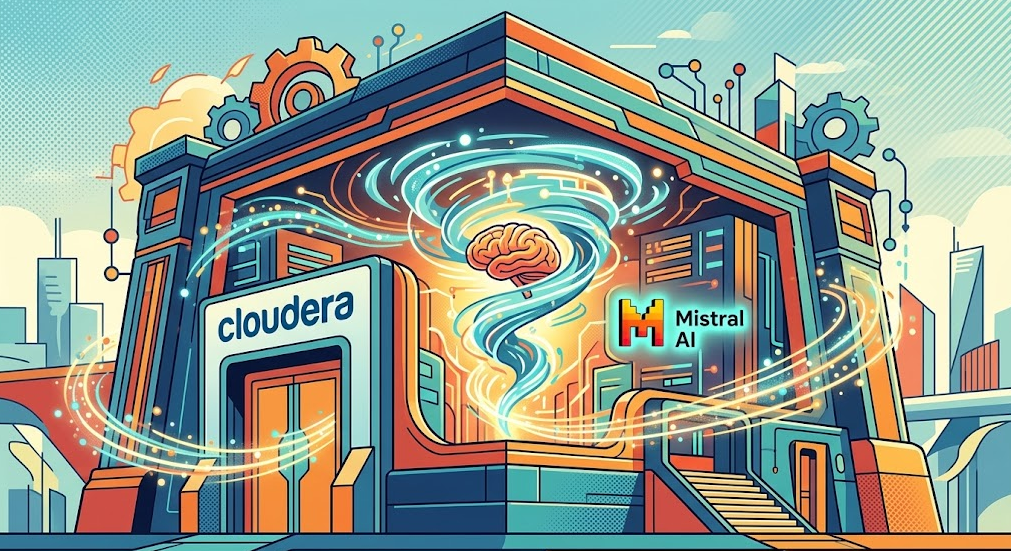
Cloudera and Mistral AI unveiled what the two companies are calling a "massive, nine-figure strategic partnership" at Cloudera's EVOLVE26 event in Sao Paulo, wiring Mistral's frontier language models (the industry term for a vendor's most advanced AI models) directly into Cloudera's hybrid data platform. The more consequential number in the announcement isn't the undisclosed nine-figure price tag, it's zero: the volume of enterprise data that now has to leave a company's own servers for that AI to run inference, generate content, or fine-tune itself on proprietary records.
For enterprise IT and security leaders who have spent the past year negotiating data-use clauses with AI vendors, that distinction is the entire story: it turns a legal negotiation over what a model provider promises not to do with your data into an architecture question your own team already controls.
What's new
Mistral AI SAS, the French AI model maker, will integrate its large language models, covering reasoning, chat, coding, and document understanding, directly with Cloudera's hybrid data and AI platform, the two companies said at EVOLVE26. Cloudera, a big data company, will host the integration across public cloud, on-premises, or hybrid environments, letting customers choose where the workload physically runs.
The structural change is what happens to data access: enterprises no longer need to call Mistral's models through an external API. Inference, generative AI, and agentic workflows (AI systems that chain multiple steps together to complete a task) all execute inside Cloudera's own security and governance perimeter, alongside the data they're operating on, rather than shipping that data out to a third-party endpoint. The setup is also framed as supporting AI workloads at the network edge, for latency-sensitive use cases where routing through a centralized cloud server isn't practical.
"Together with Mistral, we are giving enterprises the ability to run AI where their data lives, customize it with their own intellectual property and maintain control over their data, infrastructure and economics," said Abhas Ricky, Cloudera's Chief Business Officer and General Manager of Applied AI. Kamal Brar, Mistral's Senior Vice President of Partnerships and Alliances, framed the deal from the model maker's side: "Cloudera manages some of the world's most valuable enterprise data estates, making this partnership a powerful opportunity to bring our technology directly to where that data lives."
Why it matters
The partnership targets a specific anxiety that has been building inside enterprise security teams since general-purpose AI vendors started offering to fine-tune models on customer data. Steve McDowell, Chief Analyst at NAND Research and an independent industry analyst not affiliated with either company, described the underlying fear directly: "Will that data be used to train or fine-tune results that might benefit competitors? Or will there be a damaging information leak?" That question, McDowell said, "is making CISOs very uncomfortable and part of what is driving the adoption of open-weight and locally-hosted models." (CISOs -- Chief Information Security Officers -- are the executives who own that risk; open-weight models are AI systems whose underlying parameters are published for anyone to download and run on their own infrastructure, rather than accessed only through a vendor's hosted API.)
Cloudera and Mistral's answer is to keep the model, the fine-tuning process, and the enterprise's raw data inside one perimeter the customer already controls, rather than exporting it to a hosted API. McDowell called the arrangement a meaningful shift in leverage: "It provides a more comforting degree of control for enterprises." That framing matters because it reallocates risk. Instead of trusting a model provider's data-handling terms of service, a bank, hospital system, or government agency running Cloudera can govern the AI pipeline the same way it already governs its databases.

The timing lines up with a broader pattern: enterprises in regulated industries have been slow adopters of generative AI precisely because of unresolved data-custody questions. A partnership that answers "where does my data go" with "nowhere" removes one of the most persistent blockers to deployment at scale, rather than adding another capability enterprises must evaluate on top of an unresolved risk.
Competitive Landscape
McDowell drew an explicit line between this approach and the three largest frontier-model providers: "It's a more flexible approach than we see with OpenAI, Anthropic and Google, which all require you to bring your data to them." That contrast is the crux of Cloudera and Mistral's pitch, positioning data-stays-in-place architecture as a structural differentiator rather than a marketing claim. OpenAI, Anthropic, and Google remain the default path for most enterprises building on frontier models today: cloud-hosted providers that, per McDowell's comparison, require enterprises to route their data to the vendor's own infrastructure for inference or fine-tuning.
McDowell also pointed to a second axis of differentiation beyond data residency: provenance. Open-weight models are "most of which are developed in China," he said, a fact that "can appeal to enterprises concerned about the origins of open-weight models" when weighed against Mistral's standing as, in his words, "a known model backed by a known entity."
Within that landscape, McDowell singled out one piece of the announcement as the actual product differentiator: "Mistral Forge is the most compelling part of this announcement." Forge is Mistral's fine-tuning platform, letting enterprises train and enhance Mistral's frontier models on their own proprietary data without that data ever leaving their environment, the feature that turns "your data stays put" from a compliance talking point into a working product. McDowell summarized the combined pitch bluntly: "The collaboration marries Mistral's capable foundation models with Cloudera's framework to give enterprises a turnkey solution for AI inference. It's a strong story."
What's next
Cloudera and Mistral have not disclosed the exact dollar value behind the "nine-figure" description, which tiers of Mistral's model lineup will ship inside the integration, or which named Cloudera products will house it. No pricing, rollout date, or general-availability timeline accompanied the EVOLVE26 announcement. What is clear is the shape of the offering: a deployment that runs in public cloud, on a company's own servers, or across a hybrid mix of both, with Mistral Forge available for in-place fine-tuning on proprietary data.
For enterprises evaluating the deal, the near-term work is asking Cloudera and Mistral which of their existing data estates would actually qualify for the integration, and when.
The nine-figure number in this announcement will fade from memory long before the zero does. Cloudera and Mistral are betting that enterprises no longer want to choose between frontier-grade AI and control over their own data, and that the CISOs who currently veto AI rollouts over that exact tradeoff are the real buying committee here. Whether Mistral Forge lives up to McDowell's "most compelling part" billing will show up in deployment counts neither company has published yet.
For a security architect who currently routes every AI vendor's data-processing addendum through legal before a model ever touches production data, this partnership changes the audit question from "what does the vendor promise to do with our data" to "what does our own governance perimeter already allow." A CISO evaluating a locally-hosted Mistral deployment through Cloudera doesn't need a fresh vendor risk assessment cycle for every fine-tuning job. That is the practical trade on offer: fewer external data-processing agreements to negotiate, in exchange for owning more of the AI infrastructure stack directly.
-- Aria Lin, Enterprise Technology Analyst
Sources: Mistral AI | Cloudera