UK Quantum Programme Puts NatWest and Rare Disease Clinic on Same HardwareUK Quantum Programme Puts NatWest and Rare Disease Clinic on Same HardwareUK Quantum Programme Puts NatWest and Rare Disease Clinic on Same HardwareUK Quantum Programme Puts NatWest and Rare Disease Clinic on Same Hardware
July 24, 2026
Eleven organisations have joined the third cohort of the Quantum Technology Access Programme (QTAP), a structured industry access initiative run jointly by Digital Catapult and the National Quantum Computing Centre (NQCC), running from July 2026 through February 2027. For the
Eleven organisations have joined the third cohort of the Quantum Technology Access Programme (QTAP), a structured industry access initiative run jointly by Digital Catapult and the National Quantum Computing Centre (NQCC), running from July 2026 through February 2027. For the first time in the programme's three-year history, quantum computing is being applied simultaneously to banking fraud detection and to diagnosing a rare, life-threatening blood disorder. Enterprise decision-makers tracking quantum's commercial readiness should take note: the gap between laboratory hardware and live industry problem-solving just got measurably narrower.
What Happened
Digital Catapult and the NQCC formally welcomed 11 organisations to QTAP Cohort 3 in July 2026. The programme, now in its third year, had a stated target of supporting up to 12 organisations per cohort, making this intake close to capacity. Participants will work with quantum computing hardware and expert support through to February 2027, a window of approximately six months.
The cohort is structured around two distinct quantum use case streams:
- Combinatorial optimisation: targeting logistics, resource allocation, and scheduling challenges where finding the optimal solution from a large set of discrete possibilities is computationally expensive for classical systems
- Quantum machine learning (QML): targeting next-generation data analysis and pattern discovery, using quantum operations to improve the speed and efficiency of classical machine learning approaches
Named participants in Cohort 3 include NatWest, one of the UK's largest retail and commercial banks; CTA Fintech Solutions, a specialist in regulated financial technology infrastructure; the Rail Safety and Standards Board (RSSB), covering transport and infrastructure applications; and Health Innovation North West Coast, part of the UK Health Innovation Network, exploring quantum's application to clinical diagnostics. The remaining seven cohort members were not individually named in the programme announcement.
The sectors represented across Cohort 3 span defence and security, supply chains and logistics, transport and infrastructure, financial services, and healthcare -- a breadth that reflects the programme's intention to test quantum utility across economically significant verticals rather than concentrating on a single domain.

The Technical Breakthrough
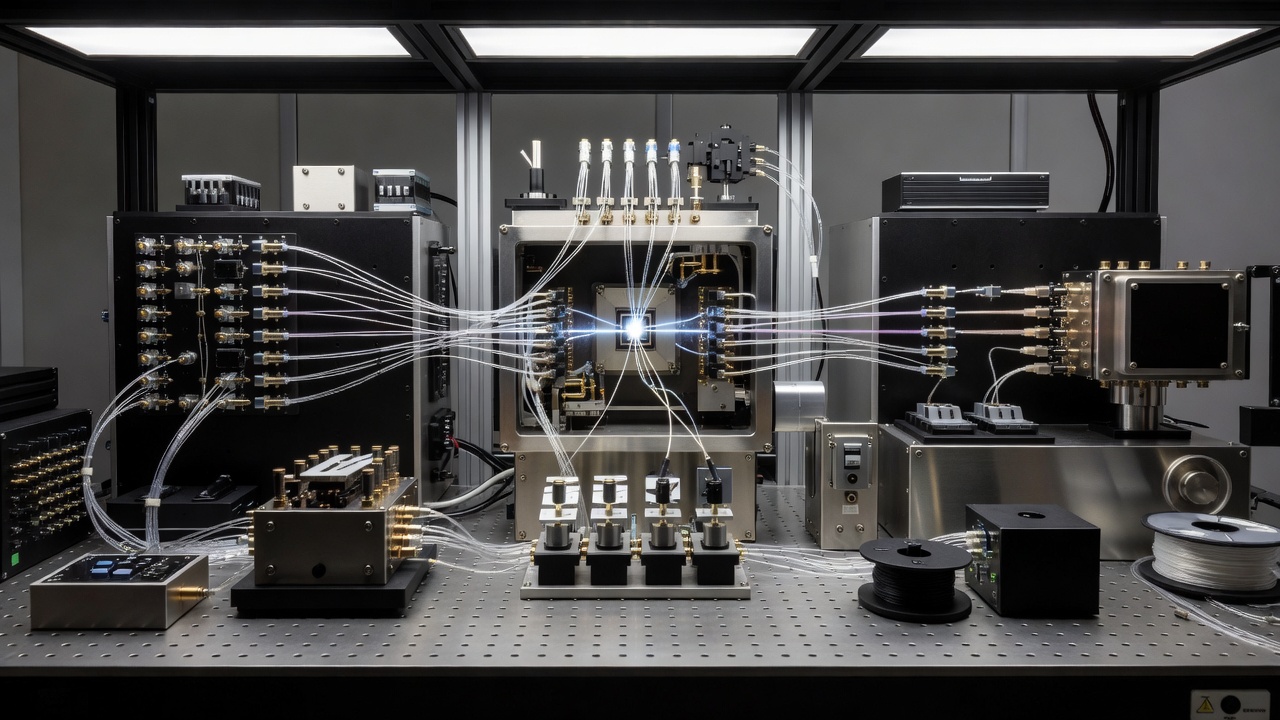
Every organisation in Cohort 3 runs its experiments on a single physical hardware platform: ORCA Computing's PT-2 quantum computer, deployed on-site at the NQCC's national facility in south Oxfordshire. This is not cloud-based access to a remote quantum system. The PT-2 is physically present at the NQCC, a UK government quantum body operating as the national laboratory for quantum computing.
Running workloads on a machine in a controlled national facility allows cohort participants to characterise hardware behaviour, latency, and error rates under conditions that reflect genuine deployment constraints rather than abstracted cloud service wrappers.
For the combinatorial optimisation stream, the PT-2 provides a testbed for problems structurally analogous to the travelling salesman or knapsack problem: finite sets of discrete feasible solutions where the optimal answer requires exhaustive or near-exhaustive classical search at scale. For the QML stream, hybrid methods involving both classical and quantum processing are the operative model -- computationally intensive subroutines offloaded to the quantum device, while classical systems handle pre- and post-processing.
Paul Ceely, Director of Technology Strategy at Digital Catapult, framed the hardware access as central to the programme's credibility: "I'm excited to see the novel solutions trialled and validated by our new cohort on a real quantum computer deployed at NQCC, which will translate deep tech into a commercial reality."
Why It Matters for Industry
The specific use cases assigned to named Cohort 3 participants illustrate how quantum computing is being applied to problems with direct commercial and social consequence.
NatWest is exploring quantum solutions for detecting fraud and illicit activity across large transaction networks -- the first time QTAP has applied quantum innovation to banking operations. Transaction network analysis at the scale a major UK bank operates involves graph problems of considerable complexity, where quantum graph algorithms and QML pattern recognition may offer detection capabilities that classical systems cannot match at equivalent speed.
CTA Fintech Solutions is working on cross-system optimisation of legacy-to-cloud transaction flows, targeting cost efficiency and resilience in regulated environments. The combinatorial challenge involves routing and scheduling transactions across heterogeneous infrastructure with regulatory constraints -- a classic optimisation problem that scales poorly under classical approaches as system complexity increases.
RSSB is applying quantum computing to transport and infrastructure use cases. The combinatorial optimisation stream maps directly to scheduling and resource allocation challenges that the rail sector manages at national scale.
Health Innovation North West Coast is applying quantum computing to diagnostic modelling for thrombotic thrombocytopenic purpura (TTP) -- a rare and life-threatening blood disorder that causes abnormal clotting throughout the body and is treated as a medical emergency. This marks the first time QTAP has directed quantum computing at a specific clinical condition. QML approaches to pattern recognition in patient data and treatment response modelling represent a category of problem where quantum-accelerated analysis could have direct clinical consequence.
Competitive Landscape
The QTAP ecosystem does not operate as a commercial competitive market. Digital Catapult is a UK-based non-profit innovation agency functioning as programme host and industry bridge. The NQCC is a UK government quantum body delivering the SparQ sponsorship programme, which funds and enables industry access to quantum testbeds. ORCA Computing is the technical hardware partner providing the PT-2 system. These three entities are collaborators within a publicly supported ecosystem, not competing vendors.
Previous QTAP cohorts included Vodafone, Airbus, Rolls-Royce, the Port of Dover, and the UK Atomic Energy Authority, spanning telecommunications, aviation, advanced manufacturing, logistics, and energy. Cohort 3's expansion into financial services and clinical healthcare represents a deliberate broadening of the sectors in which the programme is testing quantum utility. Paul Ceely framed the programme's role as bridging "quantum experts, experienced technologists, and industry leaders," positioning QTAP as an industrial translation layer rather than a purely research-oriented initiative.

Independent analyst commentary specifically on this announcement was not publicly available at publication time.
The Bigger Picture
The NQCC's role extends beyond providing hardware access. Through its SparQ programme, the NQCC acts as the sponsoring body enabling UK industry to access quantum testbeds in a structured, supported environment. Dr Simon Plant, Deputy Director for Innovation at the NQCC, described the cohort's significance in terms of systemic capability building: "Through SparQ, we're helping organisations move towards practical exploration of quantum computing. This cohort demonstrates growing confidence in quantum computing across UK industry, building the expertise, evidence and partnerships needed to accelerate responsible adoption and strengthen the UK's quantum capabilities."
The NQCC operates under UK government sponsorship as the national centre for quantum computing research and sits within a wider national strategy framework. The UK government published its National Quantum Strategy in March 2023, setting a 10-year vision for the UK to become a leading quantum-enabled economy -- a policy context that gives programmes like QTAP institutional longevity beyond any single cohort cycle.
Publicly backed access programmes like QTAP serve a function that purely commercial quantum vendors cannot: they reduce the cost and risk of early-stage exploration for organisations lacking internal quantum expertise, while generating validated real-world evidence the broader ecosystem needs to attract continued investment and policy support. Paul Ceely's observation that "quantum adoption cannot be done in isolation" reflects the structural reality that quantum computing requires a co-development model between hardware providers, domain experts, and end-user organisations to generate commercially replicable results.
What's Next
The six-month programme window running from July 2026 to February 2027 gives each cohort organisation structured time to trial and validate quantum approaches on the ORCA PT-2 at the NQCC. The expected output is a body of validated real-world use cases demonstrating whether quantum approaches offered measurable advantage over classical alternatives.

For NatWest, a validated quantum fraud detection prototype would represent a credible proof-of-concept for further investment in quantum-enhanced financial crime capabilities. For Health Innovation North West Coast, validated quantum diagnostic modelling for TTP would constitute a first-of-kind dataset for rare disease quantum applications in the UK. For CTA Fintech Solutions and RSSB, validated optimisation results would provide the evidence base needed to justify deeper quantum integration into infrastructure planning and regulated transaction management.
With three cohorts now completed or underway, QTAP is building a longitudinal dataset of quantum utility evidence across a growing range of UK industry sectors. Whether the February 2027 results validate the programme's expansion into financial services and healthcare will shape the scope and ambition of any subsequent cohort.
For enterprise IT and technology buyers: QTAP Cohort 3 runs for approximately six months on a physical quantum computer at a government-backed national facility, with no hardware cost to participants. The validated use cases across fraud detection, legacy infrastructure optimisation, transport scheduling, and rare disease diagnostics will produce published evidence of quantum advantage or limitation in each domain. If your organisation operates in financial services, transport, or healthcare, the February 2027 outputs are worth tracking as an early indicator of where quantum procurement decisions may become commercially justified within a three-to-five year horizon.
When a major UK bank and a rare blood disorder clinic enter the same quantum computing cohort in the same month, the technology has crossed a threshold worth marking. QTAP Cohort 3 is not a research programme running parallel to industry: it is industry, using real quantum hardware, on problems where the stakes are measured in fraud losses and patient outcomes. The February 2027 results will either accelerate quantum's commercial timeline or reset it, and either answer is worth having.
-- Aria Lin, Enterprise Technology Analyst
Sources: The Quantum Insider · Digital Catapult (press release)