This DIY Bipedal Robot Used Pneumatic Air-Muscles Instead of MotorsThis DIY Bipedal Robot Used Pneumatic Air-Muscles Instead of MotorsThis DIY Bipedal Robot Used Pneumatic Air-Muscles Instead of MotorsThis DIY Bipedal Robot Used Pneumatic Air-Muscles Instead of Motors
June 2, 2026
In 1987, a British photographer with no formal robotics training began building a life-size humanoid robot in his home workshop, driven by compressed air rather than electric motors, using 28 pneumatic air-muscles (fabric-covered rubber bladders that contract or extend when
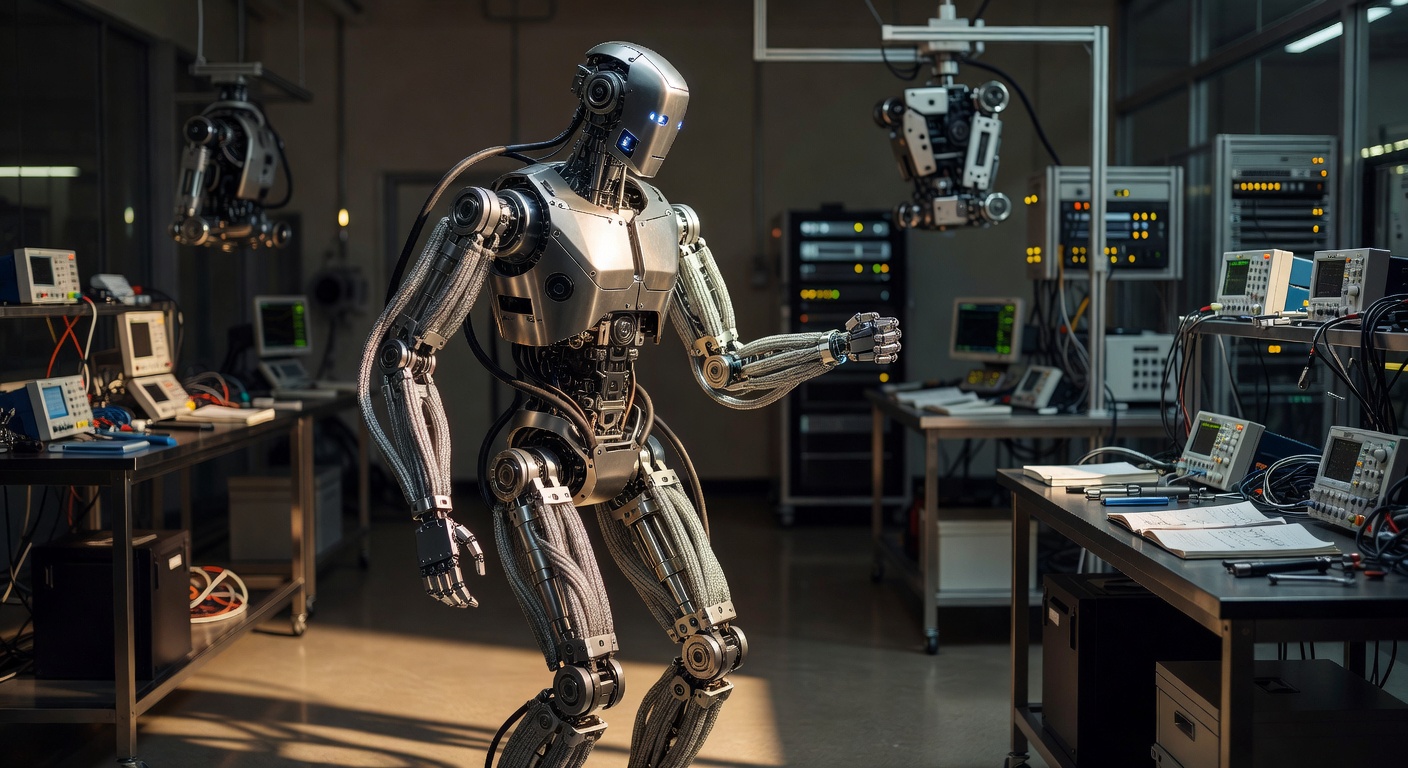
In 1987, a British photographer with no formal robotics training began building a life-size humanoid robot in his home workshop, driven by compressed air rather than electric motors, using 28 pneumatic air-muscles (fabric-covered rubber bladders that contract or extend when pressurized, mimicking the pull of biological muscle fibers) to articulate 8 joints across 12 degrees of freedom. The buried lead is not the robot itself but what it could not do: after years of construction and a public debut at the 1990 Robot Olympics in Glasgow, the Shadow Walker never took a single sustained step, finishing last in the biped race while a Cardiff University machine walked away with the win. That gap between ambition and locomotion, between a biomechanically inspired design and reliable forward motion, remains the defining fault line of humanoid robotics in 2026.
The story is documented by Allison Marsh, a professor at the University of South Carolina and codirector of the Ann Johnson Institute for Science, Technology and Society, writing in the June 2026 issue of IEEE Spectrum. Her "Past Forward" column reconstructs how a Wednesday night hobbyist collective of roughly 12 people, meeting at the home of founder Richard Greenhill in London, produced a machine that anticipated design arguments the entire industry is still litigating. The Shadow Group's creation, the Shadow Walker, now sits in the Science Museum in London, a physical record of one of the most consequential failed experiments in the history of bipedal robotics.
What It Does
The Shadow Walker stood 168 centimeters tall, 46 centimeters wide, and weighed approximately 38 kilograms, dimensions roughly equivalent to a lean adult human. Its skeleton was carved from maple wood, deliberately simplified from human anatomy: the lower leg contained only one bone rather than the two found in biological limbs, each foot ended in a single wide toe, and no kneecap was included. The simplifications were engineering choices, not oversights, intended to reduce mechanical complexity while preserving the geometry of upright bipedal stance.
Movement was controlled by 28 air-muscles, connected to the skeleton across 8 joints spanning the hips, knees, ankles, and toes. The system delivered 12 degrees of freedom in total. The ankle design was particularly considered: a double-axis configuration allowed for two degrees of movement, enabling the foot to tilt in more than one plane, a prerequisite for balance recovery. The headless torso housed the control valves, electronics, and computer interfaces that managed air pressure across the muscle network.
The robot could stand and self-balance, and could recover from a light push. Rich Walker, who joined the Shadow Group as a teenager and wrote software for the robot's standing behavior, attempted to solve sustained dynamic balance using neural networks. Hardware reality defeated the theory: sensors were unreliable, valves were unreliable, and the overall mechanical assembly was fragile. The robot also operated in teleoperation mode, with its operator wearing a data suit that captured his movements for the robot to copy. Walking independently, however, remained out of reach.
The Technical Achievement
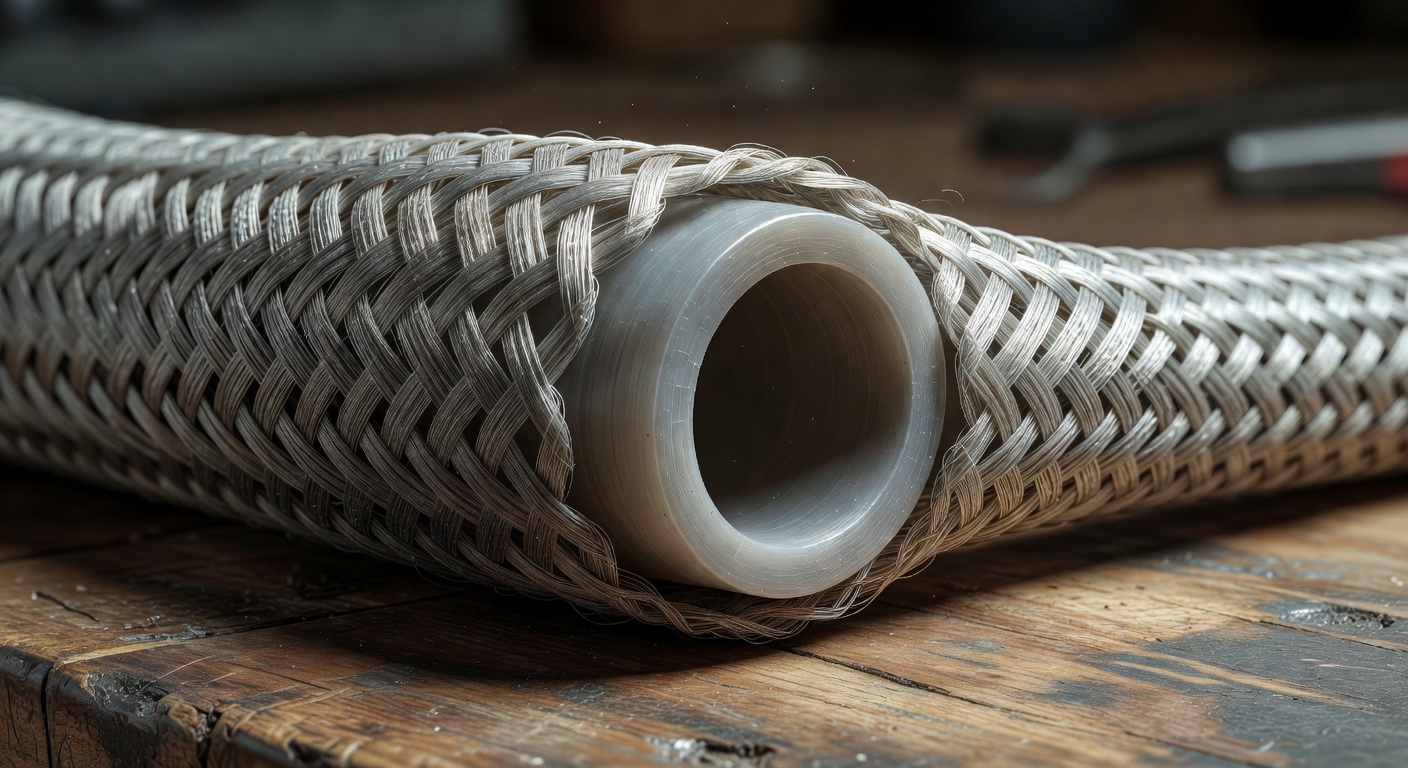
The pneumatic actuation principle behind the Shadow Walker predates the robot by three decades. McKibben muscles, the class of pneumatic actuator used, were invented in the 1950s by Joseph Laws McKibben, a physicist at Los Alamos National Laboratory, originally to assist his daughter's paralyzed hands following polio. The mechanism is geometrically elegant: a rubber bladder enclosed in a braided mesh sleeve contracts and shortens when pressurized, pulling against whatever it is anchored to, in a direct analog of how skeletal muscle shortens when activated. Units with a braid angle smaller than 54.7 degrees, the critical locking angle, contract when pressurized; those with larger angles extend. The result is a compliant, force-generating element with no rigid gearbox, no motor windings, and no electromagnetic heat signature.
Bridgestone, the Japanese rubber company, commercialized McKibben-type actuators in the 1980s under the name Rubbertuators, demonstrating that the technology had industrial credibility beyond laboratory curiosity. By the time Greenhill started the Shadow Group in 1987, the actuator type had a known commercial pedigree, even if no one had yet used 28 of them to animate a walking humanoid skeleton.
The engineering tradeoffs compared to electric motors are real and significant. Air-muscles generate high force relative to their weight, are inherently compliant (they absorb shocks rather than transmitting them rigidly through the frame), and carry no risk of burning out under sustained load in the way a stalled electric motor does. Against those advantages, pneumatic systems require a compressed air supply, introduce valve latency into every actuation cycle, and are difficult to control precisely because the relationship between air pressure and output force is nonlinear and varies with temperature and bladder fatigue. For a hobbyist group meeting on Wednesday nights, managing 28 of these variables simultaneously, in real time, with 1980s microcontrollers, was a formidable controls problem.
Greenhill had conceived the project after working at a British startup called Intergalactic Robots, where he met David Buckley, a robotics and animatronics expert. Buckley sketched the Walker's design from medical textbooks, translating anatomical structure into the simplified wooden skeleton. The Wednesday sessions, hosted by Richard's wife Sally Greenhill, who also made spaghetti for the group, drew roughly a dozen participants across the project's active years.
Real-World Impact

The Shadow Group's transition from hobbyist collective to registered company followed a common path: a paying customer arrived before the organization was ready for one. In 1997, a customer seeking a robotic leg compelled the group to formalize, and Shadow Robot was incorporated as a registered company, becoming what the company describes as Britain's oldest robotics company. The walker project itself did not become the product; instead, the group's accumulated knowledge of compliant actuation found a different outlet.
Rich Walker, who had been contributing to the group since his teenage years and holds a Bachelor of Arts in mathematics and a diploma in computer science from the University of Cambridge, joined Shadow Robot in 1999 as technical director, a role he currently holds as director. In 1999, he also published a detailed written description of the Shadow Walker on David Buckley's website, creating one of the earliest systematic technical records of the project.
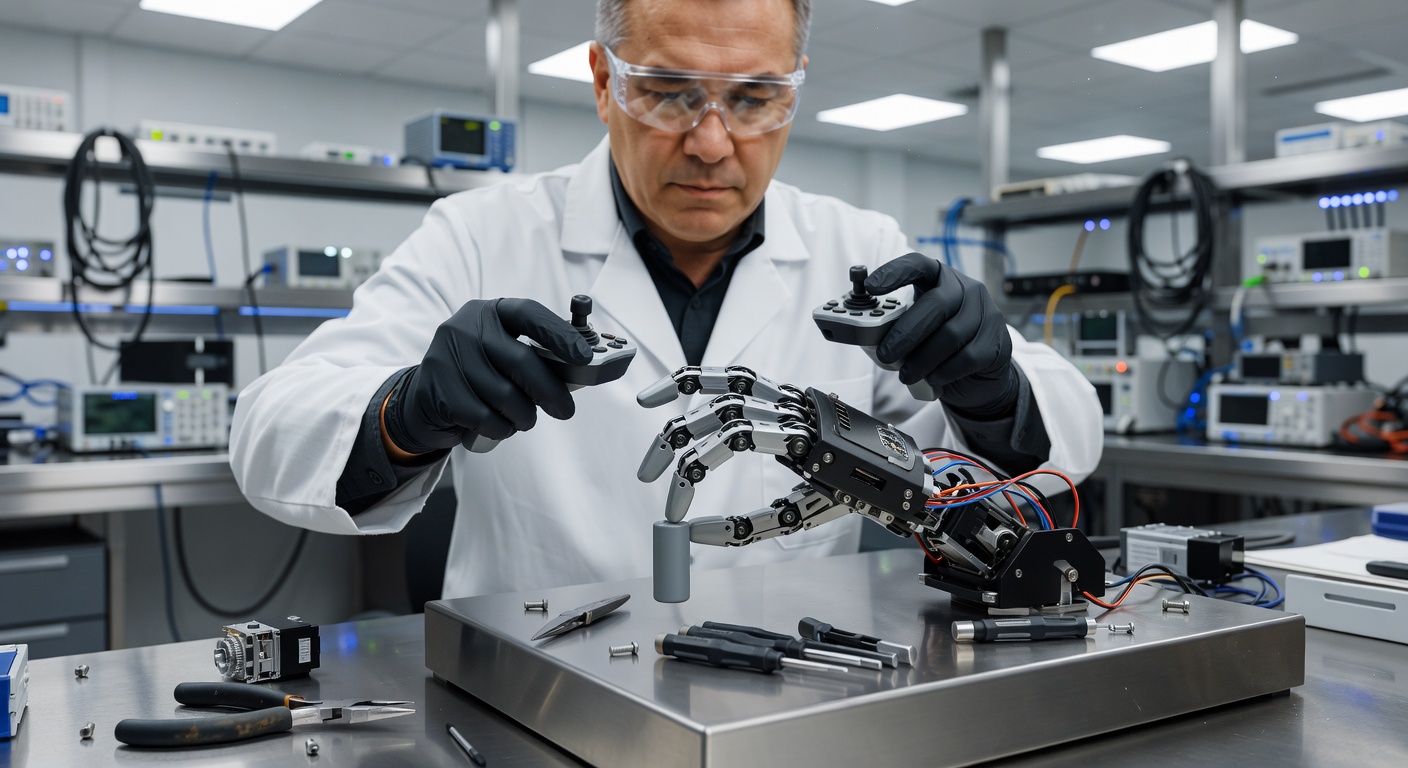
The pivot from walking robots to dexterous hands proved commercially durable. Shadow Robot's current flagship product is a dexterous robot hand built around 20 motors and 24 degrees of freedom, capable of abductive and adductive finger movement, meaning the fingers can spread apart and close together as well as flex and extend. The pneumatic air-muscles of the Shadow Walker have been replaced in the modern hand by precision electric actuators, reflecting a deliberate engineering choice: for manipulation tasks requiring fine positional control, the nonlinearity of pneumatics is a liability rather than an asset.
The shift in focus also reflected a strategic argument that Sejal Parsotomo, senior marketing executive at Shadow Robot, articulated in a recent company blog post: "while humanoid robots are great for public relations, specialized dexterity is key for success: A robot that can walk into your factory may be impressive, but a robot that can reliably manipulate objects is transformative."
Competitive Landscape
Shadow Walker's 1987 origins place it in the same founding decade as Honda's parallel effort on bipedal locomotion, but the organizational scale and engineering resources could not have been more different. Honda began its experimental E-series humanoid robot program in 1986, a year before Greenhill's group convened for the first time, and spent a decade in development before unveiling the P2 in 1996. The P2 stood 183 centimeters tall and weighed 210 kilograms, more than five times heavier than the Shadow Walker's 38 kilograms, and it achieved what the Shadow Walker could not: stable, autonomous walking. The P2 is documented as the first humanoid robot to accomplish that specific capability. Honda subsequently developed ASIMO, unveiled in October 2000, which by its 2011 model reached a running speed of 9 kilometres per hour. Honda stated in July 2018 that it would cease ASIMO development to focus on more practical robotic applications.
The 1990 Robot Olympics in Glasgow, organized by Mowforth, a researcher described as steeped in machine learning and robotics development, provided the only public head-to-head test of the era. More than 50 robots entered across multiple events. The Shadow Walker, wearing pants specifically to conceal its pneumatic air-muscles from competitors, failed to take a step in the biped race. Cardiff University's biped won that event. The overall Olympic Champion was Yamabico, built at the University of Tsukuba in Japan, which won in obstacle avoidance and wall following, though it was disqualified from the talking category for not speaking English. A 19th-century mechanical archer entered by the Museum of Automata in York, England, won gold in the javelin, beating robots built with contemporary technology.
In the current humanoid robot industry, several commercial players have moved well beyond the unresolved locomotion questions of the 1990 Olympics:
- Boston Dynamics (veteran player) has established a commercial presence in dynamic bipedal and quadrupedal robots, with Atlas among the most capable demonstrated bipedal platforms in terms of dynamic movement.
- Unitree Robotics (high-activity competitor) has fielded humanoid robots capable of real-time combat sports including jabs, hooks, sidekicks, and spin kicks at an AI-powered bipedal combat league hosted in Hangzhou, representing a performance envelope that would have been unrecognizable to the Shadow Group in 1990.
- Sanctuary AI (bold newcomer) is among the companies positioned as challengers in the humanoid robot industry, with a stated focus on general-purpose physical AI.
Independent analyst commentary specifically on this announcement was not publicly available at publication time.
What's Next
The pneumatic artificial muscle has not been abandoned by contemporary robotics research. In 2017, Bridgestone and the Tokyo Institute of Technology jointly presented a hydraulic artificial muscle claiming a strength-to-weight ratio five to ten times higher than conventional electric motors and hydraulic cylinders. Hydraulic operation, using an incompressible fluid rather than compressible air, increases system rigidity and reduces the compliant behavior that made pneumatic control difficult in the Shadow Walker era. The trajectory from McKibben's 1957 invention through Bridgestone's 1980s Rubbertuators to the 2017 hydraulic variant illustrates a technology still under active development nearly 70 years after its origin.
For Shadow Robot, the open questions center not on locomotion but on manipulation precision and deployment reliability. The company's 24-degree-of-freedom hand represents the commercial outcome of the same biomimetic design philosophy that shaped the Shadow Walker, applied to a problem the market has been more willing to pay for. The IEEE Robotics and Automation Society, established in 1987, the same year the Shadow Group started meeting, and the International Federation of Robotics, also founded in 1987, now operate in a landscape where the 2025 World Humanoid Robot Games in Beijing drew robots competing in gymnastics, soccer, track events, hotel cleaning, and medicine sorting, 35 years after the Glasgow Olympics where a wooden-skeleton air-muscle machine could not complete a single step.
The unresolved problem is not mechanical. It is systems integration: reliable sensors feeding reliable control algorithms managing reliable actuators in real time, at human scale, in unstructured environments. The Shadow Walker's failure in Glasgow was not primarily a failure of air-muscles as an actuation technology. It was a failure of the surrounding system to close the loop fast enough, accurately enough, consistently enough. That description applies, with varying degrees, to most humanoid robots still in development today.
For hands-on robotics enthusiasts and hardware developers working on compliant actuation, the Shadow Walker story offers a concrete reference point: 28 McKibben muscles across 12 degrees of freedom was achievable with 1980s materials and 1987-era microcontrollers. The same architecture, rebuilt with modern valve latency under 5 milliseconds, high-resolution pressure sensors, and a real-time control loop running at kilohertz frequencies, has never been systematically retried in a publicly documented bipedal platform. The component cost for a Shadow Walker-equivalent pneumatic skeleton today is a fraction of what it was in 1987. The controls problem is also more tractable. Whether any team picks up that specific thread is an open question, but the original design, documented by Rich Walker in 1999 and preserved at the Science Museum in London, is available as a starting point.
The most striking irony in the Shadow Walker's history is that the group failed at walking and succeeded at grasping, and the market turned out to care far more about the latter. Thirty-five years of humanoid robot development, from the Glasgow Olympics through Beijing's 2025 games, has not fully closed the gap the Shadow Walker exposed between a robot that looks like it should walk and one that reliably does. The air-muscles are now in a museum. The argument they were built to settle is still open.
-- Zara Velez, Emerging Technology Editor