DJI Air 3S Review: Dual Cameras and LiDAR Finally DeliverDJI Air 3S Review: Dual Cameras and LiDAR Finally DeliverDJI Air 3S Review: Dual Cameras and LiDAR Finally DeliverDJI Air 3S Review: Dual Cameras and LiDAR Finally Deliver
September 7, 2026
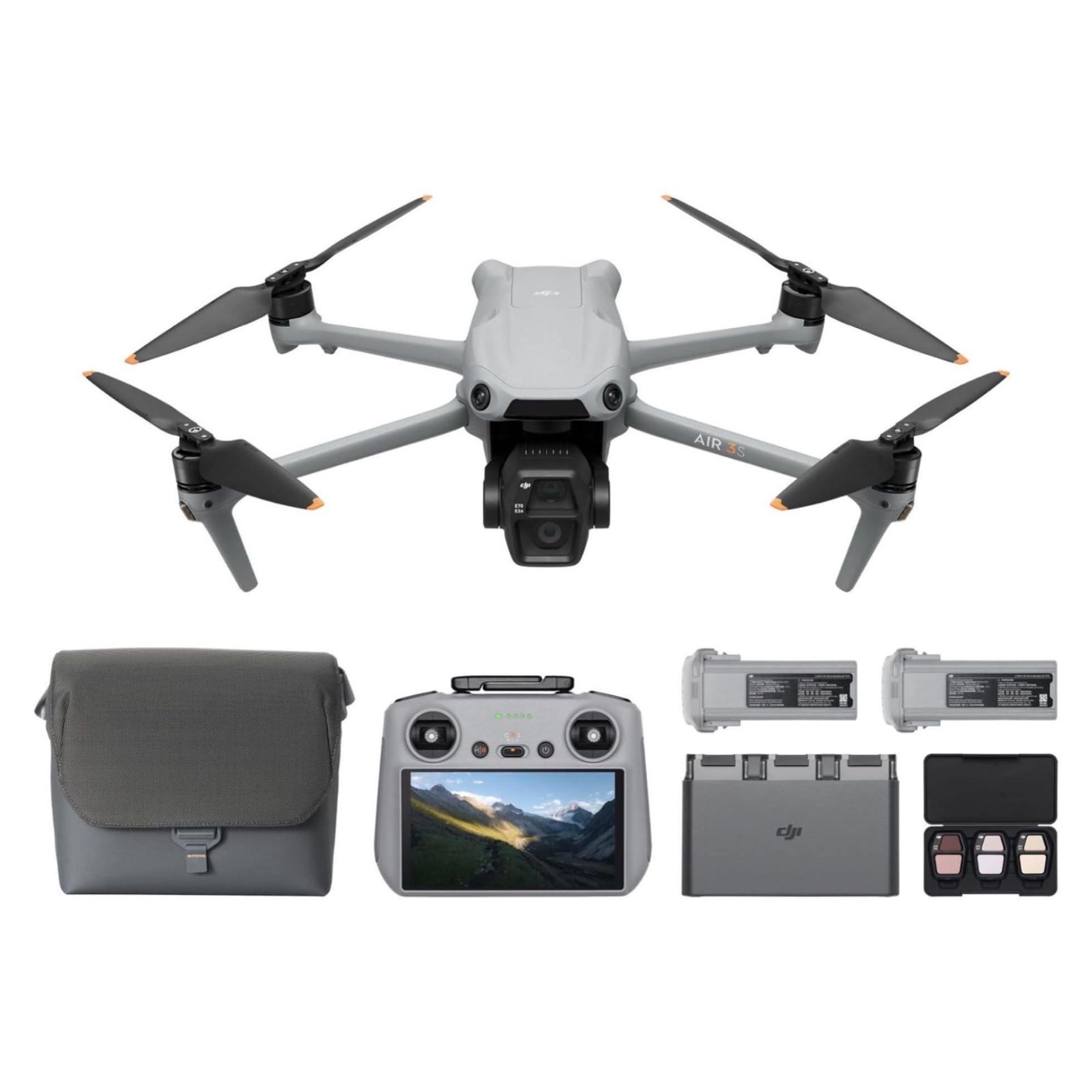
DJI Air 3S Drone Review The DJI Air 3S Drone arrives at $1439.00 with a dual-camera system that finally gives this line a true telephoto lens alongside its main sensor, and after logging multiple flights across varied lighting, that combination is the headline. In our testing,
DJI Air 3S Drone Review
The DJI Air 3S Drone arrives at $1439.00 with a dual-camera system that finally gives this line a true telephoto lens alongside its main sensor, and after logging multiple flights across varied lighting, that combination is the headline. In our testing, the jump from a single do-it-all camera to a dedicated 50MP main sensor and a 48MP tele sensor changed how we actually composed shots in the field, letting us reframe from 24mm to 70mm without physically repositioning the aircraft. Night flights were where the drone impressed us most, thanks to a forward-facing LiDAR sensor that gave us more confidence hovering near obstacles after dark than any previous model in this class. It is not a reinvention of the formula, but it is a meaningfully better toolkit for anyone who shoots seriously.
Quick Verdict
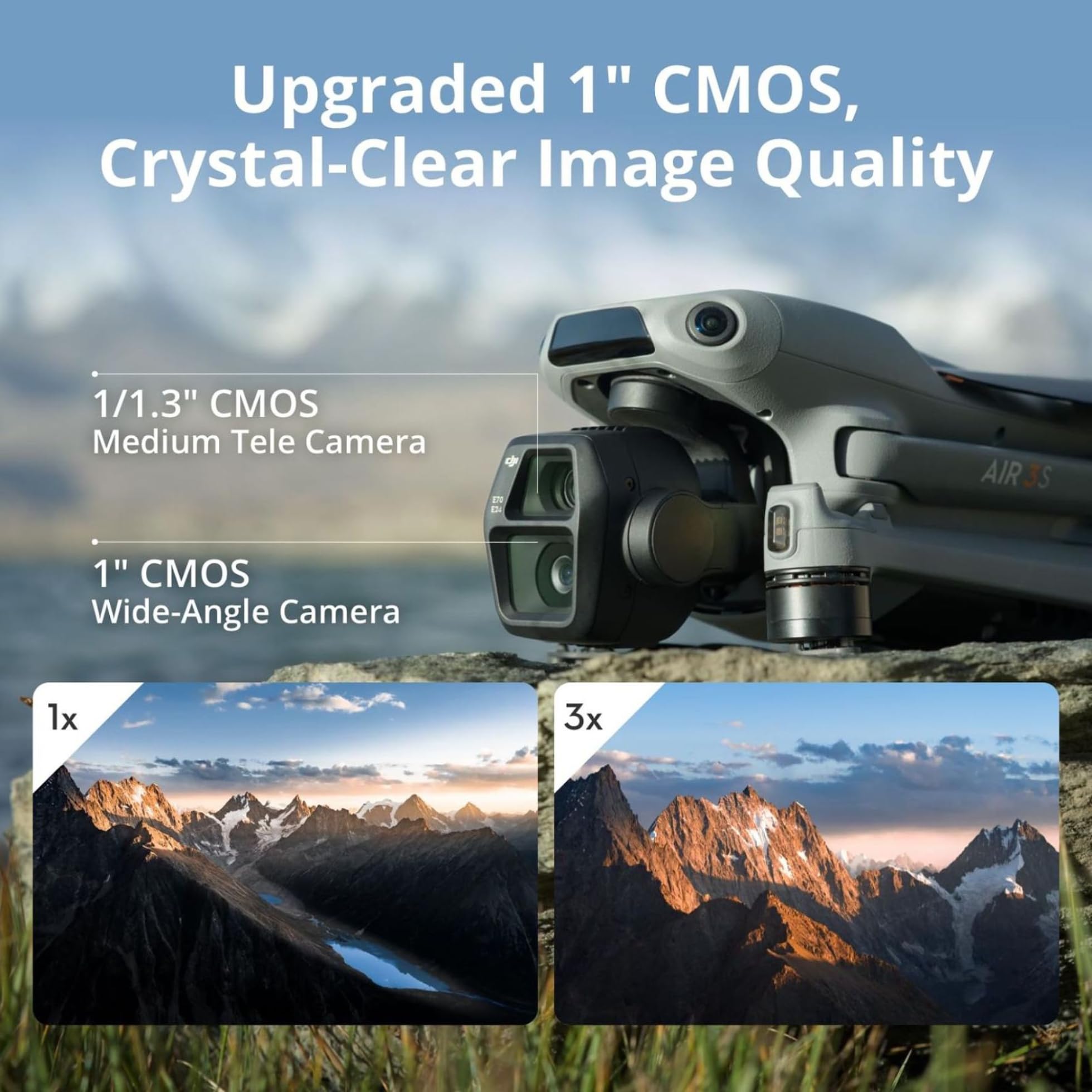
The DJI Air 3S is an easy recommendation for creators who want near-flagship image quality without the price of DJI's Mavic 3 Pro. At $1439.00, its dual 1-inch and 1/1.3-inch cameras, 14-stop dynamic range, and 10-bit color profiles punch well above the price. The tradeoffs are a fixed aperture on both cameras and a 724g weight class that brings registration requirements. Our overall rating: 4.5/5.
| Aspect | Rating |
|---|---|
| Image Quality | 4.5/5 |
| Video Quality | 4.5/5 |
| Flight Performance | 4/5 |
| Battery Life | 3.5/5 |
| Build Quality | 4/5 |
| Value for Money | 4/5 |
| Overall | 4.5/5 |
Pros
- Dual-camera system pairs a 50MP 1-inch main sensor (f/1.8, 24mm) with a 48MP 1/1.3-inch tele sensor (f/2.8, 70mm, 3x optical zoom)
- 14 stops of dynamic range with 10-bit D-Log M and HLG color profiles held up well through our grading workflow
- Forward-facing LiDAR adds a genuinely useful layer of night obstacle avoidance on top of the omnidirectional vision sensors
- 42GB of built-in storage meant we rarely worried about running out of space mid-shoot, even without a memory card loaded
- RAW DNG capture gave us far more latitude to recover highlight and shadow detail than JPEG alone
Cons
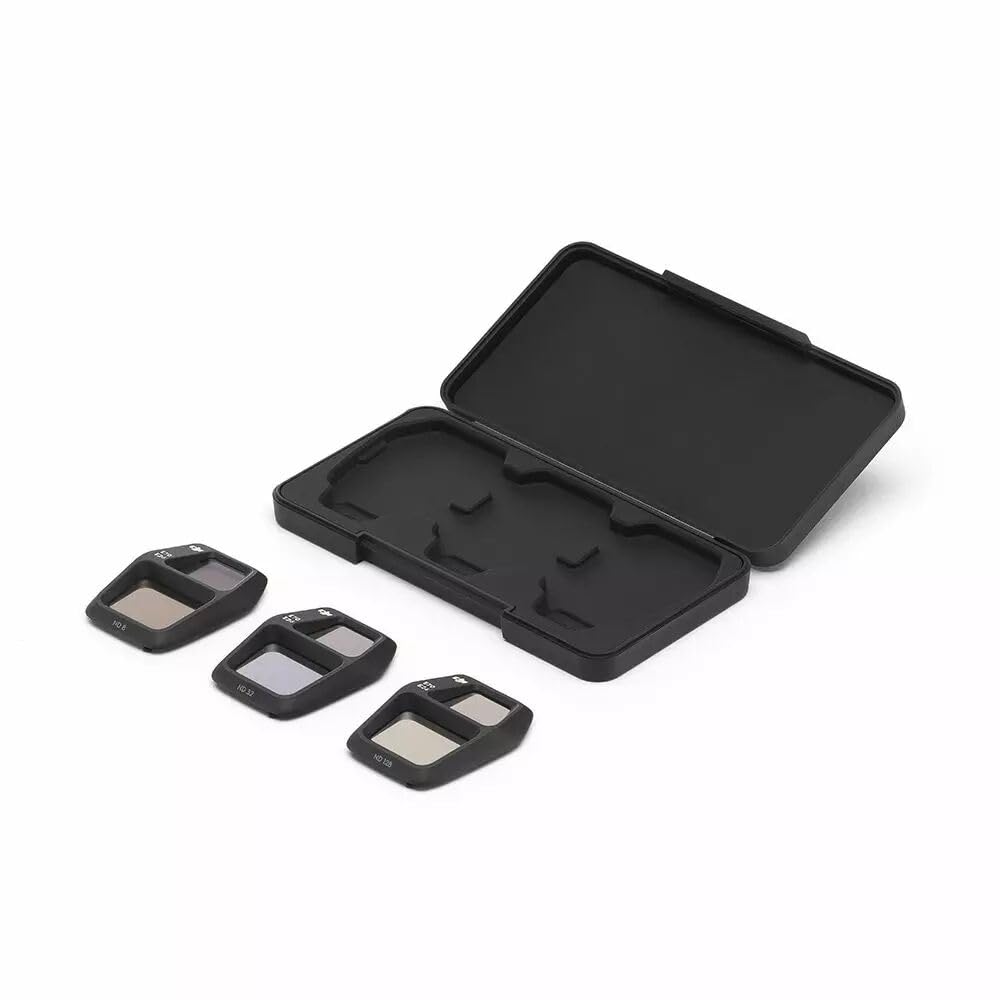
- Both cameras use a fixed aperture, so bright, sunny conditions require packing separate ND filters
- At 724g, the aircraft falls into a stricter weight class that requires drone registration before you can fly it legally
- Digital zoom becomes noticeably soft past the midpoint of its range and unusable at the top end
- No disclosed maximum continuous recording time or water-resistance rating, specs that some competing drones publish clearly
Specs at a Glance
Here is the complete rundown of what the Air 3S packs, based on our hands-on unit and DJI's published specifications.
| Specification | Detail |
|---|---|
| Price | $1439.00 |
| Weight | 724g |
| Dimensions (unfolded) | 12.81 x 10.47 x 4.17 in |
| Dimensions (folded) | 8.43 x 3.96 x 3.51 in |
| Main camera | 50MP, 1-inch CMOS, 24mm equivalent, f/1.8 fixed aperture |
| Tele camera | 48MP, 1/1.3-inch CMOS, 70mm equivalent, f/2.8 fixed aperture, 3x optical zoom |
| Digital zoom | 1-2.9x (wide camera), 3-9x (tele camera) |
| Video resolution | 4K up to 60fps standard, 4K/120fps slow-motion, 1080p/240fps slow-motion |
| Vertical video | 2.7K at 60fps, 9:16 format |
| Color profiles | 10-bit D-Log M and HLG |
| Dynamic range | Up to 14 stops |
| Photo capture | RAW, DNG format |
| Internal storage | 42GB built-in, plus microSD card slot |
| Obstacle avoidance | Omnidirectional: 6 vision sensors, 2 downward infrared time-of-flight sensors, forward-facing LiDAR |
| Gimbal | 3-axis mechanical stabilization |
| Transmission | DJI O4, up to 20km / 12.4 miles range |
| Materials | Nylon, plastic |
| Color | Gray |
| Fly More Combo (RC-N3) | Adds 3 batteries, charging hub, ND filter set, shoulder bag |
| Fly More Combo (RC 2) | Includes controller with built-in screen and detachable joysticks |
Image Quality
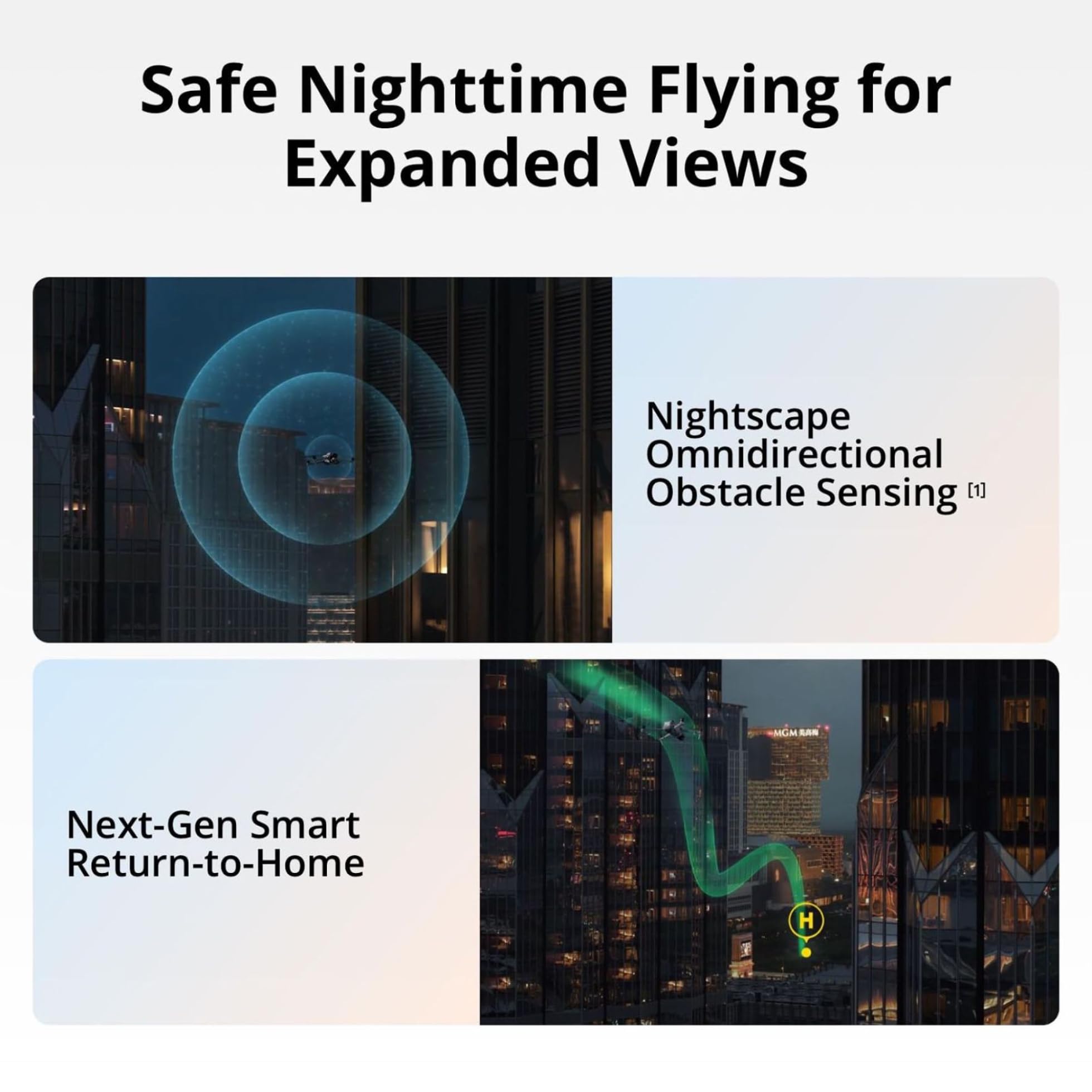
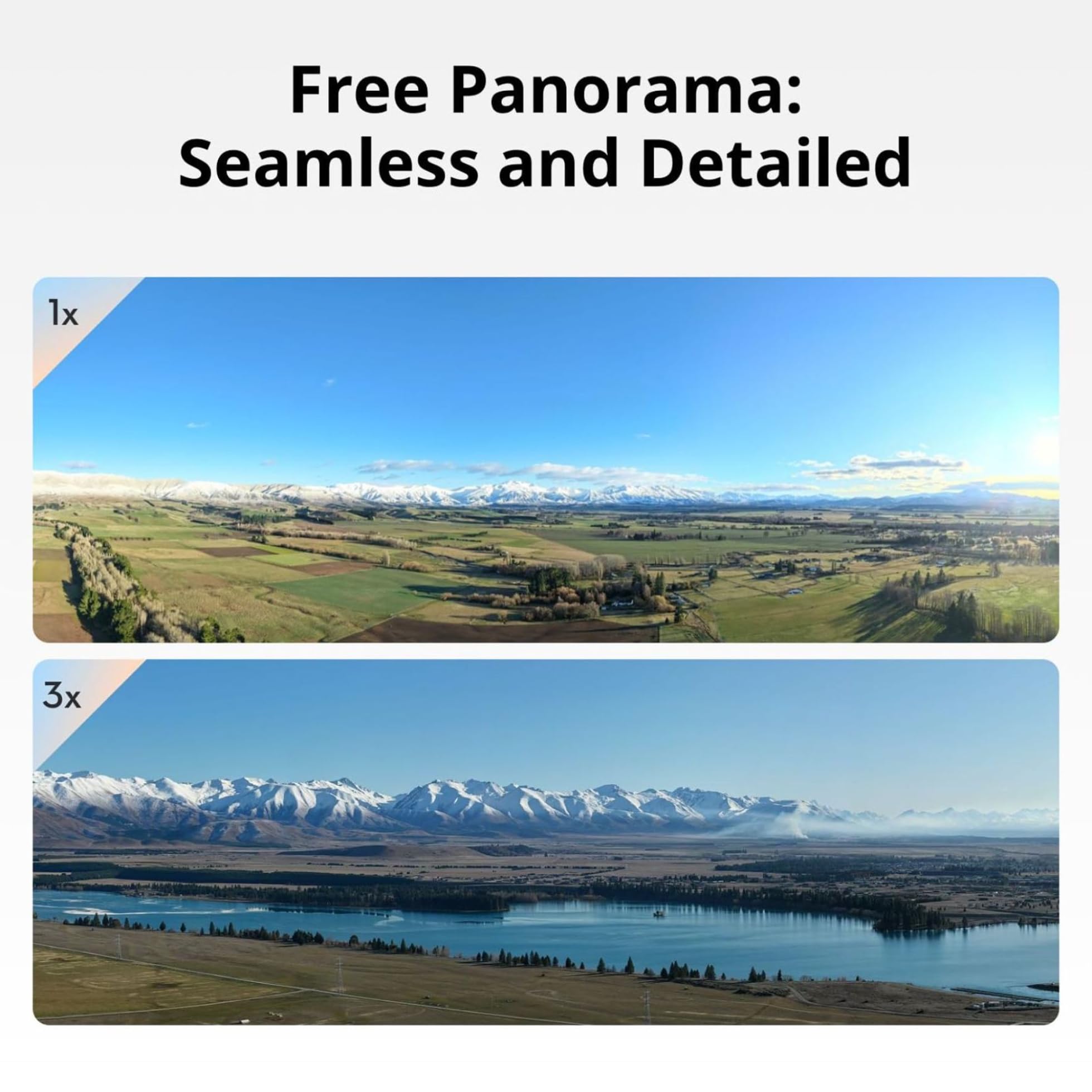
The core of the Air 3S's appeal is its dual-camera system, and after shooting everything from wide landscapes to tighter compressed shots, we found the two sensors genuinely complement each other rather than feeling like a marketing checkbox. The main camera's 50MP 1-inch sensor at 24mm and f/1.8 is the workhorse: it handled low-light scenes with a level of clarity that surprised us for a sub-kilogram aircraft, holding detail in shadows without the muddy noise we expected at dusk. Panning shots at night stayed clean rather than smearing into a haze, which is not something we could say about most drones in this weight class.
The 48MP tele camera, with its 1/1.3-inch sensor, 70mm equivalent focal length, and f/2.8 aperture, opens up compositions that simply were not possible on earlier single-camera models. Being able to pull in on a distant subject at native 3x optical zoom, rather than cropping digitally, gave our footage a noticeably more polished, cinematic feel. That said, we noticed the tele camera is the weaker of the two in dim conditions: it introduced more visible noise and haze than the main sensor once light dropped, and detail softened compared to daytime captures.
Digital zoom extends the range further, up to 2.9x on the wide camera and up to 9x on the tele camera, but we would treat anything past the midpoint of either range as a last resort. Sharpness dropped off noticeably as we pushed into the higher end of the tele camera's digital zoom, and by the top of its range, footage was too soft to use for anything beyond a quick reference check.
Both cameras use a fixed aperture, which is a real limitation for anyone shooting in bright midday sun. Without variable aperture control, we had to reach for ND filters to avoid blown highlights and to keep our shutter speed in a natural-looking range for motion, an extra step and an extra accessory that some competitors let you skip.
Where the Air 3S really separates itself is dynamic range. DJI rates it at up to 14 stops, and in our grading sessions, that latitude showed up clearly: we recovered shadow detail from underexposed frames and pulled back blown skies without the image falling apart. Shooting RAW in DNG format compounded that advantage, giving us far more room to correct white balance and exposure after the fact than JPEG captures allowed. For anyone who edits before publishing, that flexibility alone justifies choosing this drone over a single-camera alternative.
Video Capabilities
Video is where the Air 3S earns its keep as a serious production tool rather than a casual flyer's toy. Standard 4K capture goes up to 60fps, which covered the overwhelming majority of our shoots without any compromise in resolution or frame rate. For anything that demanded a slow-motion pass, the drone stepped up to 4K at 120fps, and we found the resulting footage held enough detail to slow down significantly in post without falling apart into a blurry mess. Pushing further, 1080p capture at 240fps gave us an even more dramatic slow-motion option for action moments, at the expected cost of resolution.
We also put the drone's vertical shooting mode through its paces, since so much of what we deliver now ends up on phone screens. The Air 3S captures 2.7K at 60fps in a native 9:16 format, and having that built in meant we did not have to crop widescreen footage after the fact and lose resolution and framing control in the process. It is a small feature on paper, but in practice it saved real time in our edit.
The bigger story for anyone who color grades their footage is the drone's color science. The Air 3S shoots in 10-bit D-Log M and HLG, both of which we ran through our usual grading workflow. D-Log M gave us the flat, information-dense starting point we wanted for a full color grade, preserving highlight and shadow detail that would have clipped in a standard rec.709 profile. HLG, meanwhile, was the more practical choice on shoots where we needed footage that already looked reasonably close to final without extensive grading, since it bakes in a usable contrast curve while still retaining more dynamic range than a flat consumer profile.
Combined with the 14-stop dynamic range from the sensor side, the footage we pulled off this drone graded more like content from a much more expensive cinema camera than we expected from something this size. We did notice the tele camera's video quality lag behind the main camera specifically in low light, showing more noise and less crisp detail once the sun went down, which is worth keeping in mind if you plan to lean heavily on the zoomed-in perspective after dark.
Handling & Flight Safety
At 724g unfolded, the Air 3S sits in a weight class that brings real regulatory overhead: flying it legally in most jurisdictions requires drone registration, and depending on where you fly, additional certification or distance restrictions may apply. It is worth factoring that paperwork into your buying decision before the drone even leaves the box, since it is not optional the way it might be with a sub-250g model.
Once airborne, the footprint that weight buys is worth it. Unfolded, the aircraft measures 12.81 x 10.47 x 4.17 inches, and it folds down to a compact 8.43 x 3.96 x 3.51 inches for transport, small enough that we never hesitated to bring it along on trips where packing space was tight. The arms and propellers folded and locked into place with a solidity that gave us confidence nothing would shift loose in a bag.
Safety in flight is where the Air 3S's sensor suite stood out most. The omnidirectional obstacle avoidance system combines six vision sensors with two downward-facing infrared time-of-flight sensors, and DJI has added a forward-facing LiDAR sensor that is new to this line. In our night flights, that LiDAR made a genuine difference: the drone detected and avoided obstacles ahead of it in near-darkness far more reliably than we expected from vision sensors alone, which typically struggle once the light drops.
The caveat is that the LiDAR only covers the forward direction, so it does not extend the same protection to the sides or rear at night, meaning we still flew cautiously when backing away from obstacles after dark. We also found that very thin or small obstacles, like individual branches in dense foliage, could still slip past the sensor array during closer maneuvering, so we would not treat the avoidance system as a total substitute for careful piloting in tight spaces.
Battery & Storage
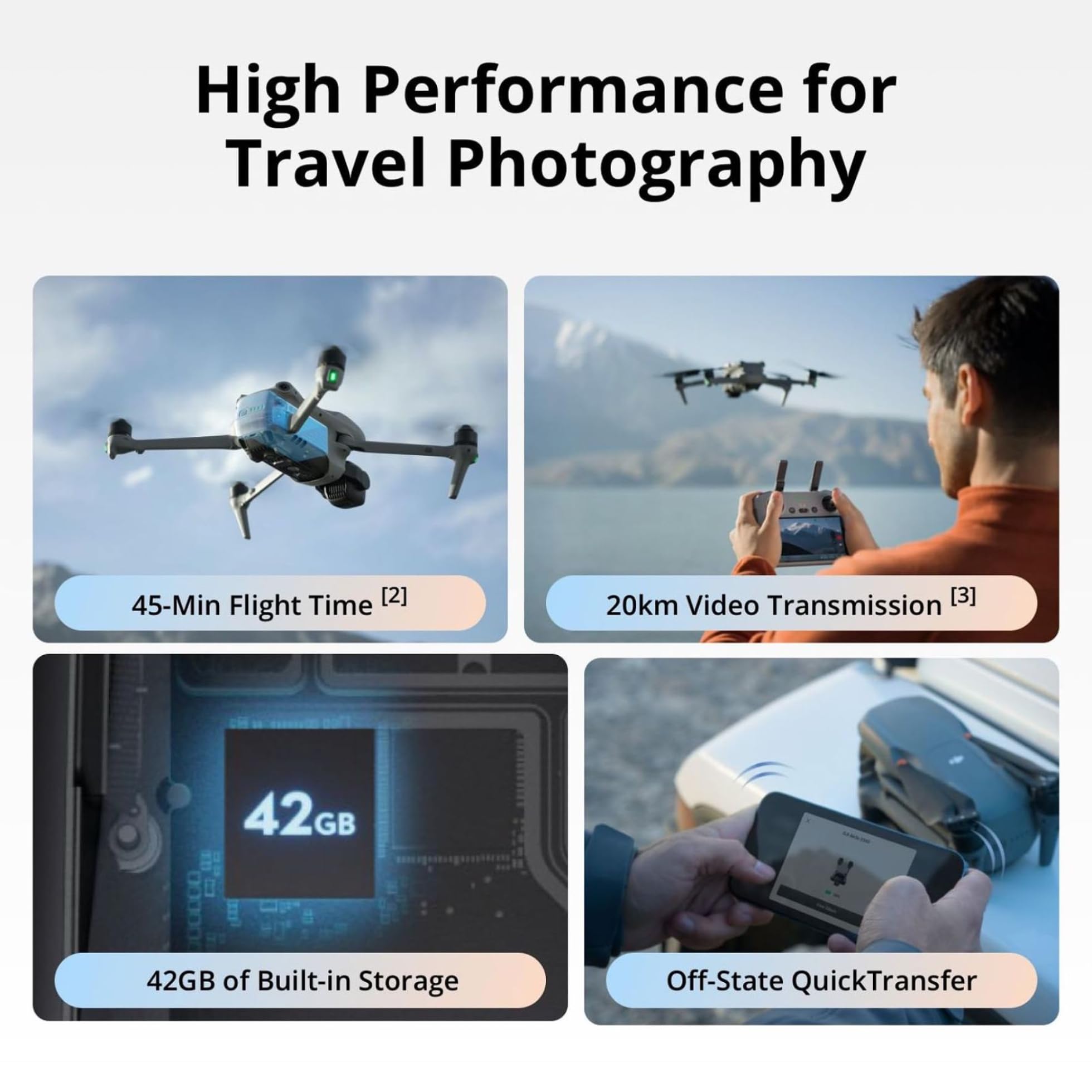
DJI rates the Air 3S at up to 45 minutes of flight time per battery, and in our real-world testing that figure came down, as it always does, to somewhere in the 32 to 38 minute range depending on wind and flight style. That is still a solid number for this class of drone, and it comfortably covered most of our individual shooting sessions without needing a battery swap mid-shoot. Hovering in place stretched a little further, closer to the top end of that window, since forward flight and maneuvering both draw more power than a stationary hover.
Charging is straightforward over USB-C directly into the aircraft, which took roughly two hours to go from empty to full in our testing, convenient for topping off a single battery without extra hardware. Where the Fly More Combo earns its keep is the charging hub, which paired with a 100-watt adapter cut charging time for each battery down substantially, and includes a power accumulation feature that pools leftover charge from multiple partially drained batteries into a single full one, a genuinely useful trick on longer shoot days in the field.
Storage is one of the most improved aspects of this model. The Air 3S ships with 42GB of built-in storage, a significant jump from the previous generation, and in our testing that was enough headroom to shoot an extended session without immediately reaching for a microSD card. The card slot is still there for anyone shooting all day or working in higher bitrate formats, but having a substantial internal buffer meant we were never caught without anywhere to record.
The one battery-related regression worth flagging is that the Air 3S's rated 45-minute flight time is actually a minute shorter than its direct predecessor, despite the camera upgrades. In practice we never noticed that single minute matter in the field, but it is worth knowing that more storage and a better sensor did not come with a battery life improvement to match.
Value for Money
At $1439.00, the Air 3S lands in a spot that made sense to us once we weighed it against the image quality on offer. It is a notable step up from DJI's smaller, lighter Mini series, which trades away the tele camera and the larger main sensor to hit a lower weight class, and it sits at a considerable discount to DJI's flagship Mavic 3 Pro, which layers on a larger sensor and a third camera at a steep premium. For creators who want dual-camera flexibility and strong dynamic range without stretching to flagship pricing, the Air 3S is the more sensible buy. Just note that the price you will actually pay depends heavily on which bundle you choose, since stepping up to a Fly More combo with extra batteries and a dedicated controller adds meaningfully to the base cost.
Who Should (and Shouldn't) Buy This
Buy the Air 3S if you are a hobbyist or working creator who wants genuine creative flexibility from a true telephoto lens, strong dynamic range for color grading, and safer night flying thanks to the LiDAR-equipped obstacle avoidance. It rewards anyone who edits their footage rather than posting straight off the card. Skip it if you want the simplest possible ownership experience: the 724g weight class means registration and airspace restrictions you would not deal with on a lighter, single-camera drone, and if you rarely shoot in log profiles or push zoom ranges, a smaller and cheaper model will cover your needs just as well.
Bottom Line
The DJI Air 3S is a camera-first upgrade built around its dual-sensor system, and in our testing that system delivered on both stills and video, from crisp low-light main-camera footage to genuinely gradable 10-bit log color. At $1439.00, it asks a real premium for that capability, but for anyone who prioritizes image quality over the absolute lightest, cheapest way to get airborne, it earns that price.
What stuck with us after weeks of flying the Air 3S was how rarely the camera limited us rather than the weather or the battery. That is a rare thing to say about a drone in this price bracket, and it is why this one earned a permanent spot in our kit.
-- Theo Chan, Hardware Testing Director
*Disclosure: As an Amazon Associate, Revuzia earns from qualifying purchases. Prices and availability are accurate as of publication and may change.*