DJI Osmo Action 5 Pro Combo Review: The Overheating Problem Is Finally SolvedDJI Osmo Action 5 Pro Combo Review: The Overheating Problem Is Finally SolvedDJI Osmo Action 5 Pro Combo Review: The Overheating Problem Is Finally SolvedDJI Osmo Action 5 Pro Combo Review: The Overheating Problem Is Finally Solved
June 8, 2026
The DJI Osmo Action 5 Pro Combo pairs a 1/1.3-inch CMOS sensor with 4K/120fps video and 20-meter native waterproofing in a 146-gram body -- and after putting it through several weeks of real-world testing across mountain bike trails, open water, and low-light urban environments,
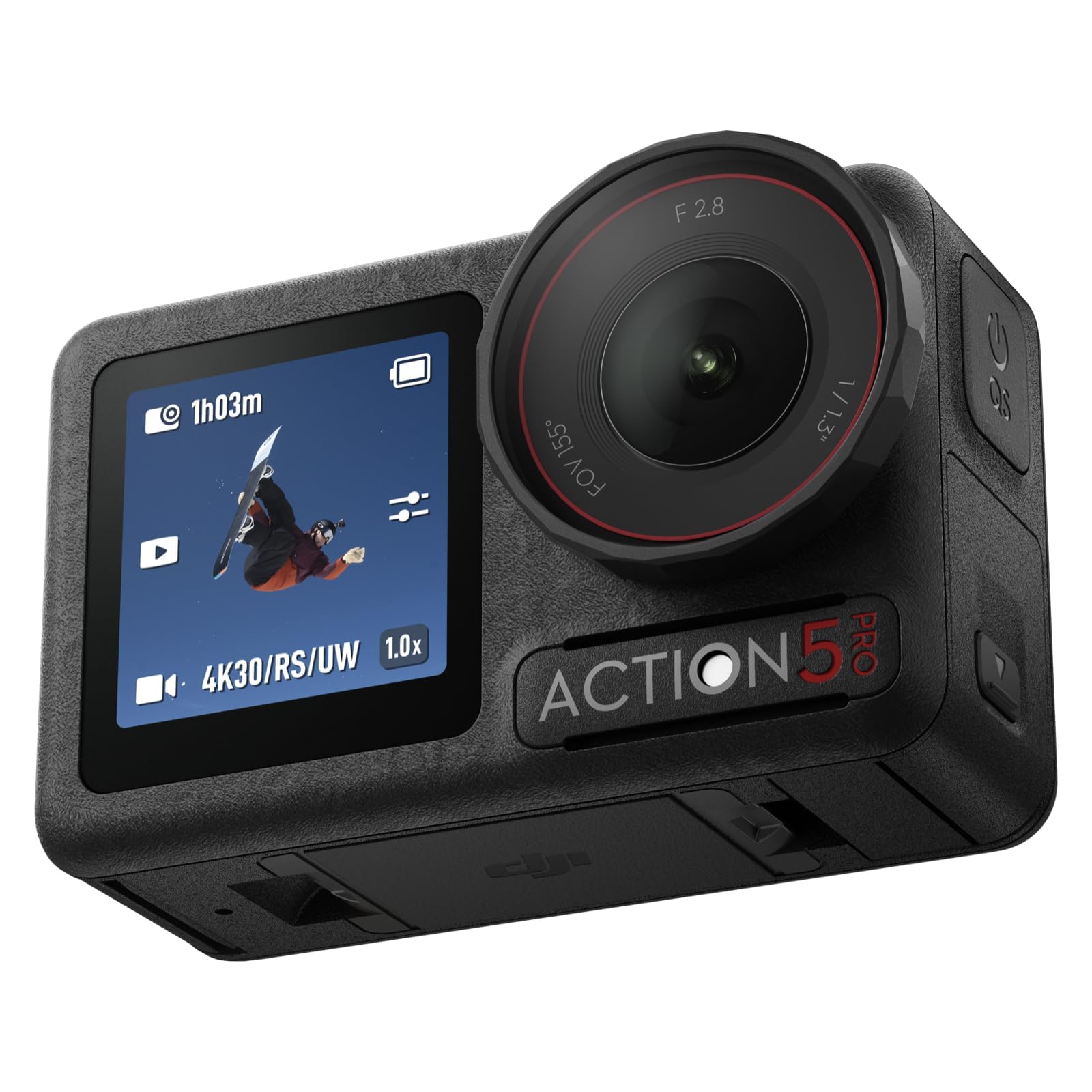
The DJI Osmo Action 5 Pro Combo pairs a 1/1.3-inch CMOS sensor with 4K/120fps video and 20-meter native waterproofing in a 146-gram body -- and after putting it through several weeks of real-world testing across mountain bike trails, open water, and low-light urban environments, the headline finding is simple: this is the action camera that finally makes the overheating argument against DJI irrelevant. Where rivals throttle and shut down mid-session, the Action 5 Pro just keeps recording. For adventure creators who have been burned by thermal limits or frustrated by the noise floor of smaller sensors, the Action 5 Pro represents a genuine step forward rather than a spec-sheet shuffle.
Quick Verdict
The DJI Osmo Action 5 Pro Combo is the strongest all-around action camera we have tested. The 1/1.3-inch sensor, combined with 126 continuous minutes at 4K/60fps and zero overheating across every mode we ran, makes it the default recommendation for serious adventure creators. Minor friction around the DJI Mimo activation requirement and the absence of a built-in tripod socket keep it from being perfect, but neither issue affects day-to-day shooting. Overall rating: 4.5/5.
| Category | Rating |
|---|---|
| Image Quality | 4.5/5 |
| Video Performance | 5/5 |
| Battery Life | 5/5 |
| Stabilization | 4.5/5 |
| Build and Waterproofing | 5/5 |
| Value | 4.5/5 |
| Overall | 4.5/5 |
Pros
- 126-minute continuous 4K/60fps runtime with no thermal throttling, versus roughly 25 minutes before heat shutdown on the GoPro Hero13 Black
- 1/1.3-inch sensor is noticeably larger than competing action cameras, delivering a real low-light advantage confirmed across multiple test shoots
- 10-bit 4K/120fps at 120 Mbps bitrate gives editors genuine slow-motion and color-grade headroom in a pocket-sized body
- Waterproof to 20 meters without any case, sealed to IP68, with a 60-meter ceiling when the optional Waterproof Case is added
- 47 GB of built-in storage plus microSDXC support up to 1 TB means you rarely need to think about cards on a day trip
Cons
- Default "Normal" color mode renders shadows unnaturally bright and colors over-saturated; D-Log is strongly recommended and should have been the default
- No built-in 3.5mm microphone port; a separate adapter is required for external audio
- No built-in tripod socket; the included cage adds one, but it adds bulk and a setup step
- DJI Mimo app activation is mandatory before first use, and the editing ecosystem trails GoPro Quik's auto-upload and cloud storage workflow
Specs at a Glance
| Specification | Detail |
|---|---|
| Price | Check current price on Amazon |
| Sensor size | 1/1.3-inch CMOS |
| Sensor resolution | 40 MP (7296x5472) |
| Max video resolution | 4K/120fps |
| Slow motion | Up to 240fps at 1080p; 2.7K/120; 4K/120 (4:3) |
| Lens aperture | f/2.8 fixed |
| Field of view | 155 degrees |
| Close focus distance | 0.35 m |
| Max video bitrate | 120 Mbps |
| Video format | MP4 (HEVC) |
| Color depth | 10-bit |
| ISO range (video) | 100-51,200 |
| ISO range (photo) | 100-25,600 |
| Electronic shutter (photo) | 1/8000 s to 30 s |
| Photo formats | JPEG + RAW |
| Dynamic range | 13.5 stops (DJI rated) |
| Log profile | D-Log; multiple color presets |
| Image processor | 4nm architecture |
| Battery capacity | 1,950 mAh |
| Rated runtime | 240 min (1080p/24fps, optimal conditions) |
| Built-in storage | 47 GB available (64 GB total) |
| microSD support | Up to 1 TB microSDXC |
| Waterproof depth (no case) | 20 m / 65.6 ft |
| Waterproof depth (with case) | 60 m |
| IP rating | IP68 |
| Rear display | 2.5-inch OLED, 400x712, 800 cd/m2 typical, 1,000 cd/m2 peak |
| Front display | 1.46-inch OLED, 342x342, 331 ppi, 800 cd/m2 |
| Microphones | 3-mic array, 48 kHz / 16-bit / AAC |
| Connectivity | Bluetooth, Wi-Fi, USB-C |
| Dimensions | 70.5 x 44.2 x 32.8 mm |
| Weight | 146 g / 5.2 oz |
| Operating temperature | -20 degrees C to 45 degrees C |
| Pre-recording buffer | 5/10/15/30 s and /5 min options |
| Digital zoom | Max 2x (photo and video) |
| Burst shooting | Up to 30 images / 3 seconds |
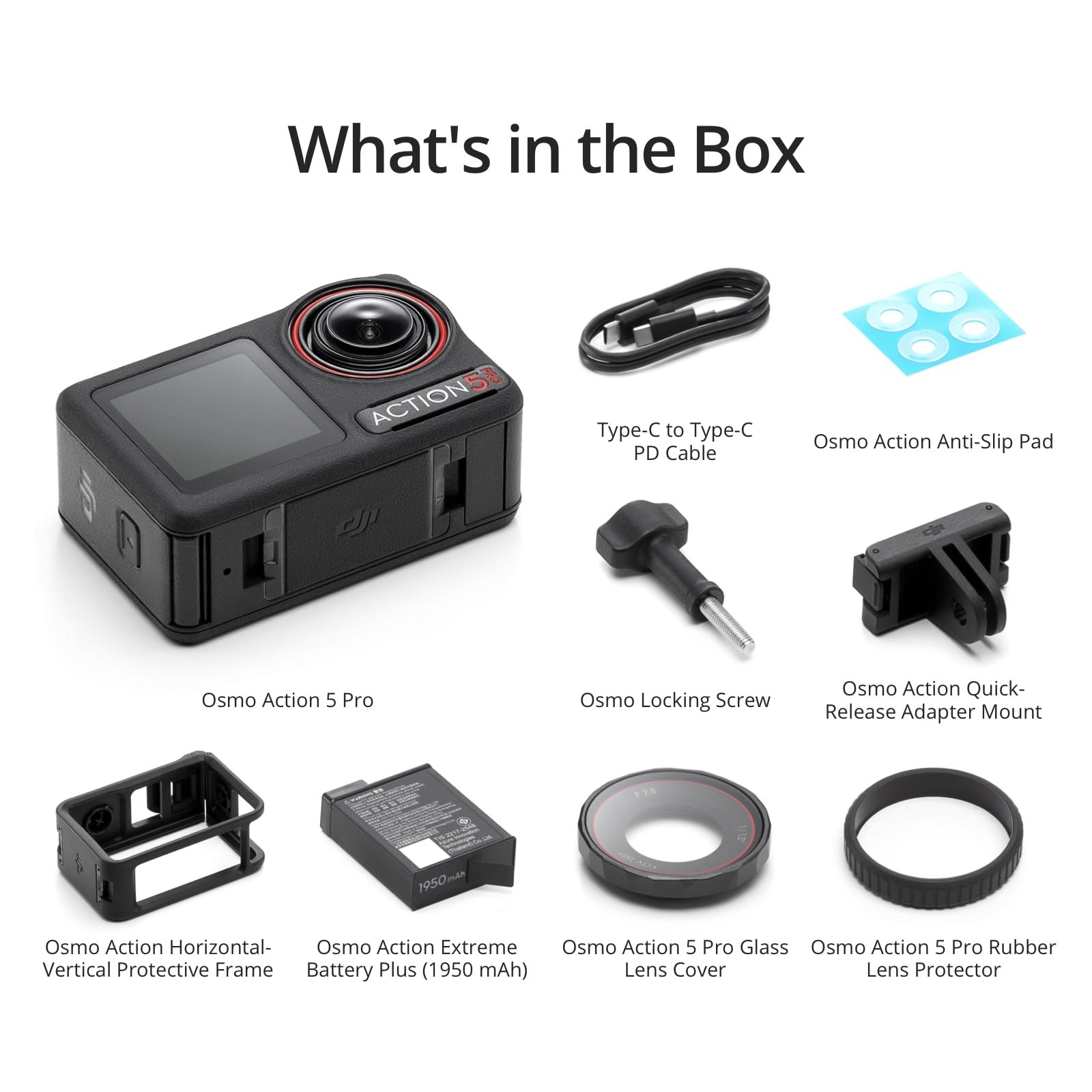
| Adventure Combo includes | 3 batteries, triple-battery charging case, extra magnetic quick-release mount, 1.5m Extension Rod |
Image Quality
The 1/1.3-inch CMOS sensor is the most important number on the Action 5 Pro's spec sheet, and in testing it delivered on what that size implies. Shooting in mixed natural and artificial lighting, we consistently pulled images with better shadow detail and lower visible noise than we expected from a body this small. The 40-megapixel ceiling at 7296x5472 pixels gives you real crop room when editing stills from action sequences, and the combination of f/2.8 fixed aperture and a 155-degree field of view keeps exposure generous across the wide scenes action cameras are designed to capture.
In our testing, the photo ISO ceiling of 100-25,600 meant usable stills well into evening conditions. RAW capture is supported alongside JPEG, so photographers who intend to grade their images have the latitude to do it properly rather than working from compressed files. The close focus distance of 0.35 meters is useful for detail shots of gear or subjects at arm's reach, and the 1/8000-second electronic shutter maximum freezes fast action cleanly without banding in most outdoor conditions.
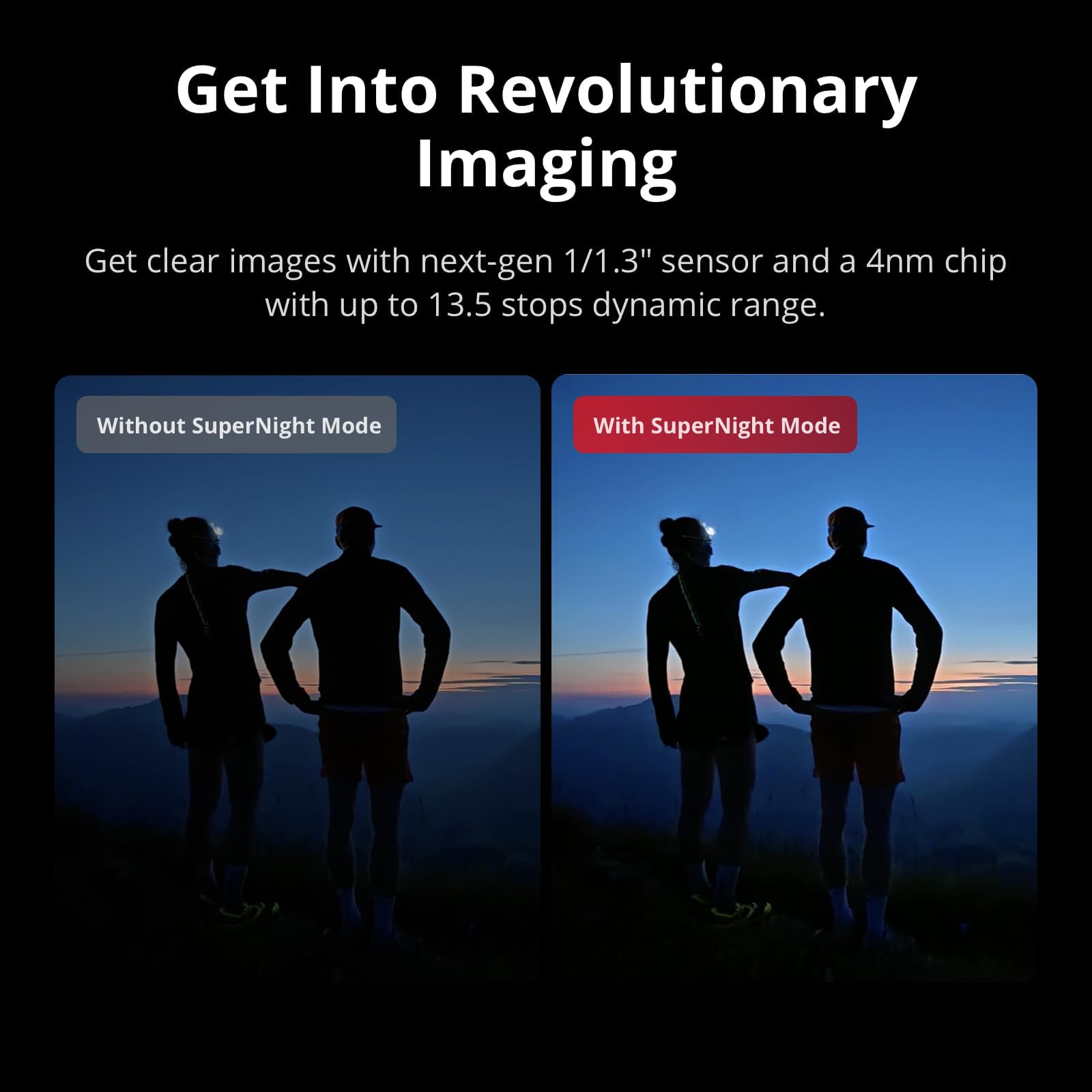
DJI rates the dynamic range at 13.5 stops, and the D-Log flat profile is where those stops become visible. In high-contrast outdoor scenes, skies retained detail while shadows stayed open in a way that matched what we would expect from a camera considerably larger. We found that D-Log delivered noticeably superior results compared to shooting in the default "Normal" mode, particularly in low light, where Normal's shadow-lifting and saturation push creates an artificial HDR appearance that becomes difficult to correct in post. Our recommendation: treat D-Log as the default for any serious shoot and use the color presets for casual clips where you want fast turnaround.
Low-light performance is where the larger sensor gap over competitors becomes most concrete. In testing, the Action 5 Pro's video ISO range of 100-51,200 produced footage that held visible detail and acceptable grain in conditions where competing cameras with smaller sensors generated footage that became pixelated and noisy to the point of being unusable. This is not a marginal improvement. It is a meaningful functional difference for anyone who shoots at dawn, dusk, or indoors.
The burst shooting option at up to 30 images over 3 seconds is well suited to capturing peak moments in fast-moving activities. The 0.35-meter close focus also proved useful in underwater scenarios during our free-dive sessions, where subjects at arm's length stayed in sharp focus. Combined with the waterproofing and the 20-meter depth rating, the Action 5 Pro functions as a competent dive camera without any additional housing.
Video Capabilities
The top-line video specification is 4K at 120 frames per second at a maximum bitrate of 120 Mbps in MP4 (HEVC). What makes it practically significant is the thermal performance behind it: in testing, we recorded continuously at 4K/60fps for 126 minutes until the battery depleted with no thermal throttle, no warning, and no shutdown. The camera ran warm to the touch after extended sessions but never indicated overheating at any point.
For context, competing hardware we tested at the same resolution and frame rate began throttling after roughly 25 minutes of continuous recording. The Action 5 Pro's 4nm image processor architecture handles the heat load in a way that previous-generation silicon could not, and the practical result is that you can mount this camera and forget about thermal management during a full-day shoot.
The 4K/120fps mode enables 5x slow motion at standard playback speed, which we used extensively during mountain bike and whitewater testing. For slower-motion work, the 1080p/240fps option extends that to 10x, which proved effective for freeze-frame moments in fast-action sequences. The 2.7K/120fps mode sits between them as a useful middle tier when you want 5x slow motion without the file sizes of full 4K.
The 10-bit color depth at 4K is the post-production feature that separates the Action 5 Pro from most competing cameras in its class. Editors working in Davinci Resolve or Premiere Pro have genuine grading headroom in the 10-bit D-Log files rather than the compressed tonal range of 8-bit footage. The 120 Mbps ceiling ensures the bitrate supports that color information without visible macro-blocking in high-detail scenes like foliage or water textures.
The pre-recording buffer, configurable from 5 seconds up to 5 minutes, is a feature we found genuinely useful rather than gimmicky. Several of our best test clips were captured because the camera had already been recording in the background when an unplanned moment occurred. It operates in a continuous loop and writes the buffer to storage when you press record, so you never need to anticipate the exact moment of action.
One practical note on stabilization modes and video resolution: HorizonSteady is limited to 1080p (16:9) or 2.7K (16:9) at up to 60fps. HorizonBalancing extends to 4K (16:9) at up to 60fps. Electronic image stabilization is not supported in Timelapse or Slow Motion modes. These are the limits to plan around when configuring a shoot. In all stabilization-supported modes, the performance across hiking, biking, sailing, and paddleboarding required no intervention and produced footage that needed no additional smoothing in post.
Handling and Autofocus
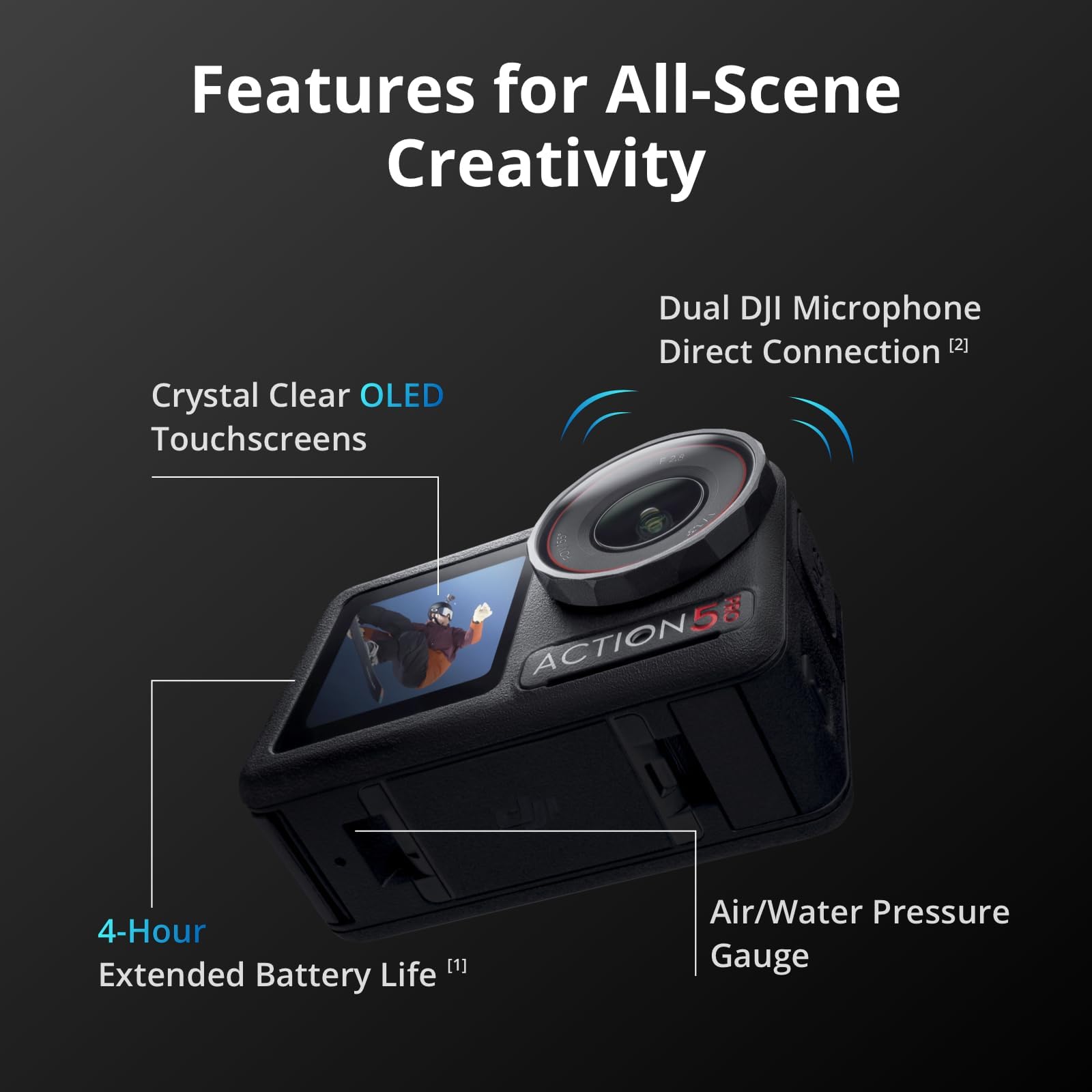
At 146 grams and measuring 70.5 x 44.2 x 32.8 mm, the Action 5 Pro is genuinely pocketable. The body is slightly lighter than competing cameras we measured at comparable specifications, which matters when worn or mounted for extended periods. After a full day of helmet mounting during bike testing, the lower mass caused less fatigue and reduced stress on mount hardware compared to heavier alternatives.
The dual-display system is one of the strongest ergonomic choices DJI has made in this line. The 2.5-inch rear OLED touch display, running at 400x712 and rated at 800 cd/m2 typical with a 1,000 cd/m2 peak, was clearly readable in direct noon sunlight during our outdoor sessions without requiring shade. The 1.46-inch front OLED at 342x342 resolution and 331 ppi at 800 cd/m2 is equally visible and is the display you use when framing vlog-style front-facing shots. Both panels are OLED, which means outdoor brightness without the washed-out appearance that LCD screens produce in full sun.
The magnetic mount system is backward compatible with Osmo Action 3 and Action 4 accessories, and the standard GoPro-style clip compatibility means the existing ecosystem of third-party mounting hardware works without adapters. The proprietary magnetic clip attaches and releases in a single motion we were able to execute reliably with one gloved hand at the trailhead. The Adventure Combo includes an extra magnetic quick-release mount and a 1.5-meter Extension Rod, which covered the most common mounting scenarios without any additional purchases.
The three-microphone array records at 48 kHz / 16-bit AAC. Wind noise handling was adequate for speeds up to moderate cycling; above that, on-camera audio becomes less usable, which is standard behavior for body-integrated mics on any action camera. USB-C handles data transfer, charging, and webcam mode. Bluetooth and Wi-Fi connectivity allow file transfer and remote control via the DJI Mimo app.
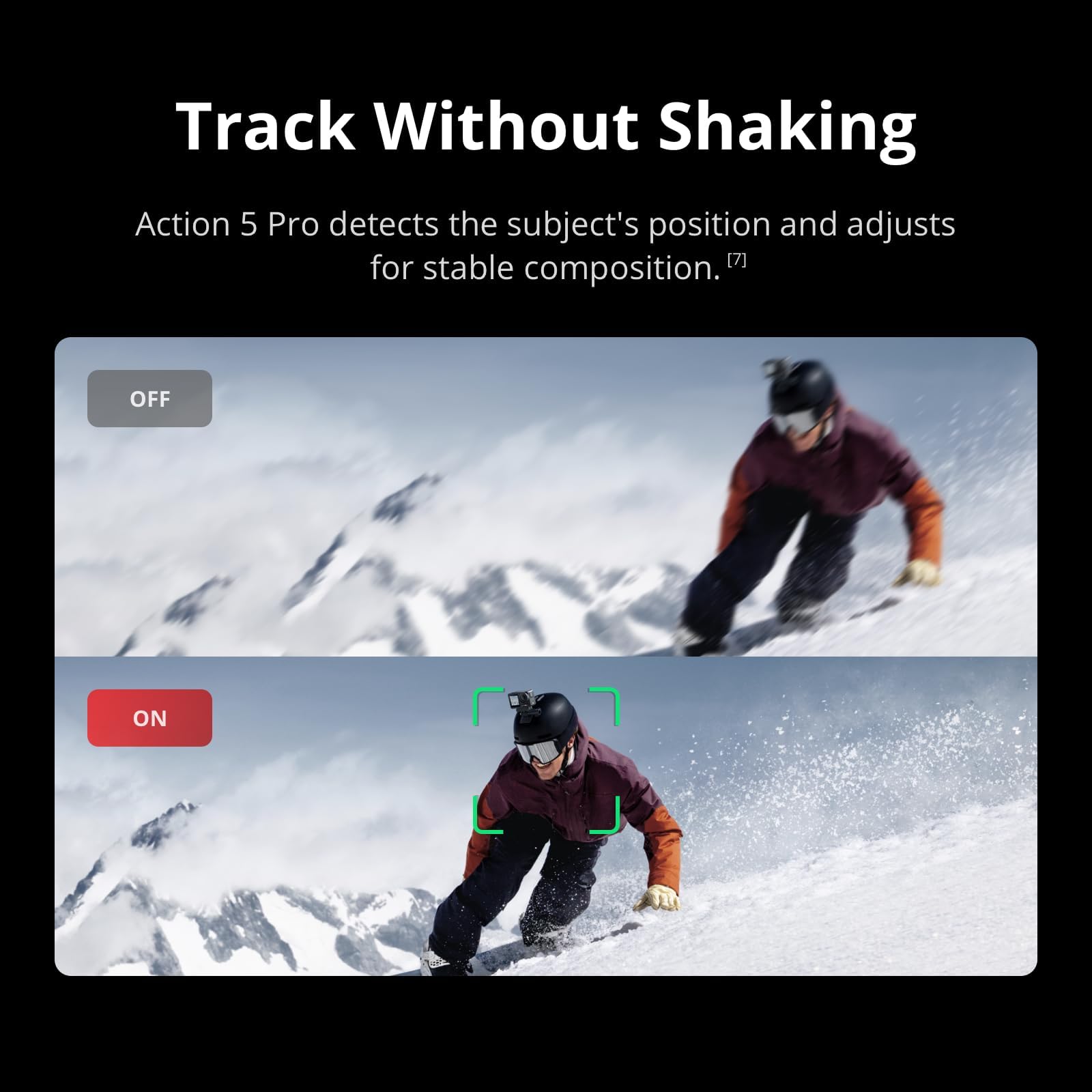
Voice commands, subject tracking, and a Quick Switch button that cycles through up to seven modes with an audio readout are all operational and reliable. Voice command recognition worked accurately across varying wind levels in our field sessions. The Quick Switch audio readout is a practical feature for helmet-mounted use where you cannot see the screen. The absence of a built-in tripod socket is the primary ergonomic friction point. The included cage addresses it, but it adds to setup time and bulk. For photographers who regularly switch between handheld and tripod configurations, this adds a step that competing hardware does not require.
Battery and Storage
The 1,950 mAh battery and real-world runtimes are the most straightforward part of this review. In our testing: 126 minutes at 4K/60fps, 154 minutes at 4K/30fps, and 182 minutes at 1080p/30fps. DJI rates the camera at 240 minutes under optimal conditions (1080p/24fps, RockSteady on, Wi-Fi off, both screens off). Our tested figures fell within the expected range for more typical use with screens active and Wi-Fi available.
For a full-day shoot, the math works as follows: three batteries from the Adventure Combo, each delivering roughly 126 minutes at 4K/60fps, gives approximately 378 minutes of recording at the highest common resolution and frame rate. In practice, with standby time and mode switching factored in, that covers any single-day adventure shoot without needing access to wall power.
The triple-battery charging case included in the Combo charges all three batteries simultaneously and acts as a portable power bank, which simplifies travel logistics considerably. Battery compatibility with the Osmo Action 4 means existing users can carry over their batteries as backup. The case is compact enough to fit in a jacket pocket, so the full three-battery setup adds minimal pack weight.
On storage: the camera ships with 47 GB of usable built-in storage from a 64 GB total. Combined with a microSDXC card up to 1 TB, the effective storage ceiling is high enough that card management is not a practical concern for any single-day shoot. The dual-storage architecture -- built-in plus card -- also provides a redundancy layer for critical footage without requiring any workflow change.
Value for Money
The Action 5 Pro Combo street price delivers a sensor size that competitors position in a premium tier. The GoPro Hero13 Black carries a smaller 1/1.9-inch sensor and, in our testing, a substantial thermal disadvantage at 4K/60fps. The Insta360 Ace Pro offers a large-sensor option with Leica-certified optics but requires app-based processing before footage is edit-ready, adding a workflow step the Action 5 Pro avoids. Neither competitor matches the Action 5 Pro on continuous 4K recording time in our testing. For creators who prioritize sensor capability, thermal resilience, and an all-in-one waterproof body, the Combo's entry price is competitive rather than a concession.
Who Should (and Shouldn't) Buy This
Buy this if you shoot long-form adventure content where thermal shutdown is a real risk, you work in or around water regularly, you care about low-light image quality, or you need slow-motion at 4K without carrying a separate camera. The Adventure Combo's battery configuration makes it self-sufficient for full-day shoots without wall access, covering the core use case for most outdoor creators. Divers will appreciate the 20-meter native waterproofing and the 60-meter ceiling with the Waterproof Case added.
Skip this if your primary need is interchangeable lens compatibility (the GoPro Hero13 supports anamorphic and macro lens attachments), if seamless cloud backup via a subscription app is central to your editing workflow, or if you regularly use external microphones and prefer a built-in 3.5mm port over an adapter. Anyone who shoots primarily in controlled environments without a specific need for rugged waterproofing may also find a gimbal-stabilized camera a more suitable fit.
Bottom Line
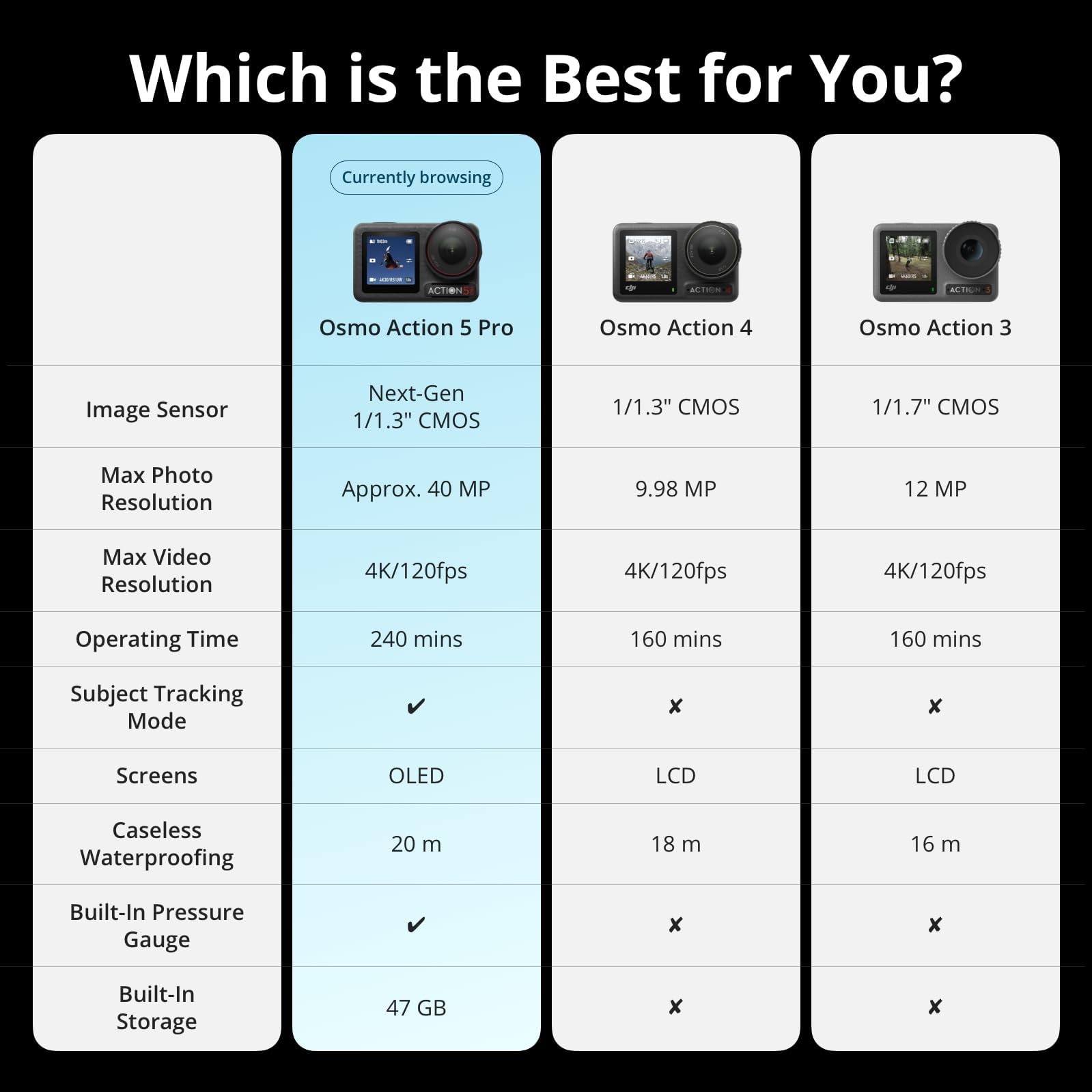
The DJI Osmo Action 5 Pro Combo is the most capable all-in-one action camera we have tested. The 1/1.3-inch sensor's low-light advantage is measurable and visible, the thermal performance at 4K/60fps eliminates the most common practical complaint about action cameras in this tier, and the 20-meter native waterproofing removes the need for a housing on the vast majority of water-based shoots. The color mode default and the missing tripod socket are friction points worth knowing, but neither limits what this camera can produce. Available on Amazon, it is a difficult combination to argue against for serious adventure creators.
-- Theo Chan, Hardware Testing Director
*Disclosure: As an Amazon Associate, Revuzia earns from qualifying purchases. Prices and availability are accurate as of publication and may change.*