Google Gemini Becomes First AI Sponsor on World Cup UniformsGoogle Gemini Becomes First AI Sponsor on World Cup UniformsGoogle Gemini Becomes First AI Sponsor on World Cup UniformsGoogle Gemini Becomes First AI Sponsor on World Cup Uniforms
June 10, 2026
Google has signed as main global sponsor of Argentina's national team for the 2026 FIFA World Cup, placing the Gemini logo on training kits while simultaneously deploying AI-powered analysis tools to coaching staff and real-time query features to millions of fan smartphones. The
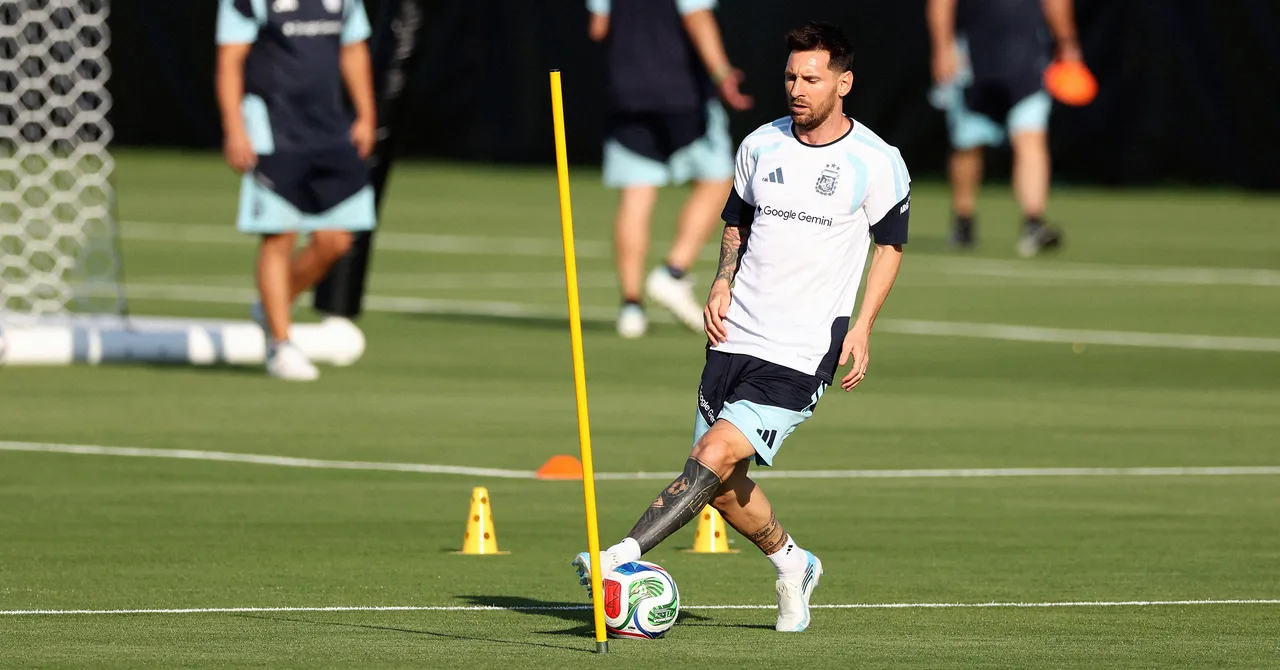
Google has signed as main global sponsor of Argentina's national team for the 2026 FIFA World Cup, placing the Gemini logo on training kits while simultaneously deploying AI-powered analysis tools to coaching staff and real-time query features to millions of fan smartphones. The deal, closed in March 2026 and announced in May, extends to Brazil and France as well, marking the first time a technology company has positioned an AI product name on player uniforms and consumer devices at the same scale. For enterprise technology leaders evaluating AI readiness under pressure, this dual-deployment strategy offers a live stress test: if Gemini can deliver accurate, real-time analysis during World Cup matches with zero room for error and global visibility, it signals maturity for mission-critical business applications requiring similar reliability.
Google closed the Argentina partnership in March 2026, delaying the public announcement until May to finalize negotiations with Brazil and France. All three teams are World Cup winners, and the tournament represents the most visible stage in professional sports. Flor Sabatini, Google spokesperson, described the World Cup as "the most important cultural event of the year" for the company and emphasized that the effort is "not just about opening the door [to] AI, but about understanding its real limits while improving experience."

What's new
Google Gemini, the AI product family that replaced the Bard chatbot branding in February 2024, now powers two parallel deployments for the 2026 FIFA World Cup. On the coaching side, Argentina's staff and players gain access to AI models that analyze opponent plays, team form, performance statistics, and tactical breakdowns. On the consumer side, Google's search engine will be reconfigured with AI-generated answers for real-time queries during matches, providing analysis of key plays and statistics. Fans can also use Gemini to create songs, memes, cartoons, and visual content tied to the tournament.
The Gemini logo will appear on Argentina's training kit throughout the World Cup, a branding integration that mirrors traditional sportswear partnerships but applied to a software product. Sabatini noted that "the passion that the Argentine national team arouses transcends Argentines. It is a shared emotion," positioning the partnership as a cultural alignment rather than a purely technical exercise.
Google announced updates to the Gemini model family at its I/O conference in May 2024, with subsequent releases continuing through 2025 and 2026. The latest versions combine what the company describes as "frontier intelligence with the ability to perform actions via AI agents," suggesting the World Cup deployment may involve agentic workflows beyond simple query-response interactions.
Why it matters
The World Cup functions as an AI stress test at a scale few enterprise deployments can replicate. Millions of simultaneous queries will hit Google's infrastructure during high-stakes matches, with diverse linguistic and cultural contexts, zero tolerance for downtime, and global media scrutiny on every output. If Gemini generates incorrect statistics, invents player lineups, or produces biased image content during live tournament coverage, the errors will be visible to hundreds of millions of users in real time.

World Cups have historically accelerated technology adoption in ways that persist beyond the tournament itself. Color television broadcasting, GPS-based player tracking systems, and Video Assistant Referee (VAR) technology all gained mainstream traction during World Cup cycles. VAR was formally written into the Laws of the Game by the International Football Association Board on March 3, 2018, after high-profile use in the 2018 tournament demonstrated its viability under pressure.
Google's positioning of Gemini in this context suggests confidence that the product can handle mission-critical scrutiny. For enterprise AI buyers evaluating whether generative models are ready for production use in high-stakes environments, the World Cup deployment offers a public benchmark. If Gemini's real-time statistics and play analysis hold up under tournament pressure, it demonstrates technical maturity. If errors surface, the failure modes will be well-documented and instructive for other deployment scenarios.
Sabatini's comment on "understanding its real limits" acknowledges the risk explicitly. AI-generated content errors have already caused reputational damage for Google: the company suspended Gemini's ability to generate images of people in February 2024 after users reported historical inaccuracies and bias. Deploying the same product family to a global audience during live sports events raises the stakes considerably.
Competitive Landscape
Google Gemini faces direct competition from two primary AI platforms in the enterprise and consumer markets. Grok, developed by xAI, and OpenAI's ChatGPT are listed as the top Google Gemini competitors in the artificial intelligence category. ChatGPT reached 100 million monthly active users two months after its November 2022 release and reported 200 million weekly active users as of August 2024, making it the largest commercial AI chatbot by user base.

None of these competitors have announced sports tournament partnerships at the scale of Google's World Cup integration. The Gemini deployment represents a category of AI use case that goes beyond traditional chatbot or coding-assistant workflows: real-time, high-volume, culturally diverse query handling with public accountability.
Independent analyst commentary specifically on this announcement was not publicly available at publication time.
What's next
The 2026 FIFA World Cup will take place across the United States, Canada, and Mexico, expanding from the 32-team format used in 2022 to 48 participating teams. The tournament begins in June 2026, giving Google roughly one month from the May announcement to finalize integrations with Argentina's coaching staff and configure Google Search for real-time AI-generated responses.
Brazil and France partnerships remain less defined in public disclosures. If Google deploys similar coaching tools and fan-facing features for all three teams, the infrastructure will need to handle differentiated workflows across languages, playing styles, and fan bases. Brazil has the largest social media following of any national team, while France's multicultural squad and diaspora fan base present linguistic complexity that tests AI translation and cultural context handling.
The real-world test will be whether Gemini's real-time statistics and play analysis match the accuracy and speed of human commentators and existing sports data providers. If Gemini's AI-generated insights lag behind established sources or produce errors, the comparison will be immediate and public. Conversely, if Gemini delivers faster or more granular analysis than traditional providers, it could establish a new baseline for live sports data.
For a CISO evaluating AI infrastructure under load, the World Cup deployment offers a rare public case study in real-time reliability at scale. The tournament will stress-test Gemini's ability to handle millions of simultaneous queries across languages, time zones, and cultural contexts with zero downtime tolerance. If Google can keep error rates low during live matches when every output is scrutinized by global media, it demonstrates production-grade AI operations. The upside is a global demonstration of AI reliability under pressure. The downside is that every hallucinated statistic, mistranslated query, or biased image will be captured, dissected, and replayed.
-- Aria Lin, Enterprise Technology Analyst
Sources: Google Gemini · International Football Association Board