Honor's Robot Beat the Human Half-Marathon Record by Seven MinutesHonor's Robot Beat the Human Half-Marathon Record by Seven MinutesHonor's Robot Beat the Human Half-Marathon Record by Seven MinutesHonor's Robot Beat the Human Half-Marathon Record by Seven Minutes
June 23, 2026
On April 19, 2026, Honor's humanoid robot Lightning finished a half-marathon in 50 minutes and 26 seconds, running at an average of 7 meters per second and beating the human world record by 7 minutes. The more revealing number is not the gap to human athletes but the gap to

On April 19, 2026, Honor's humanoid robot Lightning finished a half-marathon in 50 minutes and 26 seconds, running at an average of 7 meters per second and beating the human world record by 7 minutes. The more revealing number is not the gap to human athletes but the gap to every other robot on the course: Lightning finished nearly two hours ahead of the best robot half-marathon time recorded in 2025. In a field of more than 20 competing humanoids, one machine separated itself so completely that the story is not the finish line. The story is the engineering decision hidden inside the knee joint.
What It Does
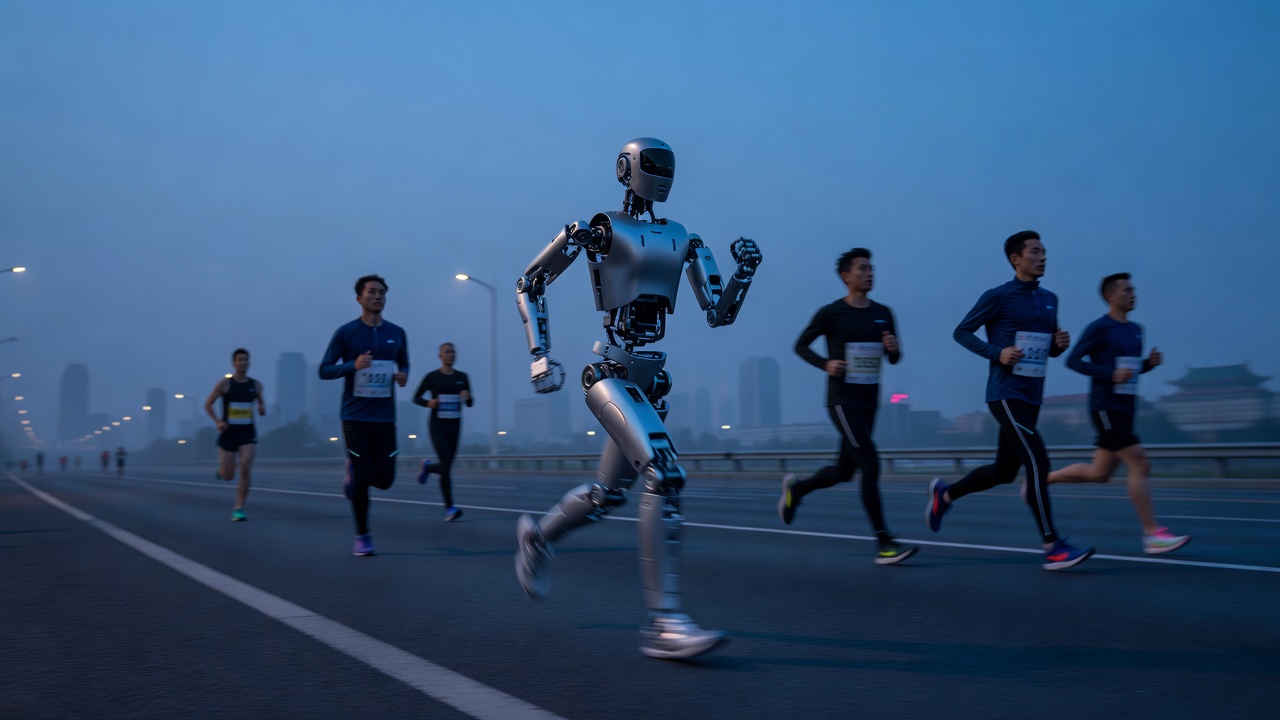
Honor, the Chinese smartphone manufacturer that produces the Lightning humanoid robot, entered the April 19 Beijing E-Town Humanoid Robot Half-Marathon against a field that included machines from robotics companies with far deeper track records in the sector. Lightning ran the course autonomously, covering 21.0975 kilometers and posting a net time that eclipsed the ratified human men's world record of 57 minutes and 20 seconds by a full 7 minutes.
The best robot half-marathon result from 2025 fell roughly two hours behind Lightning's time. That is not incremental progress. A two-hour differential on a half-marathon course is the difference between an elite finish and a casual walking pace. Whatever Lightning's engineers changed between the 2025 competitive baseline and April 2026, it produced a step-function shift in what a humanoid robot can sustain at speed.
The physics of running place specific demands on any bipedal machine. During each stride, the leg cycles between a stance phase (the foot contacts the ground and pushes off) and an aerial phase (the body falls under gravity with no ground contact). That redirecting force flows through the knee motor thousands of times across 21 kilometers, and every motor action that is not perfectly efficient exits the system as heat.
The Technical Achievement
The engineering insight at the center of Lightning's performance involves gear ratio (the mechanical multiplier between a motor's rotational speed and the torque it delivers to a joint). Roboticist and Ghost Robotics co-founder Avik De, writing in IEEE Spectrum, modeled Lightning's motor architecture and identified the tradeoff that separates the race's winner from its competitors.
For a humanoid walking at a typical 1.5 meters per second, the optimal gear ratio in the knee is approximately 30:1. Running at 7 meters per second, the optimal ratio shifts to approximately 45:1. A robot built and tuned for walking, then asked to run a half-marathon, pays a steep thermal penalty.
De's model, using the ILM115x25 motor (selected as a proxy for Lightning's actual motors based on comparable physical dimensions of 110 to 150 millimeters outer diameter), estimates that running at 7 meters per second with a walking-optimized 30:1 gear ratio generates more than 300 watts of heat in the knee motor alone. A running-optimized design at 45:1 brings that figure to approximately 150 watts. Lightning's total estimated power consumption at the running-optimal gear ratio is around 400 watts, meaning the knee motor heat under the correct ratio represents roughly 37 percent of the entire robot's power budget. De describes this as "almost an unavoidable consequence" of the physics.
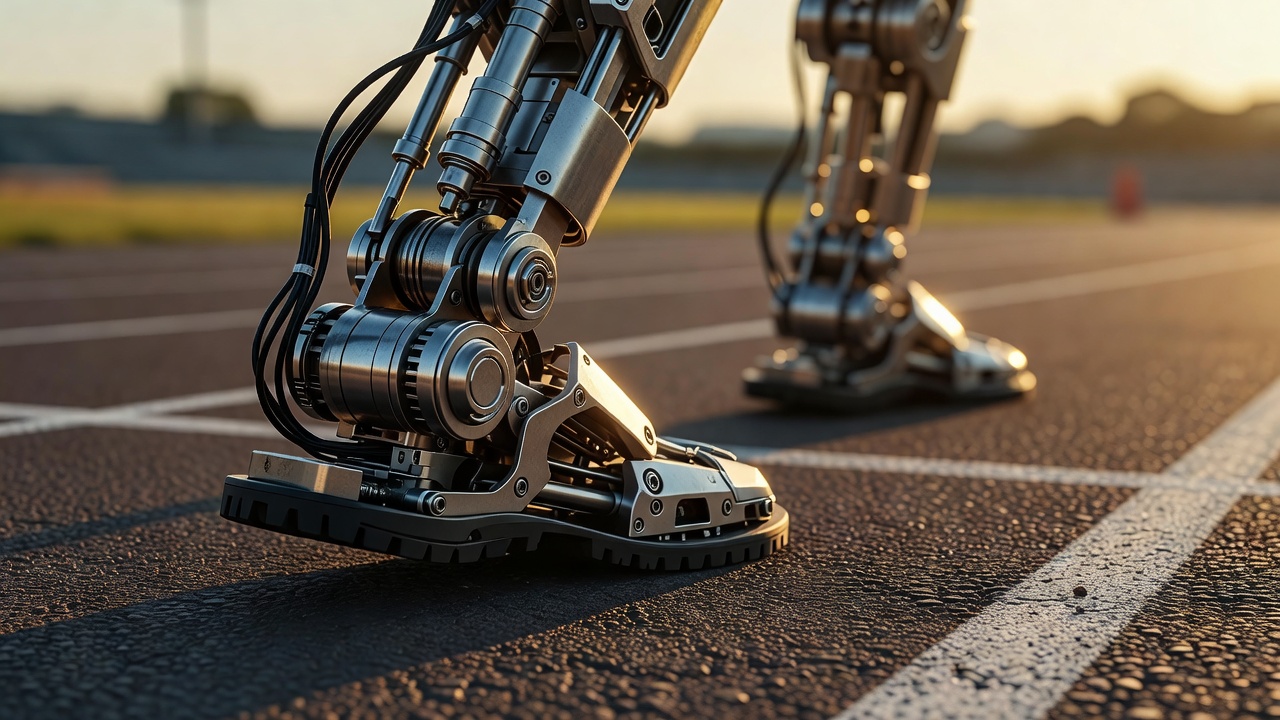
The 150-watt figure, even at the optimized gear ratio, still exceeds what passive air convection can continuously extract from a knee-sized enclosure. This is where Honor's hardware choice becomes decisive. Lightning uses liquid capillary motor cooling - a system that circulates coolant through channels inside or adjacent to the motor windings, extracting heat at a rate passive cooling cannot match. De characterized the liquid cooling as "a key enabler of this type of performance," and writes that running at human speeds in a humanoid-sized robot "will inevitably generate this amount of heat."
Larger motors carry more mass and can create clearance problems in environments designed for human occupancy. Engineers optimizing for a running task must balance motor sizing against both thermal output and practical deployment geometry - tradeoffs that do not resolve cleanly in any single direction.
Real-World Impact
De invokes IBM's Deep Blue defeating chess grandmaster Garry Kasparov in 1997 as context, but immediately complicates the comparison. The 1997 match demonstrated machine capability in a narrow, well-defined domain. Deep Blue could not play checkers, let alone drive a car.
Lightning's half-marathon result occupies the same category. The robot ran with GPS navigation assistance and did not navigate elbow-to-elbow contact with other runners. De writes that "the Honor robot's capabilities are much narrower than a human running elbow-to-elbow with other runners while visually navigating the course without GPS." The human-versus-robot framing that dominated the race's media coverage is, as he puts it, an apples-to-oranges comparison.
What the result does prove is more specific and more useful. A robot designed around the thermal constraints of its primary task, rather than designed for general versatility and then asked to run, can sustain performance that general-purpose competitors cannot approach. De notes that liquid cooling may prove equally enabling for future tasks involving heavy payload transport, where sustained high torque creates similar thermal loads. "Engineering is always characterized by tradeoffs," he writes, "and making the correct ones separates good products from great ones."
Competitive Landscape
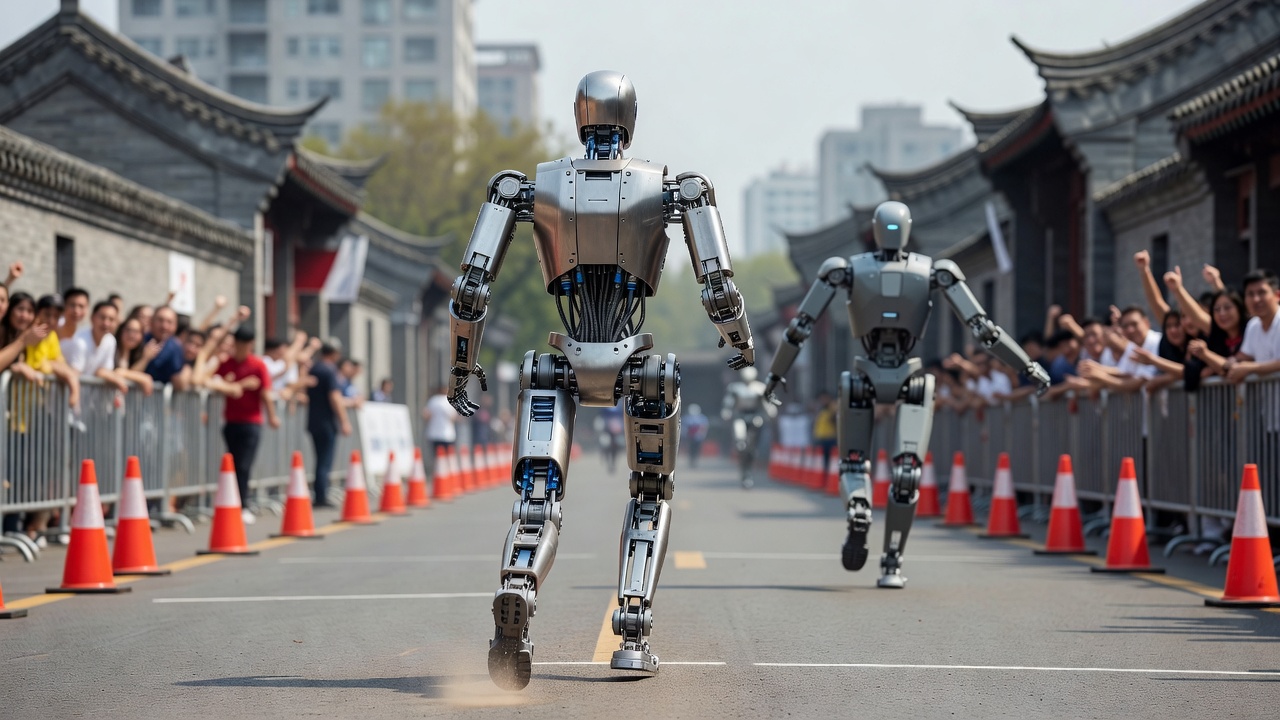
The race's competitive picture illustrates De's tradeoff argument in physical form. Three established names in humanoid robotics entered or were associated with the April 19 event, and none matched Lightning's performance.
- Unitree (a well-established commercial humanoid robotics company): Unitree reportedly supplied an ice backpack to one of its competing robots in an attempt to complete the course. De's thermal model explains why. A Unitree robot optimized for walking with a 30:1 gear ratio would generate more than 300 watts of knee motor heat at running speed - more than twice the heat produced by Lightning's running-optimized design. An external ice backpack is a symptom of an internal thermal budget never engineered for this task.
- Agibot (established humanoid robotics competitor): Named among the entrants that did not perform comparably to Lightning, though no specific technical breakdown of Agibot's architecture was available in De's analysis.
- Apptronik (commercial humanoid robotics company, maker of the Apollo platform): Not a race entrant, but relevant context. Apptronik has tested liquid cooling in a few prototypes. Their main commercial platform, Apollo, does not use liquid cooling according to De's analysis. The fact that a well-resourced commercial team evaluated and then sidelined liquid cooling for their primary product suggests it carries cost, weight, or integration complexity that makes it a deliberate architectural choice rather than a default addition.
Honor's position as a smartphone manufacturer outperforming dedicated robotics companies is the structural surprise of the event. The winner was not the most commercially established entrant - it was the one that solved the right thermal problem before race day.
What's Next
The gear ratio and thermal management findings carry implications beyond competitive racing. Humanoid robots evaluated for commercial deployment face tasks with distinct mechanical profiles: warehouse picking, payload transport, stair climbing, and sustained assembly-line motion each impose different load cycles on hip and knee actuators. A robot optimized for one task profile will carry thermal debt on others.
The industry direction this points toward is not a single universal humanoid design but a spectrum of task-specialized variants sharing a common platform. If liquid cooling proves cost-effective and durable enough for production deployment, it becomes a differentiator not just in running but in any task requiring sustained high torque.
The open questions are substantial. Honor has not published Lightning's actual motor specifications, so De's analysis rests on a proxy motor model. The robot's actual gear ratio is estimated, not confirmed. Battery capacity, runtime margin at the finish, and the production cost of the liquid cooling system remain undisclosed. Whether Honor is developing Lightning toward commercial deployment or built it as a targeted engineering demonstration has not been stated publicly.
What the April 19 result establishes is a thermal baseline: sustained running at 7 meters per second in a humanoid-sized robot generates heat loads that passive cooling cannot handle. Any team building toward high-speed or high-load humanoid performance will need an answer to the same problem Lightning solved. The question for the next competitive cycle is whether the answer is liquid cooling, a different motor architecture, or something not yet modeled.
For engineers designing humanoid actuator systems: the gear-ratio tradeoff De models is not a racing-specific edge case. A robot asked to carry a 20-kilogram payload for four hours on a factory floor faces the same torque-heat relationship at the knee and hip that Lightning faced over 21 kilometers. A 30:1 walking-optimized knee generating over 300 watts of continuous heat is a thermal failure waiting for a long enough task. The Lightning result gives the field a concrete thermal target: 150 watts at the knee, sustained, is achievable with liquid capillary cooling at 45:1. That is now a design benchmark.
A smartphone company just outran every dedicated robotics entrant in a field of 20-plus humanoids by nearly two hours. The margin was not close, and the most striking element is not the time on the clock but what it reveals about competitive advantage in physical AI: it belongs to whoever solves the unsexy engineering problem first, not to whoever has the most recognizable name in the sector. Unitree's ice backpack will be a design-school case study for the next decade.
-- Zara Velez, Emerging Technology Editor
Sources: IEEE Spectrum, Avik De: Honor Lightning Half-Marathon Analysis (June 17, 2026) · Wikipedia: Half Marathon Records