Hybrid EVs Hit Record 16% Share as Battery Electric Sales Slide After Tax Credit ExpirationHybrid EVs Hit Record 16% Share as Battery Electric Sales Slide After Tax Credit ExpirationHybrid EVs Hit Record 16% Share as Battery Electric Sales Slide After Tax Credit ExpirationHybrid EVs Hit Record 16% Share as Battery Electric Sales Slide After Tax Credit Expiration
July 28, 2026
U.S. hybrid electric vehicles reached a record 16% share of new light-duty vehicle sales in the second quarter of 2026, according to an analysis by the U.S.
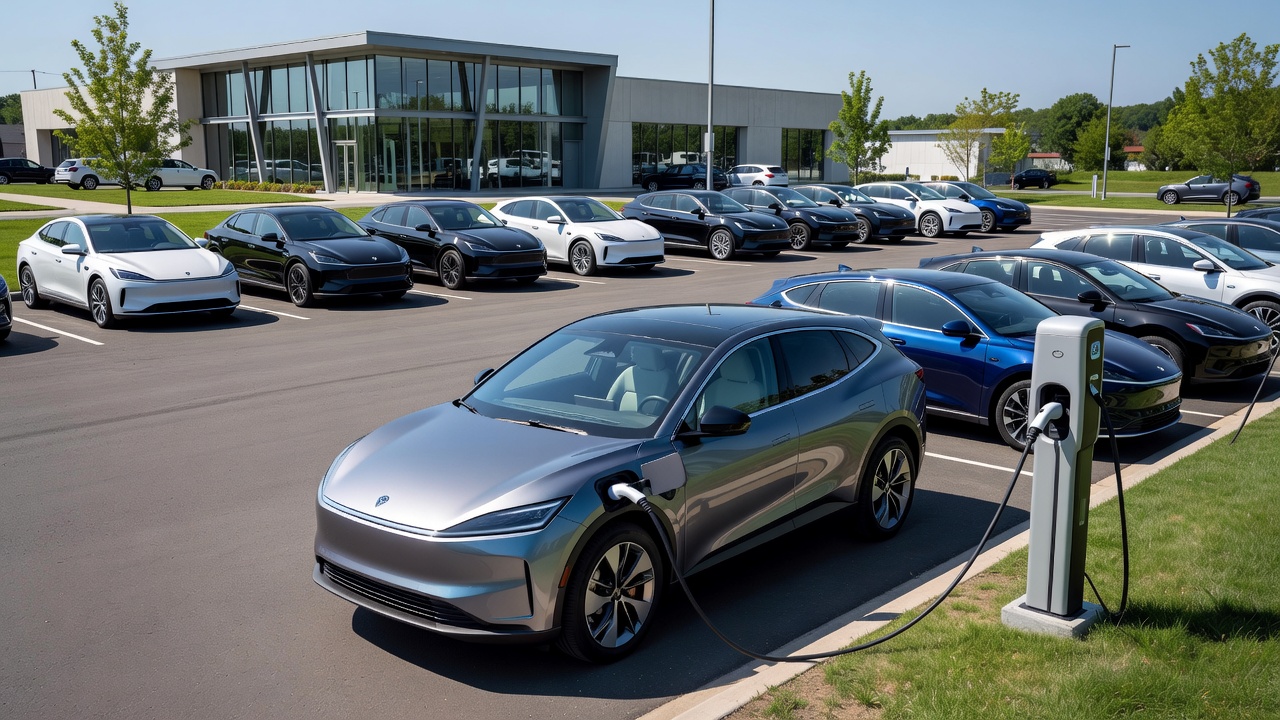
U.S. hybrid electric vehicles reached a record 16% share of new light-duty vehicle sales in the second quarter of 2026, according to an analysis by the U.S. Energy Information Administration (EIA) using market estimates from research firm Omdia -- double the 6% share held by battery electrics in the same period. The more significant number, though, is not the hybrid record but the direction of the battery electric line: battery electric vehicles (BEVs) hit 12% of monthly sales in September 2025, then fell to 6% for the first half of 2026, tracing a cliff edge that maps almost exactly onto the expiration of two federal tax credits. For sustainability professionals and fleet planners, the data marks the first structural reversal in U.S. BEV adoption on record -- and raises a direct question about how much of the electrification story was policy-dependent all along.
What's New
The EIA's Today in Energy analysis shows that the combined share of electrified light-duty vehicles -- including hybrid electric vehicles (HEVs), battery electric vehicles (BEVs), and plug-in hybrid electric vehicles (PHEVs) -- grew from 22% in the second quarter of 2025 to 24% in the second quarter of 2026. On the surface, that is progress. Beneath it, the composition shifted sharply.
HEVs climbed from an implied share near 13% in 2Q25 to a record 16% in 2Q26. BEVs fell from 7% to 6% over the same interval. PHEVs dropped from 1.9% to 1.4%. The combined electrified share grew only because HEV gains outweighed BEV and PHEV losses -- a redistribution, not a net acceleration.
The full-year picture is starker. The EIA confirms that 2025 marked the first year in which annual BEV sales and market share declined in the United States. BEV share for the first half of 2026 held at 6%, down from 7% in the equivalent period of 2025.
How It Works
The divergence between HEVs and BEVs is partly structural, and the tax credit expiration exposed it.
Hybrid electric vehicles run on liquid fuel only. Their electric motor and battery recapture energy during braking and coasting, improving fuel economy, but they never connect to the electrical grid. Because they require no charging infrastructure and carry no range anxiety penalty, their adoption curve is not shaped by the same barriers that BEVs face: the need for home charging equipment, public fast-charger availability, or the upfront cost premium that federal credits were partially offsetting.
HEVs were not eligible for either of the federal tax credits that expired in September 2025. They never benefited from the credit, and they lost nothing when it disappeared. For a buyer who had already priced a hybrid on its own economic merits -- lower fuel costs, no charging dependency, no range planning -- the post-September 2025 market was functionally unchanged.

For BEV and PHEV buyers, the calculus changed immediately. Both vehicle types can draw electricity from the grid, which is what qualified them for the credits. Both saw share declines once the credits lapsed. The data pattern is consistent with a market in which a meaningful portion of BEV and PHEV demand was credit-enabled, not organically driven by unsubsidized economics.
The Economics
Two distinct federal incentives expired simultaneously: the New Clean Vehicle Credit and the Qualified Commercial Clean Vehicle Credit. Both had been established under the Inflation Reduction Act, signed into law by President Joe Biden on August 16, 2022, which authorized energy and climate spending -- the largest such investment in U.S. history.
The credits' effect on purchasing behavior is visible in the monthly sales data. BEV share spiked to a record 12% of light-duty vehicle sales in September 2025 -- the final month before expiration -- a pattern consistent with significant pull-forward purchasing by buyers trying to capture a $7,500 credit before it disappeared. The following months traced the reversal: BEV share fell to 6% for the first six months of 2026.
The Chevy Equinox EV illustrates the exposure. The Equinox EV was positioned as an accessible, credit-eligible entry point for mainstream buyers. After the $7,500 federal credit expired, the post-credit price rose by more than 21% for buyers who had previously qualified for the full credit -- a shift that moves the Equinox EV outside the consideration set for a large segment of cost-sensitive buyers.
- New Clean Vehicle Credit expired: September 30, 2025
- Qualified Commercial Clean Vehicle Credit expired: September 30, 2025
- BEV share peak: 12% in September 2025 (pull-forward effect)
- BEV share in H1 2026: 6%, down from 7% in H1 2025
- Chevy Equinox EV sales decline in H1 2026: 41% year-over-year
- Credit value removed from BEV purchase price: $7,500
Competitive Landscape
The hybrid market's record 16% share in 2Q26 reflects gains that are broad-based across manufacturers, while BEV losses are concentrated where the credits had been doing the most structural work.
Three automakers are positioned as principal winners of the current hybrid expansion:

- Toyota (pioneer and volume leader in HEVs globally) -- the company introduced the original Prius hybrid in 1997 and now sells hybrid models across a wide range of segments. Toyota had long been criticized for its measured approach to all-electric vehicles, a posture that now looks strategically prescient in the U.S. market, with analysts characterizing Toyota as a primary beneficiary of the post-credit hybrid shift.
- Honda (expanding hybrid lineup across segments) -- named alongside Toyota as a direct winner of what analysts are characterizing as the hybrid war, as buyers who had considered BEVs shift toward fuel-efficient conventional options that require no infrastructure changes.
- Hyundai (hybrid and BEV dual-track competitor) -- Hyundai's hybrid line has seen strong growth even as its EV sales also rose, demonstrating that a manufacturer can sustain both lines simultaneously when hybrid economics are strong.
The luxury BEV segment, historically the most resilient corner of the battery-electric market, is now showing strain. BEVs accounted for a significant share of luxury light-duty vehicle sales in 2Q25 and fell in 2Q26 within a segment that makes up 12% of total U.S. light-duty vehicle sales. Luxury buyers had been assumed to be largely insensitive to a $7,500 credit on a vehicle that might cost $80,000 or more. The data challenges that assumption: even at the top of the market, the BEV share is contracting.
Independent analyst commentary specifically on this announcement was not publicly available at publication time.
What's Next
The installed base problem provides context for what the share figures mean over time. Annual sales share figures -- even the 7% BEV share of 2025 -- move the total fleet slowly because the denominator is large and vehicle lifetimes are long. A one-year decline in BEV sales share does not immediately translate to fewer EVs on the road; it compounds gradually if the trend persists.
Whether BEV sales recover depends on several variables. Federal credit reinstatement is the most direct lever: if Congress restores the New Clean Vehicle Credit or an equivalent, the pull-forward pattern seen in September 2025 suggests that credit availability has a measurable and rapid effect on purchase decisions. Automaker pricing responses are a second variable -- manufacturers who can absorb cost reductions or push BEV prices down through manufacturing efficiency may recover share independent of policy. Charging infrastructure expansion is a third factor, operating on a slower timescale: range anxiety and infrastructure access remain barriers the credits did not directly address.
The HEV growth trajectory may continue as long as credits remain lapsed. Hybrids carry no infrastructure dependency, no range limitation, and no upfront cost premium requiring subsidy. Globally, the picture diverges: BloombergNEF projects passenger EV sales reaching tens of millions of units worldwide in 2026, according to its long-range forecasts, suggesting the U.S. deceleration is a domestic policy effect rather than a signal about underlying EV technology demand. China and Europe continue to expand EV adoption under different regulatory frameworks, making the U.S. an increasingly distinct case.
The shift away from grid-connected vehicles also carries an implication for electricity demand. BEVs and PHEVs draw from the grid; HEVs do not. A sustained compositional shift toward non-grid-connected hybrids would reduce the electricity demand growth associated with transportation electrification -- a variable that grid planners and utility investors have been pricing into long-range capacity forecasts.
For the Sustainability Professional
For fleet managers and corporate sustainability teams making vehicle procurement decisions in 2026, the practical implication is direct: a BEV purchased today at list price costs $7,500 more than the same vehicle acquired before October 2025, with no current federal offset. An HEV in the same vehicle class delivers meaningfully better fuel economy than a comparable internal combustion model with no charging infrastructure requirement, and at comparable or lower total cost of ownership for many buyers over a multi-year cycle. Organizations with fleet electrification targets that assumed credit availability need to revisit their per-unit cost models and consider whether a hybrid bridge strategy holds lower transition risk than an accelerated BEV deployment while the credit question remains unresolved in Congress.
The most striking thing about the 2Q26 data is not that hybrids are winning -- it is that the EV market revealed its credit dependency at the exact moment the credits disappeared, and that the luxury segment, which was supposed to be immune, followed the same pattern as the mass market. The credits were load-bearing infrastructure, not a temporary stimulus, and the market has now disclosed that plainly. What the industry does with that disclosure -- whether it reprices, lobbies, or waits -- will define the next phase of the U.S. clean vehicle transition more than any single model launch or battery chemistry breakthrough.
-- Aria Lin, Enterprise Technology Analyst
Sources: CleanTechnica / U.S. Energy Information Administration