IBM Bets $10 Billion on Quantum as Stock Drops 25 PercentIBM Bets $10 Billion on Quantum as Stock Drops 25 PercentIBM Bets $10 Billion on Quantum as Stock Drops 25 PercentIBM Bets $10 Billion on Quantum as Stock Drops 25 Percent
July 15, 2026
IBM's stock fell as much as 25% on July 15, 2026, after the company reported preliminary second-quarter revenue of $17.2 billion, up just 1% year-over-year, with diluted GAAP earnings per share declining 2% to $2.27. In the same investor letter, CEO Arvind Krishna reaffirmed a
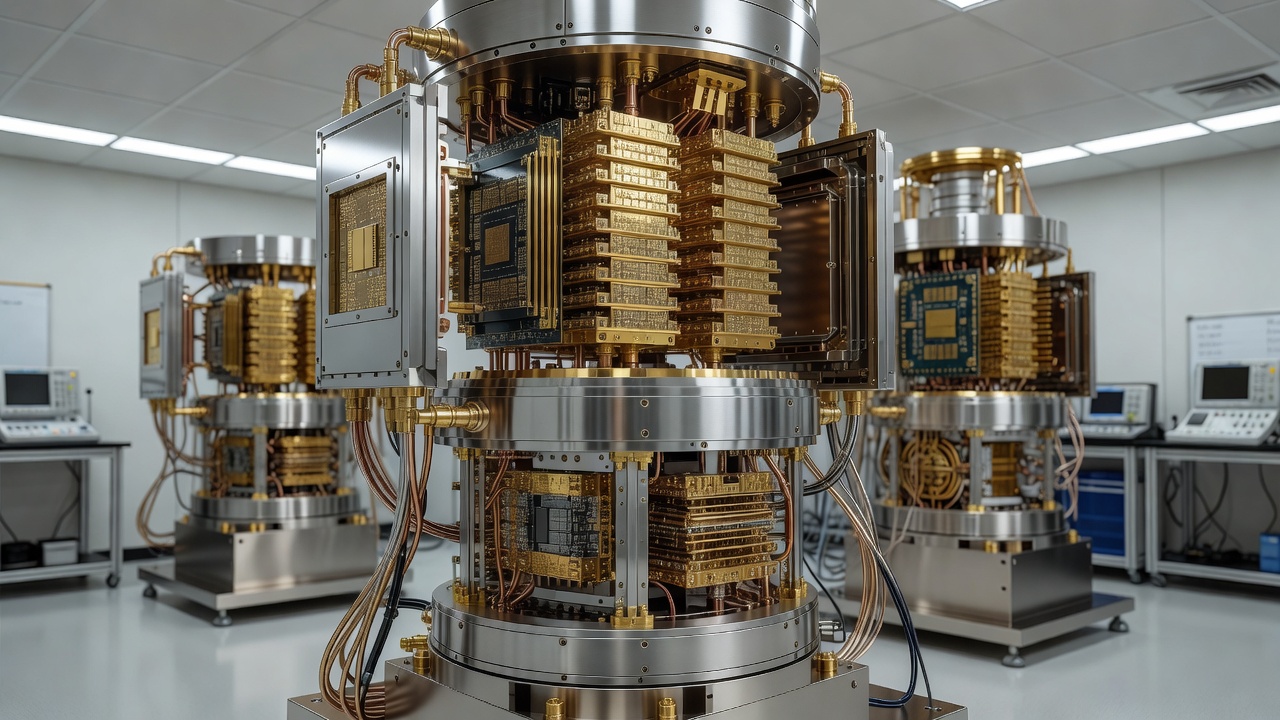
IBM's stock fell as much as 25% on July 15, 2026, after the company reported preliminary second-quarter revenue of $17.2 billion, up just 1% year-over-year, with diluted GAAP earnings per share declining 2% to $2.27. In the same investor letter, CEO Arvind Krishna reaffirmed a $10 billion, five-year investment plan for fault-tolerant quantum computing (systems capable of detecting and correcting computation errors at scale) and declared, "Finally, quantum computing is no longer decades away, it is upon us, and we are investing aggressively." That divergence - a historic single-session stock drop paired with an unreserved long-cycle capital commitment - is the central tension IBM now has to resolve.
The core data points are stark. IBM's consulting revenue was essentially flat. Infrastructure revenue fell 7%. And yet the company announced plans for Anderon, described as "the world's first dedicated quantum wafer foundry," backed by up to $1 billion in proposed CHIPS program incentives and a matching $1 billion in IBM's own cash. The full Q2 earnings call is scheduled for July 22, 2026, where management will face detailed questions about how a company missing revenue targets justifies accelerating capital allocation toward a technology still targeting commercial-scale fault tolerance in 2029.
What Happened
IBM published preliminary second-quarter 2026 financial results on July 15, 2026. The headline number: $17.2 billion in revenue, a 1% increase year-over-year, but short of analyst expectations. The stock responded immediately, falling as much as 25% intraday - an unusually severe single-session decline for a company of IBM's scale.
The segment breakdown explains where the pressure concentrated. Software revenue increased 5%, driven in part by contributions from recent acquisitions HashiCorp and Confluent. Consulting revenue was essentially flat. Infrastructure revenue declined 7%, though IBM noted that its distributed infrastructure sub-segment, covering Power systems and storage, delivered its strongest reported performance, rising 37% even as the broader infrastructure segment contracted.
IBM attributed the shortfall to four compounding factors:
- Weaker-than-expected performance in the Z mainframe business and related software
- Customers shifting late-quarter spending to servers, storage, and memory ahead of anticipated price increases from supply constraints
- Cybersecurity concerns delaying purchasing decisions across enterprise accounts
- Large customer deals that failed to close on expected timelines
Krishna's investor letter acknowledged the miss and reiterated IBM's $10 billion quantum investment commitment, originally announced June 2, 2026, without modification. IBM expects to provide complete second-quarter financial results during its scheduled earnings call on July 22, 2026.
The Technical Breakthrough
The commercial anchor of IBM's quantum push is a 2029 target delivery date for the company's first large-scale fault-tolerant quantum computer (a system capable of detecting and correcting errors that naturally occur during quantum calculations, a capability considered necessary before quantum computers can reliably solve commercially valuable problems). That target has not changed despite the quarterly miss, and Krishna's letter placed it at the center of the investment case.
The $10 billion commitment spans five years and covers research and development, manufacturing capacity, capital expenditures, acquisitions, and ecosystem expansion. The most concrete near-term commitment within that envelope is Anderon, a proposed quantum wafer foundry that IBM describes as "the world's first dedicated quantum wafer foundry" - a manufacturing facility purpose-built exclusively for quantum chip production rather than adapted from conventional semiconductor lines.
Anderon is backed by a letter of intent with the U.S. Department of Commerce under the CHIPS and Science Act, signed into law on August 9, 2022, which authorized roughly $280 billion in new funding including $52.7 billion for domestic semiconductor research and manufacturing. IBM's proposed CHIPS program incentive for Anderon is up to $1 billion, subject to confirmation, alongside $1 billion of IBM's own cash.
Quantum error correction (the set of protocols that protect quantum information from decoherence and other sources of quantum noise) is the underlying technical problem that makes a purpose-built foundry commercially significant. A logical qubit (an error-corrected quantum bit assembled from multiple physical qubits) requires dedicated manufacturing tolerances that conventional semiconductor fabs are not optimized to deliver. IBM's bet is that a facility designed from the ground up for quantum wafer production accelerates the path to the 2029 milestone.
Why It Matters for Industry
Alongside the quantum announcement, IBM used the July 15 investor letter to spotlight Lightwell, a cybersecurity and open-source software vulnerability initiative with general availability announced on July 8, 2026. IBM has committed $5 billion and more than 20,000 engineers to the program, which targets open-source software vulnerability identification and management for enterprise customers.
Lightwell's early adopter list is notable for its concentration in financial services: Bank of America, BNY, Citi, Goldman Sachs, JPMorganChase, Mastercard, Morgan Stanley, Royal Bank of Canada, State Street, Visa, and Wells Fargo - 11 major institutions across global banking, payments, and custody. That roster signals demand from precisely the category of enterprise buyer that IBM's consulting and software segments depend on, even as consulting revenue came in flat for the quarter.
The Anderon foundry carries distinct implications for the domestic semiconductor supply chain. The CHIPS and Science Act had by March 2024 incentivized between 25 and 50 separate projects with projected investments of $160 to $200 billion and 25,000 to 45,000 new jobs across conventional semiconductor manufacturing. A dedicated quantum wafer foundry, if built and operational, would represent a category of manufacturing capability not currently available in the United States at commercial scale.
The $5 billion Lightwell commitment and the $10 billion quantum investment together represent $15 billion in announced long-cycle capital allocation, made public on the same day IBM's stock fell 25% on a near-term revenue miss. For enterprise procurement teams, the question is whether that capital strengthens IBM's competitive position in software and security, or reflects strategic overextension during a period of consulting and infrastructure weakness.
Competitive Landscape
No directly comparable commercial peers were publicly identifiable at publication time in quantum computing manufacturing. Independent analyst commentary on this announcement was also not publicly available at publication time.
Within IBM's own business, the picture is more differentiated than the headline revenue miss suggests. Red Hat revenue accelerated to 11% growth in Q2 2026. The distributed infrastructure sub-segment rose 37%. Software revenue overall increased 5%, with HashiCorp and Confluent named as acquisition contributions. The pressured segments are consulting (flat) and legacy infrastructure (down 7% overall), while IBM's software-oriented and open-source-adjacent businesses are growing - the base from which the $10 billion quantum bet is being made.
The Bigger Picture
IBM has operated through technology cycles longer than most computing companies have existed. Founded in 1911, the company has repeatedly made decade-long capital commitments to infrastructure bets that were not legible to quarterly earnings models when announced. The $10 billion quantum investment, covering five years from a June 2, 2026 announcement to roughly 2031, follows that historical pattern.
The CHIPS and Science Act provides federal policy validation for that pattern. By designating quantum computing as a national priority and authorizing $174 billion in public sector research covering quantum computing, spaceflight, materials science, biotechnology, and experimental physics, the federal government has signaled that it views quantum manufacturing capacity as a strategic asset. IBM's letter of intent with the Department of Commerce for Anderon converts that policy signal into a specific capital allocation.
The 25% intraday stock drop on July 15 represents a different time horizon from the 2029 fault-tolerant quantum target. Equity markets pricing near-term earnings trajectories are not the right instrument to evaluate whether a $10 billion bet on fault-tolerant quantum computing will generate returns over five to ten years. IBM's consulting and mainframe businesses need to stabilize for the company to sustain that capital allocation - but near-term execution challenges do not themselves invalidate the long-cycle investment thesis, and the July 22 earnings call will not be the last word on either.
What's Next
IBM's complete Q2 2026 earnings call, scheduled for July 22, 2026, is the nearest-term data point for investors and enterprise buyers. That call will provide a fuller accounting of segment performance beyond the preliminary figures released on July 15, and is expected to include guidance for the remainder of 2026. Analysts will likely press management on the relationship between near-term consulting headwinds and the pace of quantum capital allocation, and on whether the proposed CHIPS incentive for Anderon has cleared required procedural steps.
Lightwell's rollout across its 11 named financial institution early adopters will serve as a near-term signal of IBM's ability to convert a major software commitment into revenue. With consulting revenue flat in Q2 and cybersecurity concerns cited as a factor in delayed purchasing decisions, Lightwell's performance in H2 2026 is a direct test of whether a $5 billion commitment to open-source vulnerability management can generate the enterprise software momentum that IBM's consulting segment currently lacks.
For enterprise IT decision-makers evaluating IBM as a strategic vendor: the relevant planning unit here is not this quarter's consulting contract but the 2029 horizon. If IBM delivers a commercially viable fault-tolerant quantum system on schedule, enterprise buyers who have built integration pathways and developer familiarity now will have a material advantage over those who wait. The Lightwell early-adopter roster - 11 of the largest financial institutions in the world - suggests that the organizations best positioned to evaluate that bet have already started placing it. The practical question for procurement teams is whether your organization's quantum readiness planning is aligned with a 2029 delivery window, or whether it is still treating quantum as a 2035-plus phenomenon.
The most striking thing about July 15, 2026 is not that IBM's stock fell 25%. It is that IBM chose that same day to reaffirm, without modification, a $10 billion quantum commitment and announce a purpose-built wafer foundry backed by federal CHIPS funding. That is either strategic conviction rare in corporate communications, or a sign that IBM's long-cycle bets and its near-term execution are operating on parallel tracks that have not yet been reconciled. The 2029 delivery date will settle it.
-- Aria Lin, Enterprise Technology Analyst
Sources: The Quantum Insider · MIT Quantum Information Review 2025