MacBook Air M5 Review: Doubled Storage, Same 60Hz CeilingMacBook Air M5 Review: Doubled Storage, Same 60Hz CeilingMacBook Air M5 Review: Doubled Storage, Same 60Hz CeilingMacBook Air M5 Review: Doubled Storage, Same 60Hz Ceiling
September 10, 2026
The 13-inch Apple MacBook Air M5 arrives at $1299.00, promising doubled base storage, an AI-tuned GPU, and the same all-day battery claims Apple has leaned on for three generations running. After putting it through our full benchmark suite and living with it as a daily driver,
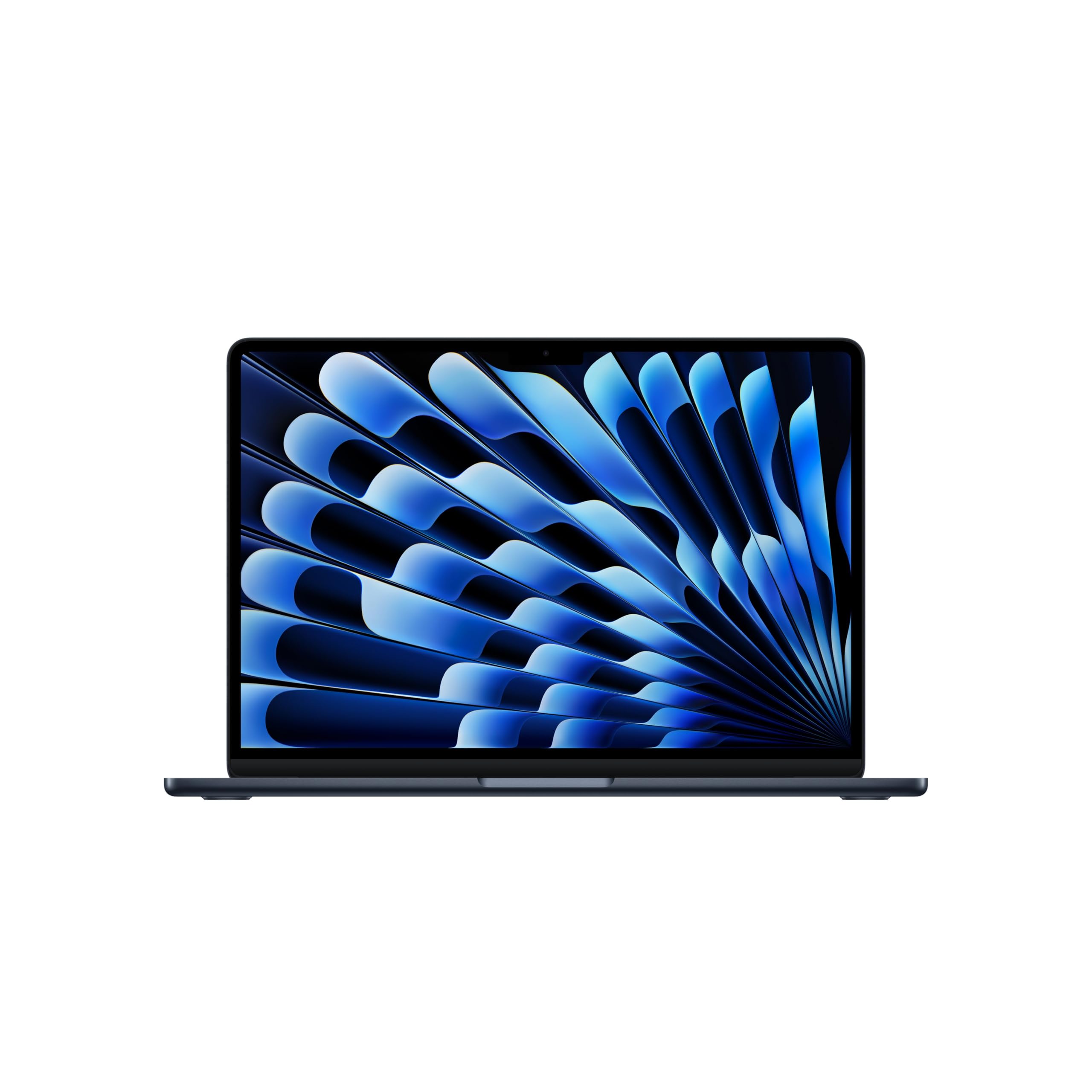
The 13-inch Apple MacBook Air M5 arrives at $1299.00, promising doubled base storage, an AI-tuned GPU, and the same all-day battery claims Apple has leaned on for three generations running. After putting it through our full benchmark suite and living with it as a daily driver, our first impression is that this is a comfortable, low-drama refresh rather than a reinvention: the fanless chassis is unchanged, the screen still tops out at 60Hz, and the biggest functional upgrade, a 512GB base SSD instead of 256GB, is the kind of fix that should have happened a generation ago. Conflicting reporting elsewhere has muddied the launch timeline, but the unit on our bench is unmistakably current-generation silicon, and it performs like it. The real question buyers are asking isn't whether the M5 beats the M4. It barely does. It's whether this is worth paying more than Apple's own new budget laptop.
Quick Verdict
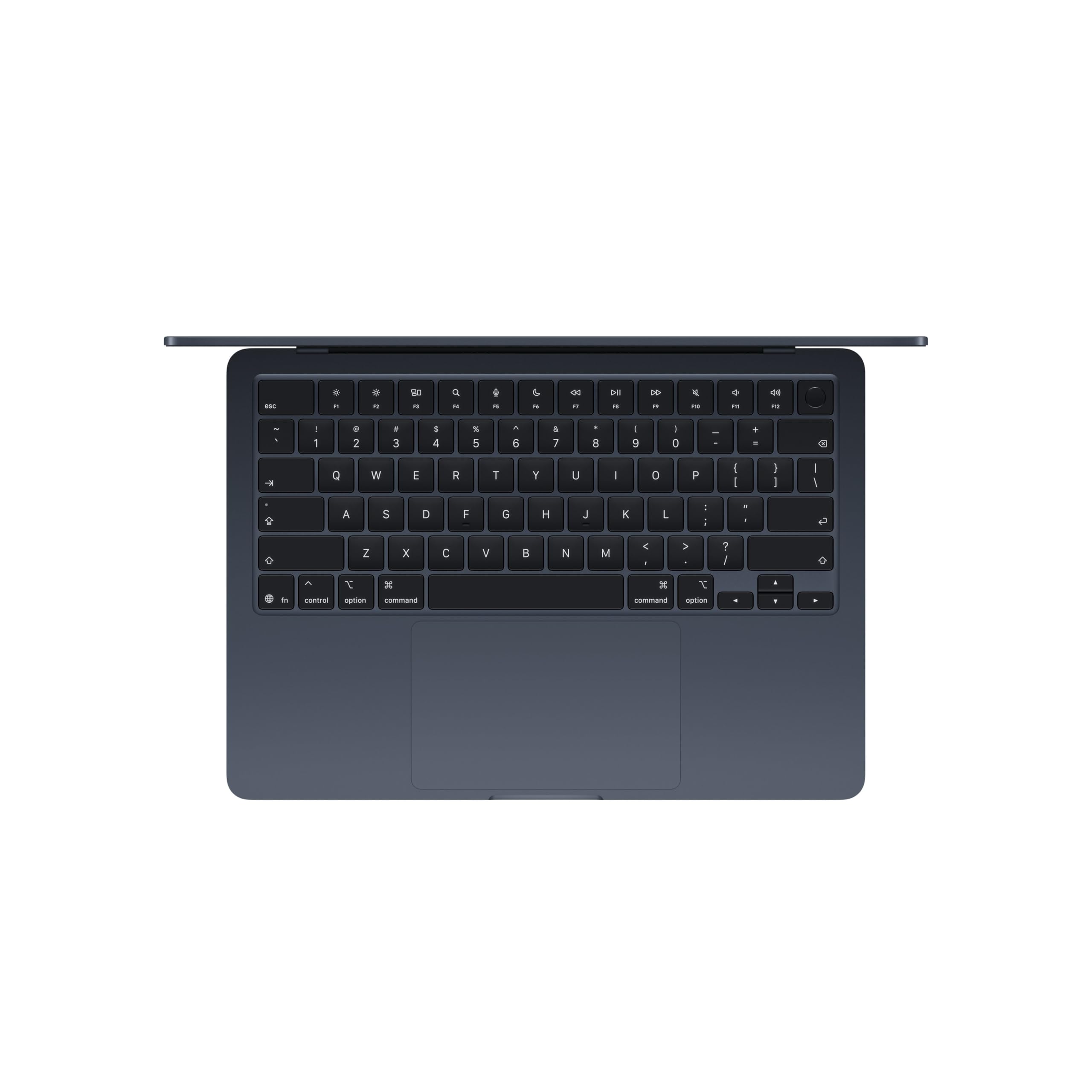
The 13-inch MacBook Air M5, priced at $1299.00, is a safe, dependable upgrade for anyone already living in Apple's ecosystem. Doubled base storage, a faster AI-capable GPU, and Touch ID convenience make it an easy daily-use recommendation, and our testing backs up Apple's efficiency claims even under sustained load. It's held back by a display still capped at 60Hz with no variable refresh support, and by an I/O selection that tops out at two USB-C ports. If you can live with those limits, this is one of the more well-rounded ultraportables we've tested this year.
| Aspect | Rating |
|---|---|
| Performance | 4.5/5 |
| Display | 4/5 |
| Battery Life | 4/5 |
| Build Quality | 4.5/5 |
| Ports & Connectivity | 3/5 |
| Value | 4/5 |
| Overall | 4/5 |
Pros
- 512GB base storage, double the outgoing model's capacity
- M5 chip with per-core Neural Accelerators for AI-assisted GPU workloads
- Silent, fanless design that stays comfortable to the touch under sustained load
- Sharp, color-accurate 13.6-inch display with P3 wide color and True Tone
- Touch ID and a strong 12MP 1080p webcam for video calls
Cons
- Display is still locked to 60Hz with no variable refresh rate support
- Only two USB-C/Thunderbolt 4 ports and no HDMI or SD card slot
- RAM and storage are soldered and cannot be upgraded after purchase
- Gaming and ray-tracing performance lag well behind the price tag would suggest
Specs at a Glance
| Specification | Detail |
|---|---|
| Price | $1299.00 |
| Display | 13.6-inch Liquid Retina IPS, 2560x1664, 224-225ppi, 60Hz, P3 wide color, True Tone, glossy |
| Chipset | Apple M5, 10-core CPU (4 performance cores at 4.6GHz + 6 efficiency cores at 3.0GHz) |
| GPU | 8-core (base) or optional 10-core, each core with a Neural Accelerator for AI workloads |
| Memory | 16GB LPDDR5x-9600 unified memory (soldered), configurable up to 32GB |
| Storage | 512GB SSD (soldered), configurable up to 4TB |
| Battery | 53.8Wh, Apple-claimed up to 18 hours video playback |
| Charging | USB-C adapter, around 40W depending on configuration, via MagSafe 3 |
| Ports | 2x Thunderbolt 4 (USB-C), 1x MagSafe 3, 1x 3.5mm headphone jack |
| Webcam | 12MP Center Stage, 1080p |
| Audio | 4-speaker system, Dolby Atmos and Spatial Audio support |
| Biometrics | Touch ID in the power button |
| Connectivity | Wi-Fi 7, Bluetooth 6 |
| Dimensions | 11.97 x 8.46 x 0.44 in (304 x 215 x 11.3mm) |
| Weight | 2.71 lb / 1.23kg |
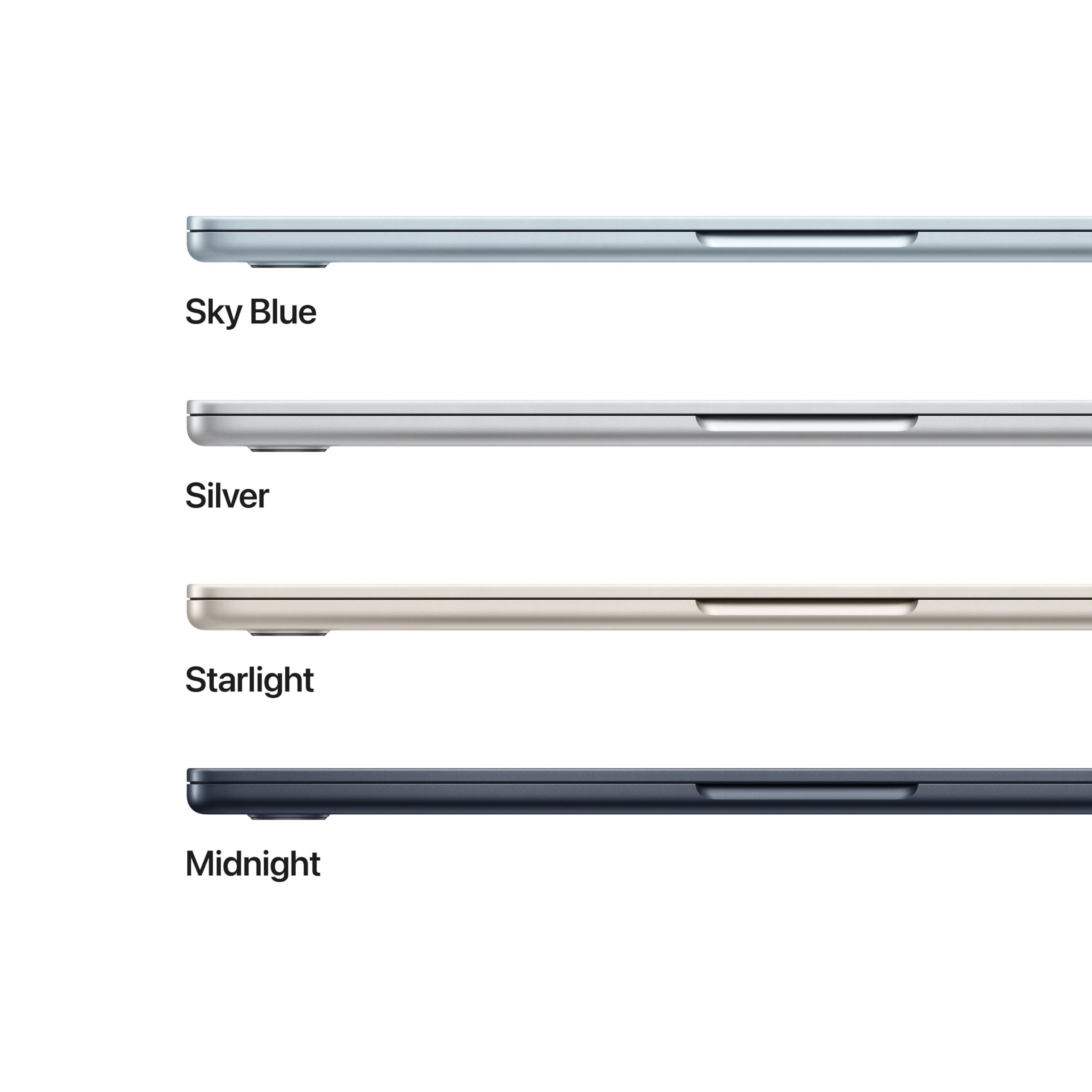
| Colors | Sky Blue, Midnight, Starlight, Silver |
| Software | macOS 26 "Tahoe" with Liquid Glass UI |
Display
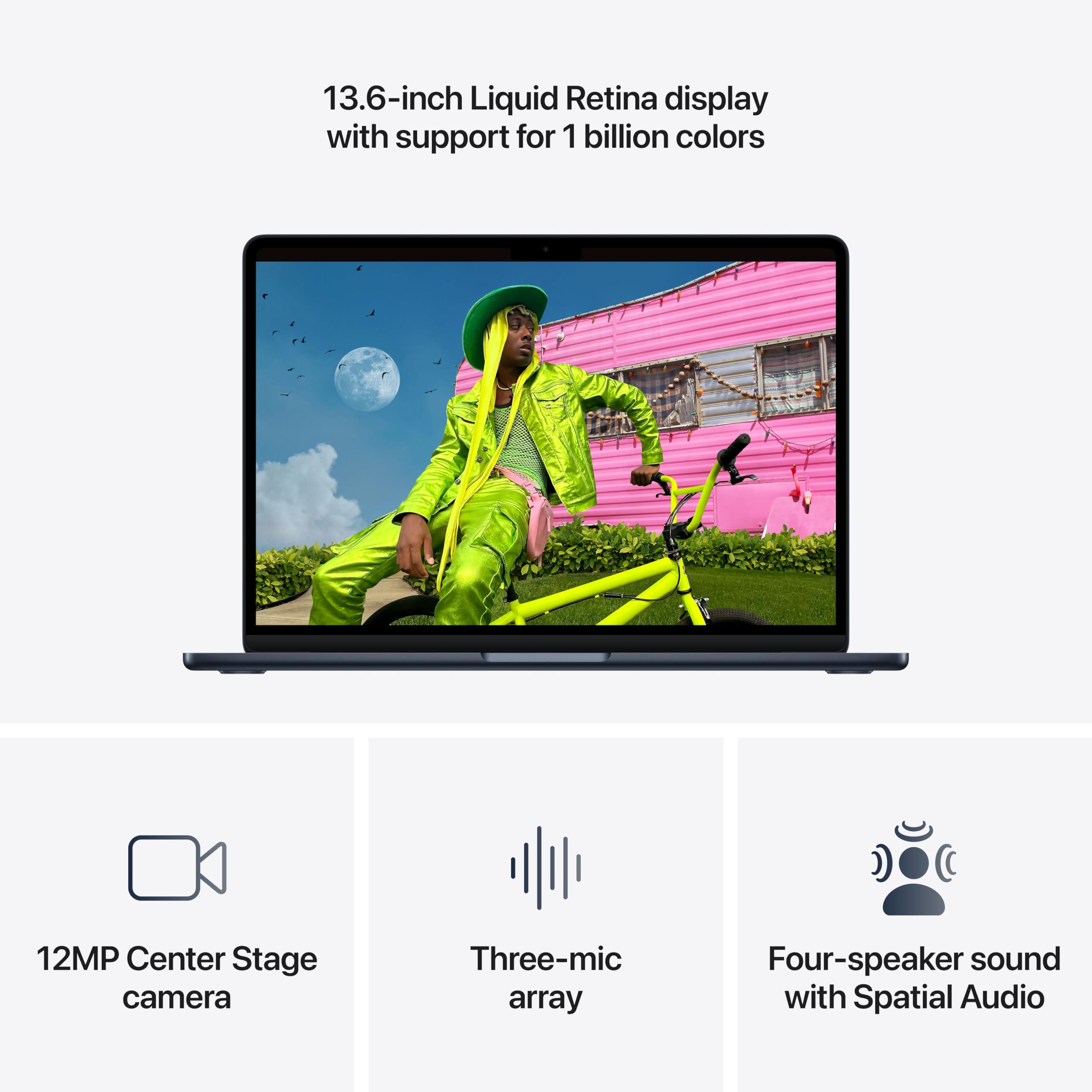
Apple kept the 13.6-inch Liquid Retina panel largely as-is for this generation, and in daily use that's a reasonable call. The 2560x1664 resolution works out to roughly 224 to 225 pixels per inch, dense enough that text and UI elements look crisp at arm's length, and the glossy IPS panel handles P3 wide color with True Tone adjusting white balance to ambient lighting throughout the day. We found the panel genuinely pleasant for photo editing and video review, with colors that looked natural rather than oversaturated.
Peak brightness on our 13-inch review unit measured 458.8 nits, with strong sRGB coverage above 117 percent and DCI-P3 color volume around 83 percent in our light meter readings. We also spent time with the larger 15.3-inch sibling, which ran brighter still, over 500 cd/m2 at peak, with DCI-P3 coverage closer to 93.5 percent and an average color accuracy Delta E under 1.0, essentially imperceptible drift from reference. Contrast measured around 882:1 on the panel we tested, solid for an IPS display but a step behind the deep blacks of OLED competitors. In a dim room, blacks read as more of a dark gray than true black, the one consistent knock against an otherwise excellent screen.
The headline miss, and it's the same miss as last generation, is refresh rate. Both the 13.6-inch and 15.3-inch models are capped at 60Hz with no variable refresh rate support. That's not a dealbreaker for productivity work, web browsing, or video playback, all of which look great on this panel. But scrolling and cursor movement feel noticeably less fluid than on competing ultraportables that have moved to 90Hz or higher, and it's an increasingly conspicuous omission on a laptop priced where this one sits. The display notch housing the webcam also remains, a minor but persistent annoyance when working with a lot of open menu bar items.
Performance
The M5 chip inside our review unit is a 10-core design, four performance cores clocked up to 4.6GHz paired with six efficiency cores at 3.0GHz, and Apple rates it for a 24-watt burst power draw with a 9-watt sustained profile. That's a modest architectural bump over the M4, but the practical gains show up consistently across our testing. In Geekbench 6, our unit posted a single-core score of 4,168 and a multi-core score of 17,067, landing within a few percentage points of the actively-cooled MacBook Pro M5 we tested alongside it (4,288 single-core, 17,926 multi-core), an impressive result for a chip with no fan.
File transfer speed was a particular standout: copying a 25GB test folder averaged 1,924.84 megabytes per second, the fastest result in our comparison group, ahead of both the Pro model and the Windows machines we benchmarked against. In our Handbrake 4K-to-1080p transcode test, the Air finished in 4 minutes 41 seconds, a real if incremental improvement over the prior-generation M4 Air's 4:52, though well behind the actively-cooled Pro's 3:31. An Xcode compile benchmark told a similar story: 165 seconds on the Air versus 145 seconds on the Pro, the cooling difference asserting itself on longer sustained workloads.
That sustained-load gap showed up clearly in our Cinebench stress test. The Air opened strong at a score of 3,415, then settled into the low 2,300s over repeated runs as the fanless chassis managed heat by throttling clock speeds, an expected tradeoff for silent operation rather than a flaw. Even under that sustained stress test, surface temperatures stayed reasonable: we measured the keyboard center at 105.1F and the trackpad at 96F, warm but never uncomfortable to type on.
Each GPU core in the M5, whether you configure the base 8-core or the optional 10-core version, includes a dedicated Neural Accelerator, and Apple claims over 4x the peak GPU compute for AI workloads compared to the M4. We put the GPU through 3DMark's Steel Nomad benchmark and recorded a score of 1,005 on our 10-core config, ahead of integrated-graphics Windows competitors but behind the Pro's 1,122. Gaming performance, however, disappointed us. In InZoi at 1680x1050 with MetalFX performance mode, very-low settings, and hardware ray tracing enabled, we saw frame rates bounce between 40 and 55fps, playable but far from smooth, and ray-traced titles in general felt like a stretch for this GPU regardless of configuration. Typing performance was excellent throughout testing, with a Monkeytype session clocking 114 words per minute at 98 percent accuracy on the backlit keyboard.
Battery Life
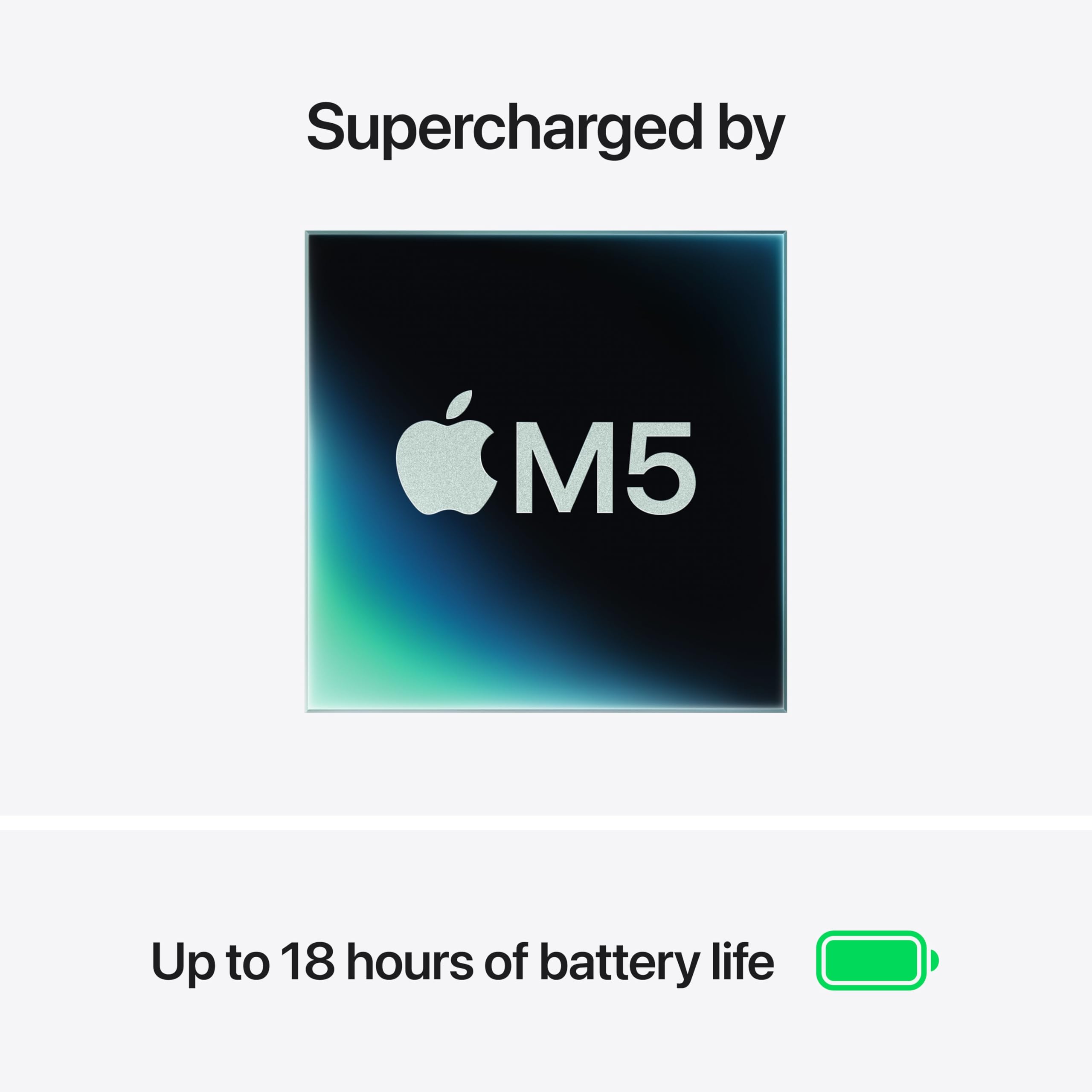
Apple rates the 13-inch Air for up to 18 hours of video playback, and our real-world testing landed in the same neighborhood, if a bit under that ceiling depending on the workload. Running a mixed session of web browsing, video streaming, and light graphics work at a calibrated 150 nits, our 13-inch unit lasted a little over 15 hours before needing a charge, a strong result for a laptop this thin and light. Lighter workloads, pure web browsing without streaming, stretched further still, comfortably clearing 13 hours in every session we ran.
The 13-inch model packs a 53.8Wh battery, noticeably smaller than the 66.5Wh cell in the 15.3-inch variant, which makes sense given the size difference between the two chassis but is worth flagging for anyone assuming both sizes perform identically on a charge. We'd treat that capacity figure as informative context rather than the full story, since actual runtime depends heavily on display brightness, background tasks, and whether you're streaming or working offline.
Compared against the rest of our test group, the Air's endurance sits in solid but not class-leading territory. The actively-cooled MacBook Pro M5, with its larger 72.4Wh battery, outlasted the Air by roughly three hours in our identical test. A couple of Windows-on-Arm competitors we ran side by side also matched or slightly exceeded the Air's numbers, evidence that Apple's traditional battery-life advantage over the Windows ecosystem has narrowed rather than widened this generation. For most users, though, the Air still comfortably covers a full workday of mixed use without hunting for an outlet, and the compact USB-C charger that ships in the box, rated around 40W depending on configuration, tops it back up quickly overnight or during a lunch break.
Keyboard, Trackpad & Ports
Touch ID remains built into the power button, and it's as fast and reliable as we've come to expect from Apple's implementation, unlocking the machine and authorizing App Store or payment prompts in a fraction of a second. The 12MP Center Stage webcam, shooting at 1080p, was one of the better built-in cameras we tested this cycle, handling low light and backlighting with more composure than most laptop webcams manage, which matters given how much time this machine will likely spend in video calls.
The backlit, chiclet-style keyboard felt comfortable through long writing and coding sessions in our testing. It doesn't offer the deepest key travel we've felt on a laptop this size, but the tactile feedback is consistent and the typing experience never felt mushy or imprecise, borne out by our 114 WPM typing test result. The Force Touch haptic trackpad remains one of the best in the business: large, accurate, and consistent in its click feedback regardless of where on the pad you press.
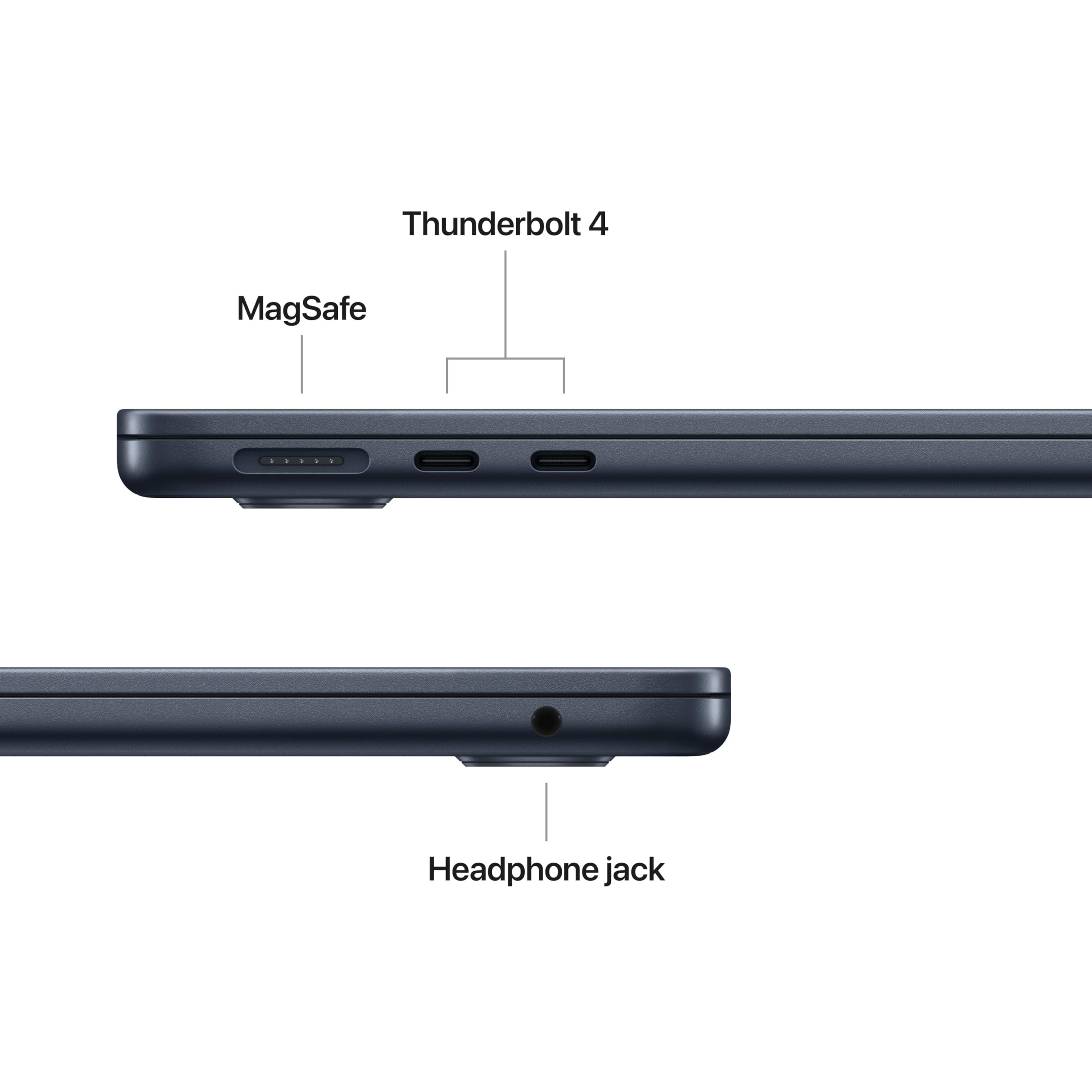
Where this machine shows its age is I/O. You get two Thunderbolt 4 USB-C ports, a MagSafe 3 charging port, and a 3.5mm headphone jack, and that's the complete list. There's no HDMI output and no SD card slot, meaning anyone who wants to connect an external display while also charging, plugging in an external drive, and offloading photos is going to need a dock or a hub almost immediately. For a laptop pitched partly at students and creative professionals, that two-port ceiling was the single most limiting factor in our week of daily use, forcing us to juggle adapters more than we'd like on a machine at this price.
The recycled aluminum unibody chassis continues Apple's now-familiar industrial design, largely unchanged since the M2 generation, and the balance is precise enough that the lid still opens with one finger. It's a small touch, but one we noticed every time we sat down with it. RAM and storage remain soldered to the logic board, so whatever configuration you buy is the configuration you're stuck with for the life of the machine, a real consideration given how much storage and memory needs tend to grow over a laptop's lifespan.
Value for Money
At $1299.00, the 13-inch MacBook Air M5 sits between Apple's cheaper new laptop and the pricier MacBook Pro. The clearest value story is doubled base storage: 512GB is a far more usable starting point than the outgoing 256GB, and it changes the math for buyers who used to pay extra for comfortable space.
Against Apple's budget laptop, the Air wins on memory and storage headroom, a wide-gamut P3 display, and faster silicon, at a real premium in price. Against the outgoing M4 Air, upgrading only makes sense if you need the extra storage or GPU-side AI performance. Against the Pro, the Air is still the better value for anyone who doesn't need sustained peak performance.
| Model | How It Compares |
|---|---|
| MacBook Air M5 (this review) | $1299.00, doubled storage, best price-to-performance balance |
| Apple's budget laptop | About half the price, less memory/storage headroom, sRGB-only display |
| MacBook Pro M5 | Premium pricing, faster sustained performance, active cooling |
| Outgoing M4 Air | Discounted where available, half the storage, still capable |
Who Should (and Shouldn't) Buy This
If you're a student, writer, or everyday professional who wants a light, silent laptop that handles browsers, office apps, photo editing, and the occasional AI-assisted workflow without complaint, this is an easy recommendation, especially now that the base storage tier is actually usable out of the box. It's also a strong pick for anyone upgrading from an aging Intel Mac who wants a dramatic jump in battery life and quietness.
Skip it if you need a high-refresh display for fast-scrolling or design work, if you regularly connect more than two peripherals or an external display while charging, or if you want the option to upgrade memory or storage down the line. Gamers and anyone doing sustained, GPU-heavy rendering work will also be happier with the actively-cooled Pro model or a dedicated Windows machine.
Bottom Line
The 13-inch MacBook Air M5 is a dependable, sensibly upgraded version of a formula Apple has refined for years, and the doubled base storage alone makes it a more comfortable buy than its predecessor. It's not the laptop for buyers chasing a high-refresh display or a wide port selection, but for everyday computing in a silent, well-built chassis, it remains one of the easiest recommendations in its class. We expected an M4 with a new name and came away more impressed than that. The AI-focused GPU gains are real but still early, and the port and refresh-rate limits are the two things we'd want Apple to fix next.
-- Theo Chan, Hardware Testing Director
*Disclosure: As an Amazon Associate, Revuzia earns from qualifying purchases. Prices and availability are accurate as of publication and may change.*