MAVEN's Silent-Spacecraft Data Reveals a Solar Wind Effect Never Seen in a Planet's AtmosphereMAVEN's Silent-Spacecraft Data Reveals a Solar Wind Effect Never Seen in a Planet's AtmosphereMAVEN's Silent-Spacecraft Data Reveals a Solar Wind Effect Never Seen in a Planet's AtmosphereMAVEN's Silent-Spacecraft Data Reveals a Solar Wind Effect Never Seen in a Planet's Atmosphere
May 26, 2026
A solar wind effect that physicists had never detected inside any planetary atmosphere turned up in a data set collected by MAVEN two years before the spacecraft went silent. The finding, published May 18, 2026, in Natur...
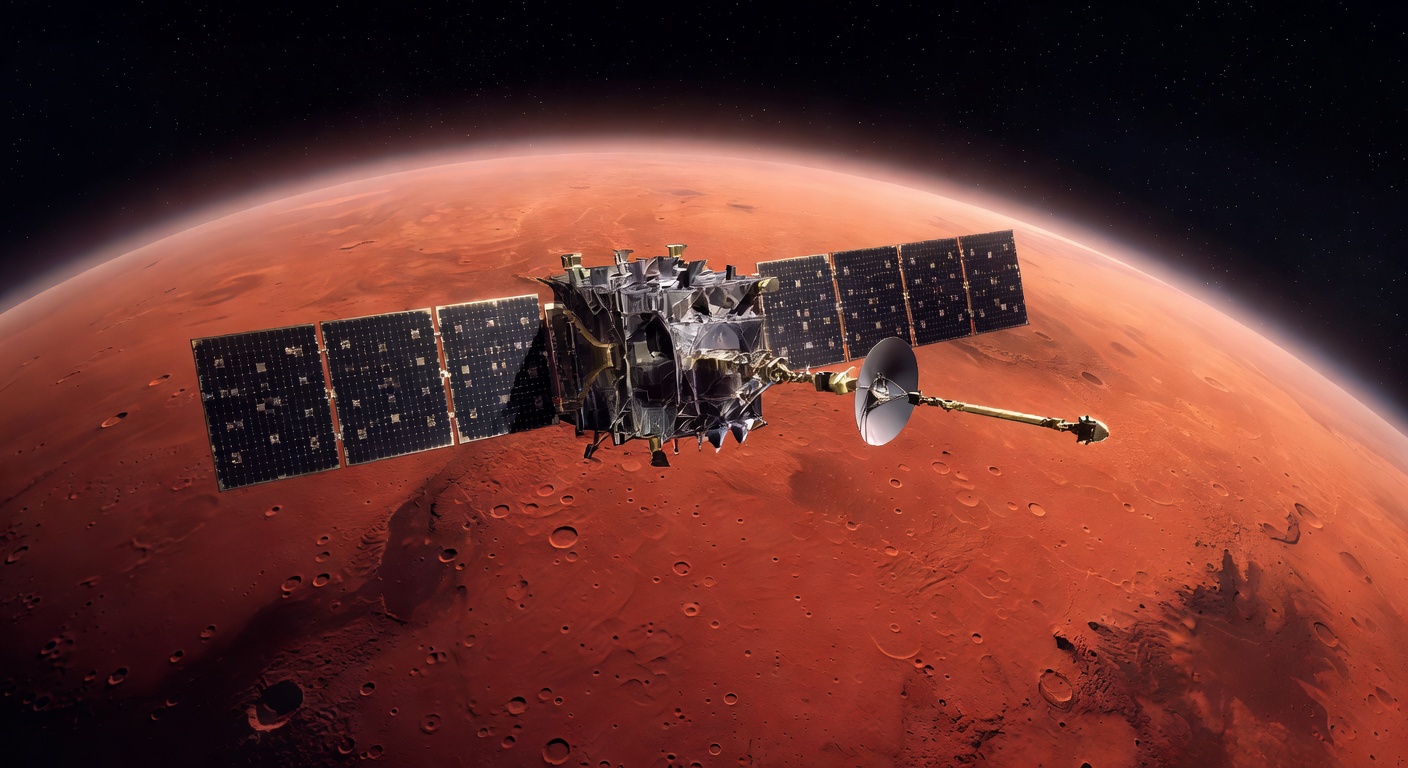
A solar wind effect that physicists had never detected inside any planetary atmosphere turned up in a data set collected by MAVEN two years before the spacecraft went silent. The finding, published May 18, 2026, in Nature Communications, identifies the Zwan-Wolf effect operating in the upper atmosphere of Mars, a planet that lost its global magnetic field billions of years ago and has no conventional magnetosphere to speak of. That gap between what the physics said was possible and what the data actually showed is exactly what makes the result consequential: if this effect can operate at Mars, it almost certainly operates at Venus, at Saturn's moon Titan, and at every other weakly magnetized world we have yet to study in detail.
What Happened
In December 2023, a powerful solar storm struck Mars. MAVEN, which had been stationed in Martian orbit studying the planet's atmosphere since 2014, recorded conditions during and after the impact. Roughly 12 hours after the storm hit, instruments detected unusual fluctuations in the planet's upper atmosphere that did not match the expected post-storm behavior.
Christopher Fowler, a professor at West Virginia University who led the subsequent analysis, described his reaction when the anomaly surfaced in the data set: "When investigating the data, I all of a sudden noticed some very interesting wiggles. I would never have guessed it would be this effect, since it's never been seen in a planetary atmosphere before."
The wiggles, as Fowler put it, were the signature of the Zwan-Wolf effect, a specific mode of solar wind deflection. The study identifying that signature was published in Nature Communications on May 18, 2026. What makes the timing notable is that MAVEN itself fell silent in December 2025, following a planned communications pause during solar conjunction, and has not re-established contact since. The data that produced the result was sitting in researchers' hands before the spacecraft stopped transmitting.
The Science Behind It
The Zwan-Wolf effect describes a process in which the solar wind, a stream of charged particles flowing outward from the Sun's corona at speeds between 250 and 750 kilometers per second, is deflected and compressed through interaction with a planet's magnetic environment. Before the MAVEN finding, the effect had been documented only around strongly magnetized planets, places like Earth, where a robust, field-generated magnetosphere provides the structural conditions the effect was assumed to require.
Mars is a fundamentally different environment. The planet lost most of its global magnetic field billions of years ago. What it has instead is an induced magnetosphere: a magnetic environment created not by the planet's interior but by the direct interaction of the solar wind with its thin upper atmosphere. That environment is far weaker and more variable than the magnetospheres of Earth or the gas giants.
The December 2023 solar storm changed the local conditions enough to push the effect above the detection threshold of MAVEN's instruments. The storm created temporary magnetic structures in the upper atmosphere, and charged particles were funneled and compressed along those structures in a pattern the study authors compared to "toothpaste coming out of a tube." That compression and channeling is the observable fingerprint of the Zwan-Wolf effect.
The study authors note that the effect is not a one-time storm phenomenon: "The effect likely operates continuously at Mars, but below instrumentation detection thresholds most of the time." The December 2023 event amplified it to the point where it became visible. Fowler framed the significance this way: "No one expected that this effect could even occur in the atmosphere. That's what makes this even more exciting."
The core physics the finding introduces:
- Solar wind deflection via the Zwan-Wolf mechanism does not require a planet-scale, field-generated magnetosphere.
- Induced magnetospheres, produced by atmospheric interaction alone, can support the same deflection dynamics under sufficiently energetic solar conditions.
- The effect is likely a persistent, low-level feature of the Martian atmospheric environment, not an artifact of storm conditions.
- Venus and Titan, both weakly magnetized bodies with substantial atmospheres, are explicitly identified in the study as candidates where the same dynamics may operate.
Fowler described the broader implication in direct terms: the discovery "introduces interesting physics that we haven't yet explored and a new way the sun and space weather can change the dynamics in the Martian atmosphere."
Why This Mission Matters
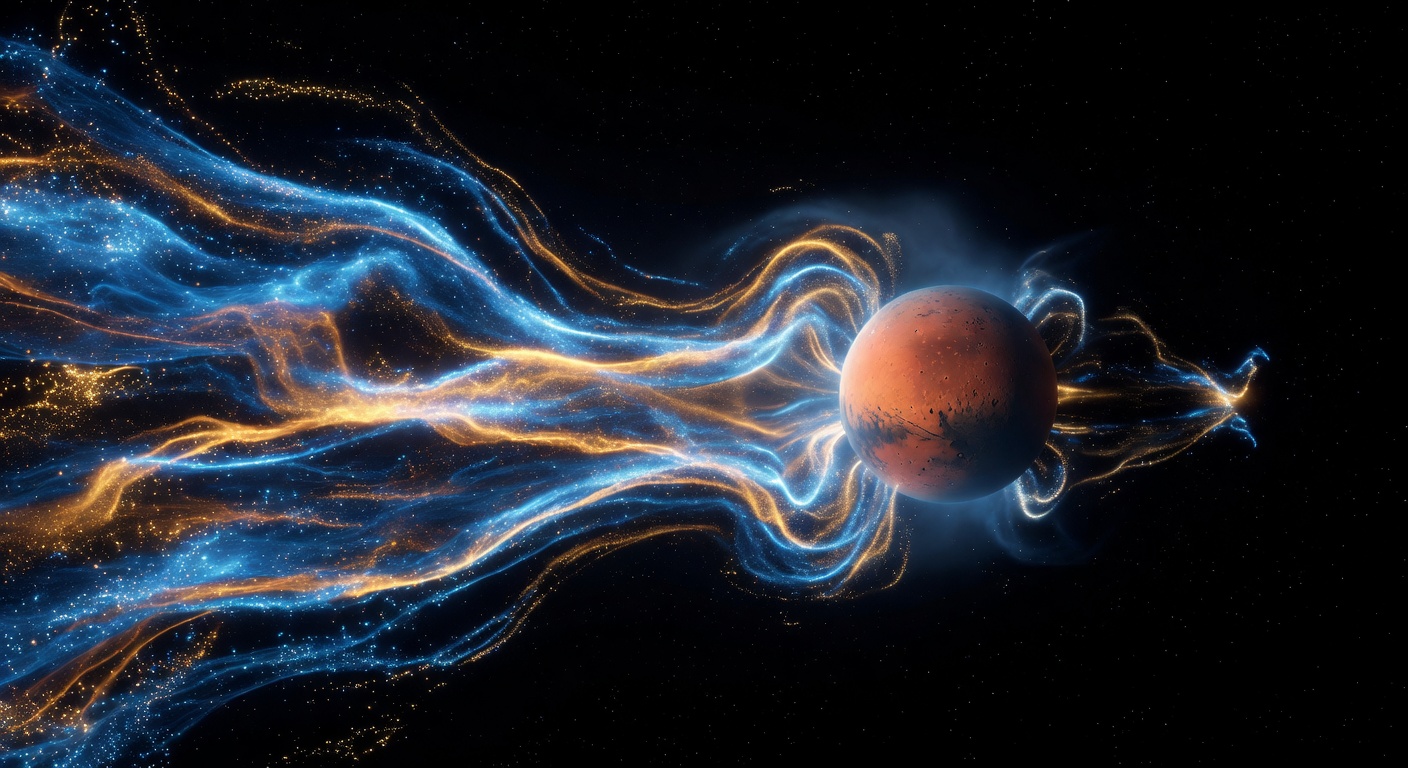
MAVEN began science operations at Mars in 2014 with a mandate to study the planet's upper atmosphere and understand how Mars lost the dense atmosphere it once had. Over more than a decade, the spacecraft accumulated a data archive that researchers continue to work through. The December 2023 solar storm data is one example of how much remains to be extracted from that record.
The spacecraft's current status complicates any forward-looking plans. In December 2025, MAVEN entered its scheduled communications blackout during solar conjunction, a routine period when the Sun sits between Earth and Mars and direct radio contact is impossible. After the conjunction window ended, contact was never reestablished. NASA launched an anomaly review board to assess the situation.
At the Lunar and Planetary Science Conference in Texas, Louise Prockter, Director of NASA's Planetary Science Division, addressed the situation directly: "We haven't officially said MAVEN is lost yet." That statement, calibrated and precise, reflects both the genuine uncertainty about the spacecraft's condition and the institutional care with which NASA characterizes the status of active missions.
The Fowler et al. result demonstrates that even a spacecraft operating at the edge of contact, or potentially past it, can deliver scientific output that reshapes a field. The data that produced the first-ever atmospheric observation of the Zwan-Wolf effect was already in hand. It waited for the right analytical lens. That is a pattern that applies to every archived planetary mission data set: the science in the record does not expire when the hardware does.
Competitive Landscape
No directly comparable research programs were publicly identifiable at publication time in the study of Zwan-Wolf dynamics in induced magnetospheres. Adjacent activity from solar wind interaction studies at Venus and Titan suggests the field is active and expanding, but a direct competitive ranking would require disclosures not yet released.
What the finding does clarify is a gap in the prior literature. The Zwan-Wolf effect had been documented around Earth and other strongly magnetized planets, in environments defined by large, field-generated magnetospheres. The underlying assumption, that the effect required that structural context, had never been directly tested in an induced magnetosphere at a planetary scale. MAVEN's instrument record provided the first test, and the result ran counter to that assumption.
That gap matters for mission planning as much as for theory. Solar wind interaction studies at Venus are a priority target for the ESA EnVision mission and for NASA's DAVINCI program. Titan research continues under data returned by the Cassini mission, with Dragonfly scheduled to arrive at Titan in the 2030s. Neither program has publicly framed its solar wind interaction objectives around Zwan-Wolf dynamics specifically, though the Fowler et al. finding gives both teams a new mechanism to account for in their atmospheric models.
Independent analyst commentary specifically on this announcement was not publicly available at publication time.
What Comes Next
The immediate research agenda follows from the finding's own characterization of its limits. The Zwan-Wolf effect at Mars was detectable only because a sufficiently powerful solar storm amplified it above MAVEN's instrument floor. Under ordinary solar conditions, the effect is believed to be continuous but invisible to the instruments available. That creates an observational constraint that future Mars missions will need to address with higher-sensitivity magnetometer and particle detector suites if the effect's routine behavior is to be mapped.
Venus and Titan are the next logical targets. Venus has no global magnetic field; its ionosphere separates the atmosphere from direct solar wind contact and produces an induced magnetosphere structurally analogous to Mars'. Titan's dense nitrogen-dominant atmosphere, with surface pressure 1.45 times Earth's, creates a different but also magnetically weak interaction zone with the surrounding Saturnian plasma environment. Whether the Zwan-Wolf mechanism operates in either case is now an empirical question rather than a theoretical impossibility.
Fowler's framing sets the scope: the discovery "introduces interesting physics that we haven't yet explored." The practical implication is that atmospheric models for unmagnetized worlds have been missing a forcing term. Every simulation of long-term atmospheric loss at Mars, Venus, or Titan, and every exoplanet candidate in the same physical category, will need to account for the possibility that this mechanism shapes particle flux and atmospheric escape rates in ways that prior models excluded by assumption.
MAVEN's fate remains unresolved. If the spacecraft can be recovered, it holds additional archived data sets from solar events before and after December 2023 that could allow researchers to map the Zwan-Wolf signature across a range of storm intensities. If it cannot, that archive is inaccessible. Either way, the December 2023 data set has already done its work.
For planetary scientists modeling atmospheric evolution on unmagnetized worlds, the Fowler et al. result adds a previously unquantified forcing mechanism to the standard interaction framework. The Zwan-Wolf effect, operating continuously at sub-detection thresholds under quiet solar conditions and rising above the noise floor during energetic events, functions as a persistent, storm-modulated driver of charged-particle dynamics in induced magnetospheres. Atmospheric loss models that treat solar wind interaction as a function of ionospheric standoff pressure alone will need to incorporate this additional deflection and compression pathway. The quantitative contribution under typical solar wind conditions remains unconstrained, since MAVEN's instrument sensitivity was the binding factor; establishing that baseline will require either reanalysis of existing archived data during moderate solar events or purpose-designed high-sensitivity instrumentation on future missions to Mars, Venus, or Titan.
MAVEN launched with a question: how did Mars lose its atmosphere? It spent over a decade gathering data toward that answer, went silent before researchers had finished reading it, and then delivered a result that extends the question outward to every unmagnetized world in the solar system. The spacecraft may be gone. The physics it uncovered is not going anywhere.
-- Zara Velez, Emerging Technology Editor
Sources: Space.com · Fowler et al., Nature Communications, May 18, 2026