NASA-Backed Algorithm Lets Robots Assemble Satellites Without CamerasNASA-Backed Algorithm Lets Robots Assemble Satellites Without CamerasNASA-Backed Algorithm Lets Robots Assemble Satellites Without CamerasNASA-Backed Algorithm Lets Robots Assemble Satellites Without Cameras
July 22, 2026
A Texas A&M Ph.D. candidate has developed a camera-free robotic assembly algorithm, in collaboration with NASA and the U.S.
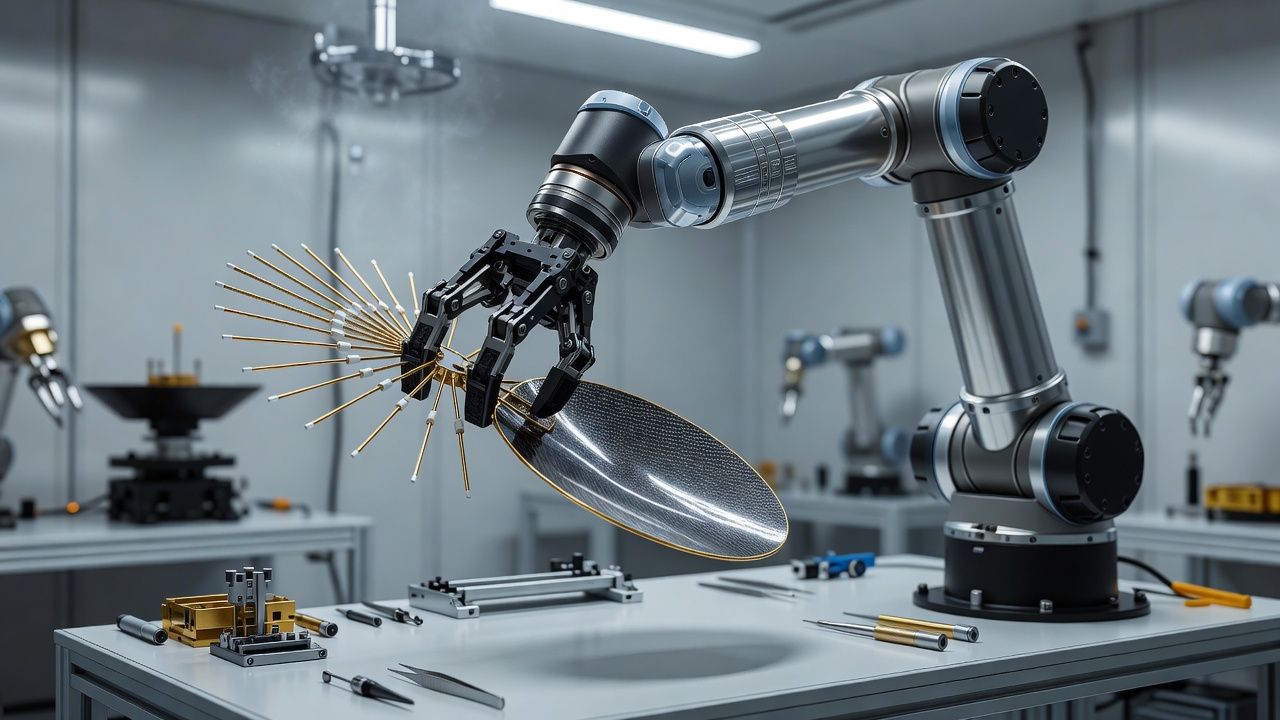
A Texas A&M Ph.D. candidate has developed a camera-free robotic assembly algorithm, in collaboration with NASA and the U.S. Air Force, that guides a robot arm to insert a satellite antenna into its correct slot using only force feedback, with no vision system at all. The counterintuitive design choice -- touch over sight -- is the point: in the radiation-saturated, signal-delayed environment of deep space, cameras can malfunction or encounter latency that makes them unreliable for precision work. Sarah Downs's algorithm solves one of robotics' oldest benchmark problems, the peg-in-hole task (inserting a precisely shaped component into a matching receptacle), in one of the most unforgiving operating environments humans have ever devised.
Downs, now a Ph.D. student in electrical engineering at Texas A&M University in College Station, developed the core algorithm during her master's program at the University of Tulsa after the NASA project secured government funding in 2025. She is continuing that research at Texas A&M's Robotics and Automation Design (RAD) Lab, founded in 2022 by her thesis advisor Robert Ambrose, a NASA veteran, where the focus is on machines built for extreme environments. With the Texas A&M Space Institute due to open in 2026 in Houston, adjacent to Johnson Space Center, the institutional infrastructure around her work is growing to match its ambition.
What It Does
The problem Downs set out to solve is conceptually simple and practically brutal. A robotic arm must pick up a satellite antenna and insert it into the correct slot on a satellite body during in-space assembly. On Earth, this is the kind of task an assembly-line worker handles in seconds. In orbit, the zero-gravity environment introduces a complication that most ground-based robotics work never confronts.
"Without gravity, you now have to consider the arm's reaction torques on the satellite to avoid flinging it into space," Downs explained in an IEEE Spectrum profile published July 17, 2026. Every motion the arm makes exerts an equal and opposite force on the satellite it's working on. Without a counteracting system, those forces accumulate and can push the satellite off its intended position, turning a precision assembly task into an uncontrolled drift problem.
Downs's solution involves calculating targeted reverse thrusts to counter the arm's motion forces, stabilizing the satellite while the insertion proceeds. The arm uses a torque sensor mounted on the gripper to detect force feedback, sensing the relative position and orientation of the antenna and the target slot without any camera input. The arm loosely grips the antenna, using continuous force data to guide the component into the opening, then holds position while adhesion is completed.
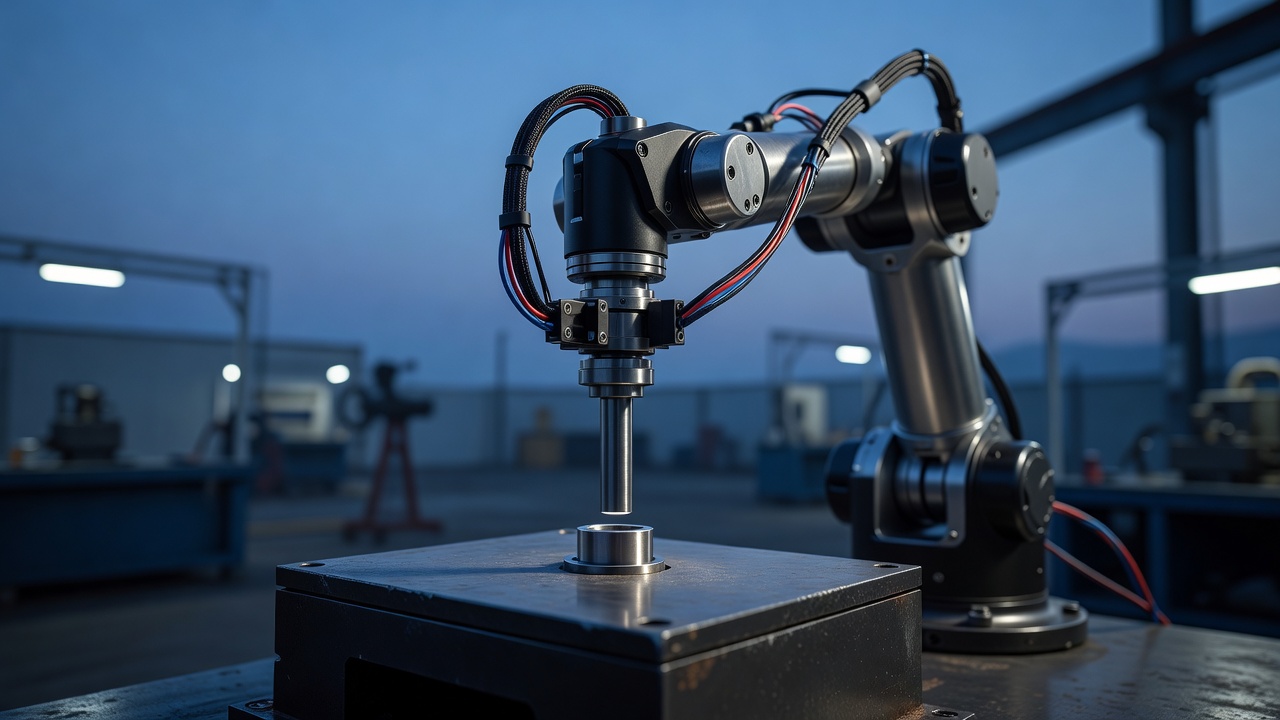
The system relies on Denavit-Hartenberg (D-H) parameters, a mathematical convention introduced in 1955 to standardize the coordinate frames that describe how a robotic arm is positioned in space. Four values fully characterize any serial robot manipulator regardless of its specific hardware. "I think robots are both more and also less complicated than people think," Downs said. "Really, all you need to start programming a robot is its Denavit-Hartenberg parameters, and you can do a lot with that. But we're still learning so much about how robots interact with their environment. Even something simple to us, like manipulating a pen, is still complex for robots."
The Technical Achievement
The deliberate elimination of cameras reflects a reasoned engineering tradeoff rather than a hardware limitation. Vision systems are standard in industrial and space robotics because they provide rich spatial data with relatively low computational overhead. But in the deep-space operating environment the RAD Lab is designing for, cameras carry failure modes that force-sensing avoids: radiation damage, lens contamination, signal propagation delays across interplanetary distances, and latency introduced by any image-processing pipeline. A torque sensor that returns a real-time force reading has fewer failure modes in that specific context than a camera waiting for a signal that may take minutes to travel from Earth.
The D-H parameter convention remains the field's standard framework for describing manipulator geometry. A typical six-degree-of-freedom serial robot arm is characterized by a sequence of joint axes and the common normals between them. Downs's work applies this framework to a task that standard industrial automation has no template for: force-controlled precision insertion with a loosely gripped component, performed in microgravity, with no ground-truth visual reference.
Government funding for the project was secured in 2025, before Downs began her second graduate year, resolving an earlier delay that had pushed the NASA collaboration back during her first year. During that delay, Downs worked at the University of Tulsa on a robotic arm designed to identify objects and place them in appropriate home locations -- such as unloading groceries onto a shelf -- for older adults and wheelchair users. She earned her bachelor's degree in electrical engineering from UTulsa in 2024 and is now extending the satellite assembly work at Texas A&M on what she describes as "a much larger scale."
Real-World Impact
The collaboration structure behind Downs's algorithm reflects the dual-use nature of in-space assembly technology. NASA's interest in autonomous robotic assembly centers on reducing the need for crewed extravehicular activity, which is expensive, risky, and limited by astronaut endurance and suit constraints. The U.S. Air Force's parallel involvement points toward satellite servicing and construction tasks in orbits where human access is impractical or impossible.
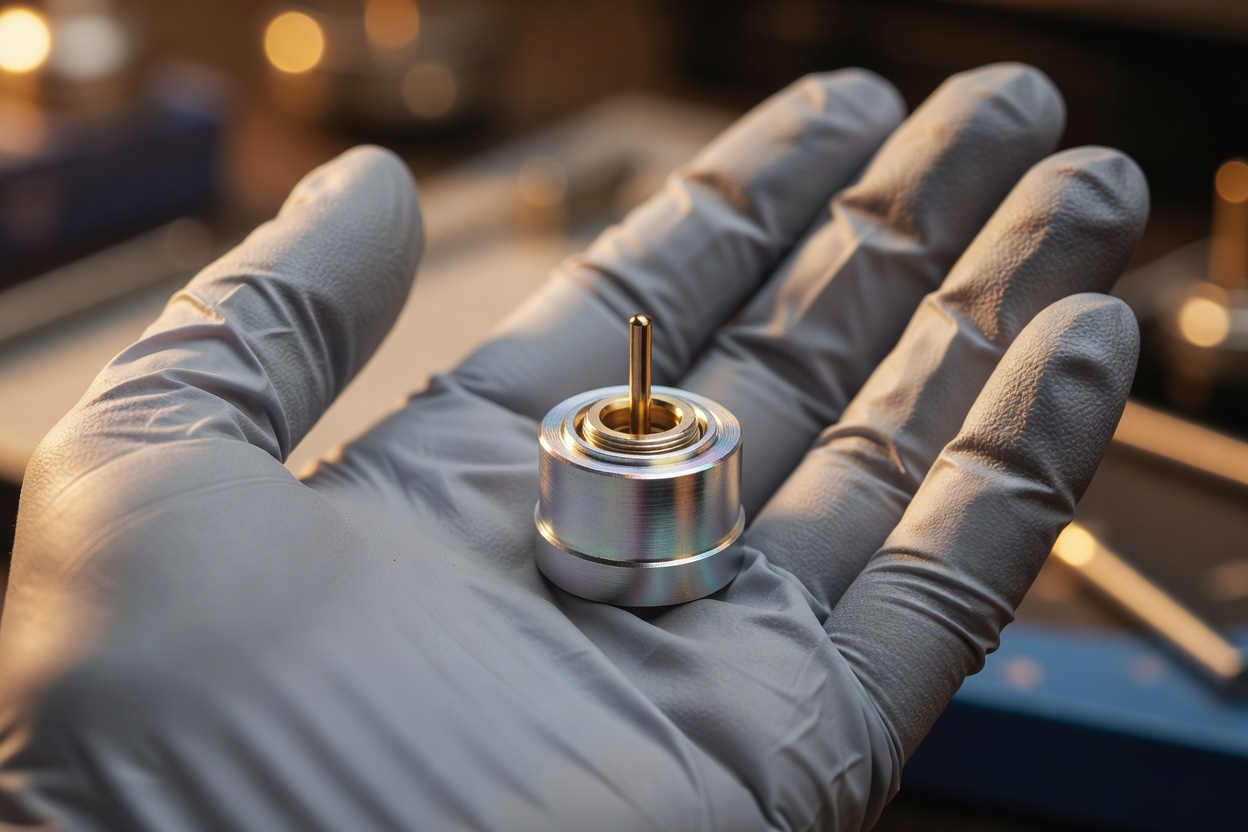
The peg-in-hole problem is relevant to any task that requires mating two mechanical components in space: connecting power connectors, latching structural sections, installing instruments. A force-based solution that works without vision has potential applicability across a wider range of mission scenarios than a camera-dependent one, precisely because it degrades more gracefully in environments where sensors fail.
The opening of the Texas A&M Space Institute in Houston, adjacent to Johnson Space Center, creates a direct institutional link between the RAD Lab's research and NASA's primary human spaceflight operations center. Ambrose's role as associate director of the Space Institute means Downs's thesis advisor will sit at the intersection of the university research pipeline and the agency with the operational requirement the research is designed to address.
The force-sensing approach also sidesteps a practical constraint of camera-based systems: any vision-guided system requires image acquisition, feature detection, pose estimation, and motion planning before the arm moves. A torque sensor returns a force vector continuously, enabling real-time closed-loop control with lower computational overhead -- an advantage that compounds in remote assembly scenarios where communication delays make teleoperation impractical.
Competitive Landscape
The student-and-agency collaboration model Downs's work exemplifies is not without precedent in the NASA robotics ecosystem, though the specific approach of camera-free, force-only manipulation in zero gravity occupies a narrower niche.
NASA's Kennedy Space Center runs the Lunabotics program, a systems engineering competition challenging college teams to design robots capable of excavating lunar regolith -- a different problem domain from in-space assembly but the same institutional model of agency-backed student research.
On the commercial side, PickNik Inc. worked with NASA on robotic intelligence systems for astronauts and industry applications, according to a NASA Tech Transfer article from June 2026. The distinction between that approach and Downs's work is methodological: commercial robotics collaborators typically build on existing vision-and-software stacks, while the RAD Lab's force-only algorithm is designed specifically for environments where those stacks become unreliable.
Independent analyst commentary specifically on this announcement was not publicly available at publication time.
What's Next
Downs's path to the RAD Lab involved a deliberate accumulation of technical and organizational experience. She began building hardware skills in middle school through First Lego League, participating from 2014 to 2016 in Tulsa, Oklahoma. She split her final two high school years between her regular school and Tulsa Tech, a vocational school where she took engineering courses, and interned at Tulsa International Airport and American Airlines in facilities engineering during her sophomore year at UTulsa.
The IEEE student branch she led at UTulsa from 2022 to 2024 grew its executive board from approximately 5 to 25 members during her presidency, and a soldering workshop she organized in 2023 drew roughly 80 students. Her motivation was practical. "During the COVID-19 pandemic, engineering students stayed in their bubbles," she noted. "Networking is very important, especially in today's tough job market. It's a lot about who you know and how people observe your work ethic."
She is direct about what she observed in students she was trying to reach: "Their resumes are very sparse, and they have no proof of their technical skills." Her senior capstone project at UTulsa -- an interactive exhibit simulating robotic missions on the Moon, Venus, Mars, and Titan across 3 computer monitors controlled by a game controller -- remains on display at the Tulsa Air and Space Museum.
For engineers building manipulation pipelines for remote or extraterrestrial environments, Downs's work points toward a practical design principle: when your deployment environment degrades sensors, the cheapest reliable sensor wins. A force-torque sensor that returns a clean signal in high-radiation deep space costs less in failure-mode overhead than a camera stack that requires image processing, pose estimation, and a clear line of sight. If you're scoping an autonomous assembly system for any environment where vision is unreliable, the RAD Lab's force-only insertion approach is a concrete architecture to evaluate against your own baseline before committing to a vision pipeline you may not be able to maintain.
Downs watched the Curiosity rover launch live in 2011, when she was nine years old, and decided then that she wanted to work in space robotics. Fifteen years later, she is writing the algorithms that may determine whether robots can assemble satellites in orbit without human hands or camera lenses. "Don't stop asking questions," she said. "Especially in engineering, don't pretend like you know everything, because science is about constantly wanting to learn and listen."
-- Zara Velez, Emerging Technology Editor
Sources: IEEE Spectrum / The Institute