Older Adults Remember More Than Lab Tests Show, Smartphone Study FindsOlder Adults Remember More Than Lab Tests Show, Smartphone Study FindsOlder Adults Remember More Than Lab Tests Show, Smartphone Study FindsOlder Adults Remember More Than Lab Tests Show, Smartphone Study Finds
June 15, 2026
A smartphone app recorded 74 adults going about their daily lives for 10 consecutive days, capturing 30-second audio clips five times per hour across 14 waking hours each day, and when researchers at the University of Arizona sorted through what people were actually saying, the
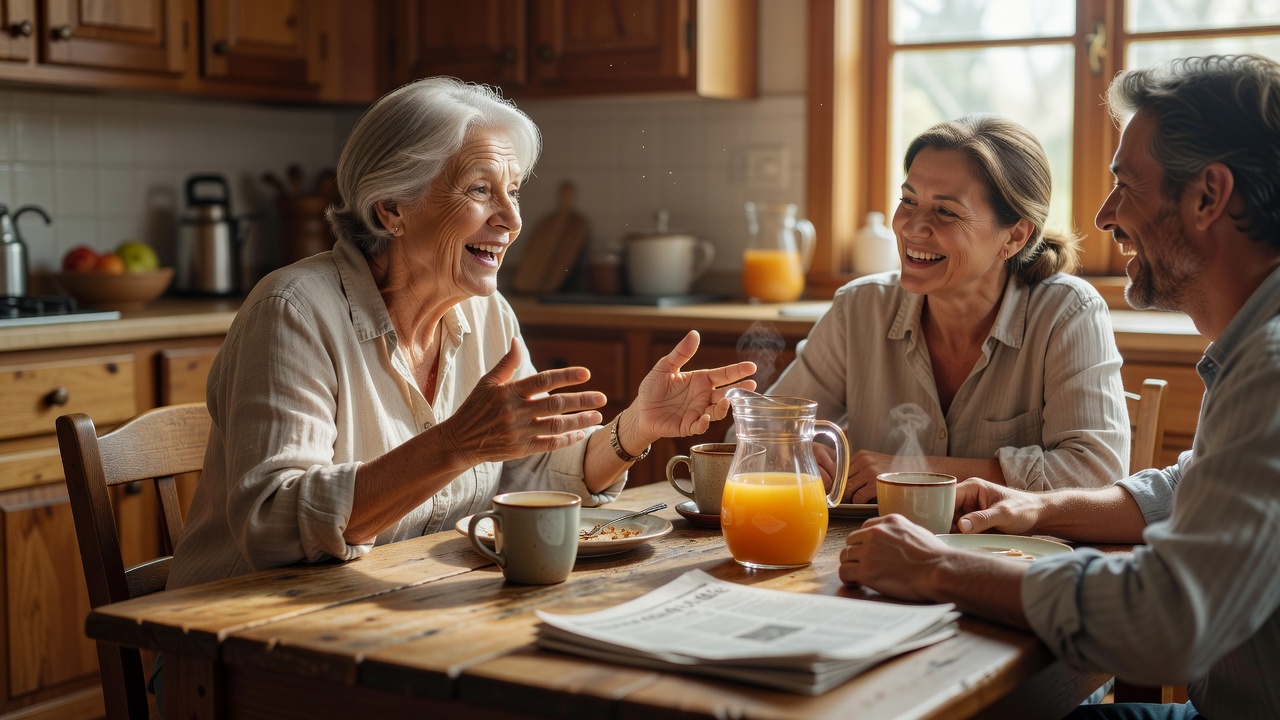
A smartphone app recorded 74 adults going about their daily lives for 10 consecutive days, capturing 30-second audio clips five times per hour across 14 waking hours each day, and when researchers at the University of Arizona sorted through what people were actually saying, the older participants, ages 61 to 81, showed no significant difference in autobiographical memory detail compared to adults ages 18 to 28. The buried finding is more consequential than the headline number: decades of laboratory research establishing age-related memory decline as a reliable cognitive marker may have been measuring the laboratory itself as much as the memory. For clinicians, dementia researchers, and anyone who has watched an older parent fumble through a structured recall test, the implications are immediate and unsettling.
What the Researchers Found
The core result of the ecological momentary assessment (EMA) audio study -- a method that captures behavior as it happens in daily life rather than reconstructing it under controlled conditions -- conducted by psychologist Matthew Grilli and cognitive neuroscientist Jessica Andrews-Hanna at the University of Arizona, Tucson, is a null finding in the most productive sense: older adults sharing memories in natural conversation were not measurably less detailed than younger adults doing the same thing. This directly contradicts what the same participants showed when assessed in parallel through conventional in-lab interviews conducted during the same period, a within-subject design that makes the contrast unusually clean.
The EMA audio study has been accepted for publication in the Journal of Experimental Psychology: General. A companion study, published in January 2026 in PNAS (Proceedings of the National Academy of Sciences), used a different method called experience sampling, or thought-ping, to reach a related but even stronger conclusion across a much larger sample: more than 1,900 adults ages 18 to 89. In that study, older adults did not merely match younger adults in memory specificity; they surpassed them, reporting more specific and more vivid recollections of past events.
Grilli is direct about what these results require of the field. "We may need to take a step back from the assumptions that we make about how autobiographical memories may or may not change in older age based on laboratory research, which might not be capturing the whole picture," he said. That is not a minor methodological note. It is a challenge to the evidentiary foundation of a large body of cognitive aging literature.
The Methodology
The EMA audio study enrolled 24 younger adults, ages 18 to 28, and 50 older adults, ages 61 to 81. A smartphone app triggered 30-second ambient audio recordings at random intervals, five times per hour, during 14 hours of waking time per day, across 10 consecutive days. Participants were not asked to perform memory tasks. The recordings simply captured whatever they were saying in the course of ordinary life. Researchers then manually reviewed the recordings to identify moments when participants were spontaneously sharing autobiographical memories in natural conversation.
Critically, the same participants also completed conventional in-lab autobiographical memory interviews during this same period. That within-subject comparison allowed the researchers to hold individual differences constant and isolate the effect of setting: lab versus real world, structured elicitation versus spontaneous recall. The divergence between those two conditions is the central finding.
The companion PNAS study used a structurally different approach. Rather than passively recording ambient audio, it used experience sampling, in which smartphone prompts ask participants at random intervals to report on their current thoughts and mental states. Across more than 1,900 adults ages 18 to 89, thought-pings queried what participants were thinking about at the moment of the prompt, and older adults reported more specific and more vivid recollections of past events than younger participants.
The two methods converge on a shared implication: when memory is assessed in contexts closer to how it actually operates in daily life, the age-related deficit that dominates laboratory research either shrinks substantially or reverses.
Why It Matters
The stakes here extend beyond academic methodology. Laboratory-based assessments of autobiographical memory -- the form of explicit memory that combines episodic detail (the what, where, and when of a specific past event) with semantic self-knowledge (general facts about one's own life) -- have served for decades as cognitive benchmarks in aging research. The finding that older adults recall fewer episodic details than younger adults in structured interviews has been observed across a substantial body of prior literature, and the effect has been found to be more pronounced in individuals with dementia, framing it as a marker of cognitive decline. If that marker is partly an artifact of the assessment setting, the clinical implications are significant.
Brian Levine, a scientist at the Baycrest Academy for Research and Education in Toronto, is not affiliated with either study but has spent his career working at the intersection of memory research and geriatric medicine. Levine puts the problem plainly: difficulty remembering details of past episodes is "one of the most common complaints of aging," and yet, he said, "when we bring them into the lab and test them on things that are not optimized to their needs, then they're going to look more impaired than they really are."
Andrews-Hanna has offered a plausible structural account of why this gap might be specifically larger for older adults. Laboratory settings are less familiar to older participants than to younger ones, since younger participants are often college students tested on their own campuses. Experimenters are typically young adults themselves, which may cause older participants to supply more background context before describing a specific memory, artificially expanding the apparent recall deficit. Neither explanation has been confirmed mechanistically, and no neuroimaging or physiological data were collected in either study. But both are consistent with the pattern observed.

Competitive Landscape
The traditional paradigm for studying autobiographical memory has relied on structured, controlled laboratory interviews in which participants are asked to recall specific personal events in response to experimenter prompts. That paradigm has generated a consistent and reproducible finding across decades of research: older adults retrieve fewer episodic details than younger adults. Because the effect has been robust across labs and operationalizations, it has accumulated the kind of replication credit that becomes embedded in clinical assumptions.
EMA and experience-sampling approaches represent a methodological alternative with growing traction in cognitive science. Both share a core commitment to ecological validity -- assessing mental states as they occur in real life rather than reconstructing them under controlled conditions. No directly comparable peer studies using naturalistic audio capture for autobiographical memory in aging populations were publicly identified at publication time. Independent competitive benchmarking in this methodological space would require disclosures not yet available.
Limitations and Caveats
The EMA audio study enrolled 24 younger and 50 older adults. Those are small samples for a finding that challenges decades of prior literature, and the researchers have not published a formal power analysis or described replication plans. The null result on the age-by-detail interaction might survive a larger study or might attenuate.
A more fundamental limitation is that neither study assessed whether the memories participants reported were accurate. Andrews-Hanna explicitly flags this. Naturalistic richness does not equal verified correctness. A person can recall an episode in considerable detail and still be substantially wrong about what happened. The relationship between recall specificity and memory accuracy is a separate empirical question left entirely open here.
Daniel Schacter, a psychologist at Harvard University who was not involved in either study, acknowledges the value of out-of-lab research but also notes that narrative style can explain some of the lab-based differences in autobiographical recall. Differences in how older and younger adults structure and tell stories -- not just in what details they access -- may contribute to the lab-based gap independently of any environmental unfamiliarity. "We need more studies on aging that go outside the laboratory and look at memory and related function in a more naturalistic context," Schacter said, while leaving open the possibility that the lab gap is not entirely artifactual.
The studies also do not address whether the lab-versus-real-world gap observed in healthy older adults would hold, shrink, or amplify in individuals with early-stage dementia. Generalizability across cultures and socioeconomic groups is also unaddressed.
What Comes Next
The most immediate methodological implication is the one Schacter voices directly: the field needs more studies that assess memory function outside the laboratory. EMA and experience-sampling approaches provide two distinct instruments for doing that, and the Grilli and Andrews-Hanna work suggests they can be designed with enough rigor to speak directly to laboratory-derived findings rather than run parallel to them.
The open questions are substantial. Which domains of memory show real age-related deficits versus artifactual ones when assessed naturalistically? Does the lab-versus-real-world gap vary with the type of memory being queried, the familiarity of the testing environment, or the demographic profile of the experimenter? For dementia research specifically, the unresolved question is whether the laboratory's systematic disadvantage for older adults masks early-stage cognitive decline or merely compresses the apparent gap between healthy aging and clinical impairment.
Grilli and Andrews-Hanna have established a proof of concept for large-scale naturalistic memory assessment in aging populations. Whether that approach scales to the sample sizes and replication standards necessary to revise clinical guidelines is the next practical question for the field.
For clinicians and dementia researchers who rely on structured recall tests to distinguish normal aging from early cognitive decline: the standard laboratory interview may be systematically underestimating what older patients can actually remember. A 10-day smartphone recording study with 74 participants is not sufficient to rewrite assessment protocols -- but it is sufficient to treat every lab-derived recall deficit as a finding about performance in that specific context, not as a direct measure of real-world capacity, until naturalistic data either confirm or contradict it. The correction came not from a new scanner or a new drug but from leaving a smartphone in someone's pocket for ten days.
-- Zara Velez, Emerging Technology Editor
Sources: Science News, June 11, 2026; Grilli and Andrews-Hanna, PNAS (January 2026); Grilli and Andrews-Hanna, Journal of Experimental Psychology: General (accepted, in press).