Quantum computer breakthrough tracks qubit fluctuations in real timeQuantum computer breakthrough tracks qubit fluctuations in real timeQuantum computer breakthrough tracks qubit fluctuations in real timeQuantum computer breakthrough tracks qubit fluctuations in real time
April 5, 2026
Researchers at Denmark's Niels Bohr Institute have built a quantum monitoring system that tracks qubit performance fluctuations roughly 100 times faster than previous methods, revealing that the microscopic defects plaguing superconducting quantum computers shift position
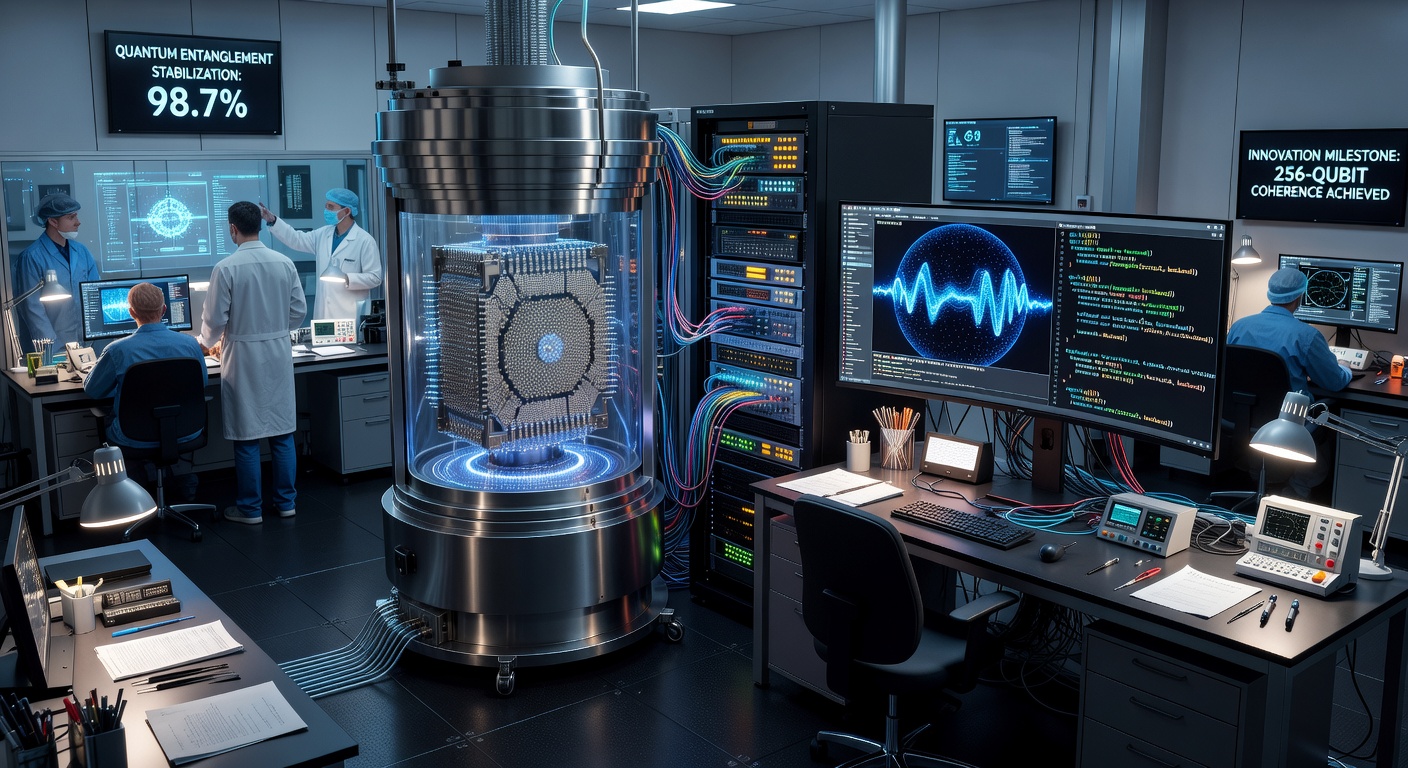
Researchers at Denmark's Niels Bohr Institute have built a quantum monitoring system that tracks qubit performance fluctuations roughly 100 times faster than previous methods, revealing that the microscopic defects plaguing superconducting quantum computers shift position hundreds of times per second. The breakthrough, led by postdoctoral researcher Dr. Fabrizio Berritta, uses a commercially available FPGA-based controller to update estimates of a qubit's energy loss rate within milliseconds, compared to the minute-long measurements that represented the previous state of the art. The most unsettling finding: what quantum engineers thought was stable performance averaged over time is actually wild oscillation masked by slow measurement cadence.
According to ScienceDaily QC, the work fundamentally changes how researchers understand qubit coherence (the fragile quantum state that collapses when qubits lose energy to their environment). Traditional testing methods could only capture an average energy loss rate, smoothing over the chaotic reality underneath. The Niels Bohr team's system operates on nearly the same timescale as the fluctuations themselves, exposing instability that was always present but never before visible in real time.
This matters because quantum computing has reached a troubling inflection point: adding more qubits no longer reliably improves performance when the worst-performing qubits bottleneck the entire system.
What Happened
The Center for Quantum Devices at Niels Bohr Institute, in collaboration with Chalmers University, the Norwegian University of Science and Technology, and Leiden University, developed a real-time diagnostic system for tracking how quickly qubits lose quantum information. Chalmers designed and fabricated the quantum processing unit, while the Copenhagen team built the measurement architecture using Quantum Machines' OPX1000 controller, a field-programmable gate array engineered for rapid quantum operations.
The core innovation eliminates the bottleneck of transferring measurement data to conventional computers for analysis. Instead, the FPGA runs experiments directly on the quantum chip, generating a best-guess estimate of each qubit's relaxation rate (how quickly it loses energy and quantum information) using only a few measurements. The controller updates its internal Bayesian probability model after every single qubit measurement, rather than waiting to accumulate hundreds of data points.
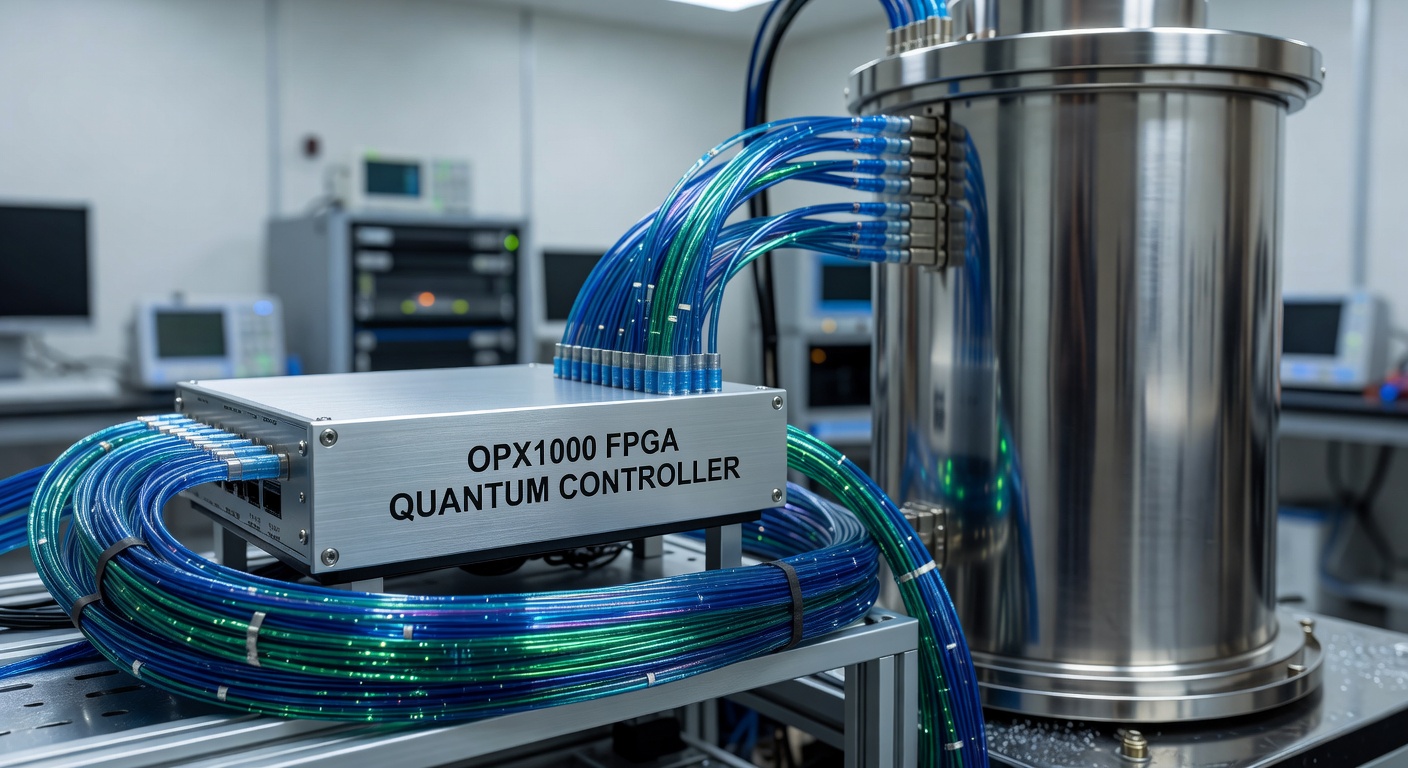
Microscopic defects in the materials used to fabricate qubits cause these fluctuations. As defects shift position at timescales of milliseconds, they alter the electromagnetic environment around each qubit, changing how quickly it decoheres. Previous measurement protocols took up to a minute to characterize a single qubit's performance, lagging behind the natural speed of the physical processes causing the instability.
Associate Professor Morten Kjaergaard, who leads the research group at Niels Bohr Institute, emphasized the hardware integration: "The controller enables very tight integration between logic, measurements and feedforward: these components made our experiment possible." The OPX1000 can be programmed in a Python-like language, lowering the barrier for physics researchers.
The Technical Breakthrough
The system's speed advantage comes from architectural decisions that prioritize latency over measurement precision. Classical quantum characterization protocols optimize for accuracy by averaging thousands of repeated measurements, which takes time. The Niels Bohr approach inverts this: sacrifice some statistical certainty in exchange for updates that happen faster than the underlying physics changes.
The FPGA implementation runs a lightweight Bayesian inference algorithm that updates probability distributions for each qubit's current relaxation rate. After measuring a qubit's state, the controller immediately refines its estimate and uses that updated model to inform the next measurement. This feedforward capability means the system actively responds to what it just learned, rather than passively logging data for later analysis.
The tight coupling between measurement, logic, and feedforward represents control-loop latency reduction. In quantum error correction schemes, detecting an error and applying a correction must happen faster than new errors accumulate. The Niels Bohr system demonstrates the hardware speed required to make real-time feedback viable at scale.
The researchers chose to focus on tracking T1 relaxation time (how long a qubit maintains its excited state before decaying to ground state). T1 directly measures energy loss to the environment, making it a clean signal to track. More complex metrics like T2 coherence time (which includes both energy loss and phase errors) would require more sophisticated measurement protocols, but the same FPGA architecture could support them.
The Quantum Machines OPX1000 is commercially available hardware, not a custom research prototype. Any lab with the budget to purchase the controller could replicate this approach, assuming they have compatible qubit hardware.
Why It Matters for Industry
The research team's most striking finding appears in an unsigned quote from the paper: "Nowadays, in quantum processing units in general, the overall performance is not determined by the best qubits, but by the worst ones: those are the ones we need to focus on. The surprise from our work is that a 'good' qubit can turn into a 'bad' one in fractions of a second, rather than minutes or hours."
This observation dismantles a foundational assumption in quantum processor design. Engineers have treated qubit quality as a static property determined during fabrication and validated during cooldown, with the expectation that performance remains stable for hours or days of operation. The Niels Bohr data shows that assumption is wrong. A quantum processor characterized as having 50 high-quality qubits might only have 35 high-quality qubits at any given millisecond, with the identity of those 35 changing faster than classical control systems can track.
The implications for quantum error correction are severe. Modern error correction codes like the surface code assume error rates stay constant over thousands of logical gate operations. If the error rate of individual physical qubits fluctuates by orders of magnitude on millisecond timescales, codes designed for time-averaged error rates will systematically underperform their theoretical limits.
With the new diagnostic capability, researchers can gather useful statistics on poorly performing qubits in seconds instead of hours or days. That compression of debugging time enables a new operating mode: adaptive qubit selection. If a quantum algorithm can detect which qubits are currently in a low-noise state and dynamically route operations to those qubits while avoiding the noisy ones, overall circuit fidelity could improve without any changes to qubit fabrication.
The researchers acknowledged a gap in current understanding: "We still cannot explain a large fraction of the fluctuations we observe." Despite achieving 100x faster measurement, the physical mechanisms driving many of the observed instabilities remain unknown.
The Bigger Picture
The Niels Bohr work represents a paradigm shift from static qubit validation to continuous performance monitoring. The previous model treated quantum processors like traditional semiconductors: fabricate, test, deploy, assume stable operation. The new model resembles how cloud infrastructure monitors server health, flagging degraded nodes and rerouting workloads in real time.
This shift arrives as the field confronts the gap between physical qubits (the actual quantum hardware) and logical qubits (error-corrected qubits robust enough to run useful algorithms). Google's 2024 Willow chip demonstrated a logical qubit assembled from 105 physical qubits, with error rates decreasing as more physical qubits were added to the error correction code. But those gains assume accurate knowledge of which physical qubits are failing and when. Real-time diagnostics turn that assumption into an engineering capability.
The Center for Quantum Devices operates within the Novo Nordisk Foundation Quantum Computing Programme, a multi-institution Danish initiative funding both fundamental research and commercial development. The team focuses on problems that block near-term scalability, not just fundamental physics questions. Real-time qubit monitoring fits that brief precisely.
The collaboration structure matters as well. Chalmers University fabricated the quantum processing unit using their in-house superconducting qubit foundry, while Norwegian and Dutch partners contributed measurement theory and validation. This distributed model, where hardware fabrication, control systems, and theoretical validation happen at separate institutions, increasingly defines European quantum research.
The researchers' candid acknowledgment that they cannot explain most of the fluctuations they observe highlights how early-stage quantum hardware remains. Classical semiconductor manufacturing has spent 60 years characterizing and eliminating defects in silicon. Superconducting qubits are made from aluminum, niobium, or tantalum deposited on sapphire or silicon substrates, with material science understanding that lags decades behind.
What's Next
The immediate research priority is explaining the unexplained fluctuations. Knowing that defects move hundreds of times per second narrows the range of possible physical mechanisms. Candidates include two-level system defects (quantum states within the substrate or dielectric materials that couple to qubits), phonon interactions (vibrations in the crystal lattice that transfer energy), and magnetic flux vortices (quantum whirlpools of magnetic field that penetrate superconductors). Each mechanism predicts different fluctuation patterns, which the real-time monitoring system can now resolve.
A longer-term question is whether this diagnostic approach integrates into commercial quantum systems. IBM, Google, Rigetti, and IonQ all use different qubit modalities with different noise profiles. But the core principle, running adaptive measurement protocols on fast classical controllers to track time-varying noise, generalizes across platforms. Quantum Machines already sells controllers to multiple quantum computing companies, creating a potential distribution channel.
The Python-like programming interface lowers the barrier for adoption. If the Niels Bohr team publishes their measurement algorithms as open-source code alongside the peer-reviewed paper, other labs could adapt the approach without reimplementing everything from scratch.
One speculative possibility: dynamic qubit quality monitoring could enable a new class of hybrid algorithms that adjust their structure based on real-time hardware performance. Classical machine learning already does this with gradient-free optimization when gradients become noisy. Quantum algorithms might similarly adapt circuit depth, qubit allocation, or measurement strategies when the monitoring system flags elevated noise.
The researchers have not yet published a peer-reviewed paper describing this work. Timeline for broader availability of their methods depends on that publication clearing review and appearing in a journal like *Nature Physics* or *Physical Review X*. Given the commercial hardware involved, Quantum Machines may also integrate these protocols into their standard software stack, making real-time qubit diagnostics a turnkey feature.
The quantum computing field has spent two decades building better qubits. This work suggests the harder problem may be understanding the qubits we already have. Watching a 'good' qubit degrade in fractions of a second is like discovering your foundation is shifting while you are building the second floor. At least now the sensors are fast enough to see the cracks form.
-- Aria Lin, Enterprise Technology Analyst
More on Revuzia
Algorithmiq Raises EUR 18 Million, Beats Harvard and Stanford on Quantum Drug Simulation
Suniva Plans 564-Job Solar Manufacturing Facility in South Carolina
India Adds 44.6 GW of Solar in One Year While US Falls Further Behind