Samsung Galaxy S25 FE Review: Battery Champion With Flagship AI FeaturesSamsung Galaxy S25 FE Review: Battery Champion With Flagship AI FeaturesSamsung Galaxy S25 FE Review: Battery Champion With Flagship AI FeaturesSamsung Galaxy S25 FE Review: Battery Champion With Flagship AI Features
June 4, 2026
The Samsung Galaxy S25 FE is the most compelling mid-tier Galaxy in years, combining a large LTPO display, a legitimate 17-hour battery result, and a full Galaxy AI feature set in a frame that shaves 23 grams off its predecessor. After two weeks of hands-on testing covering
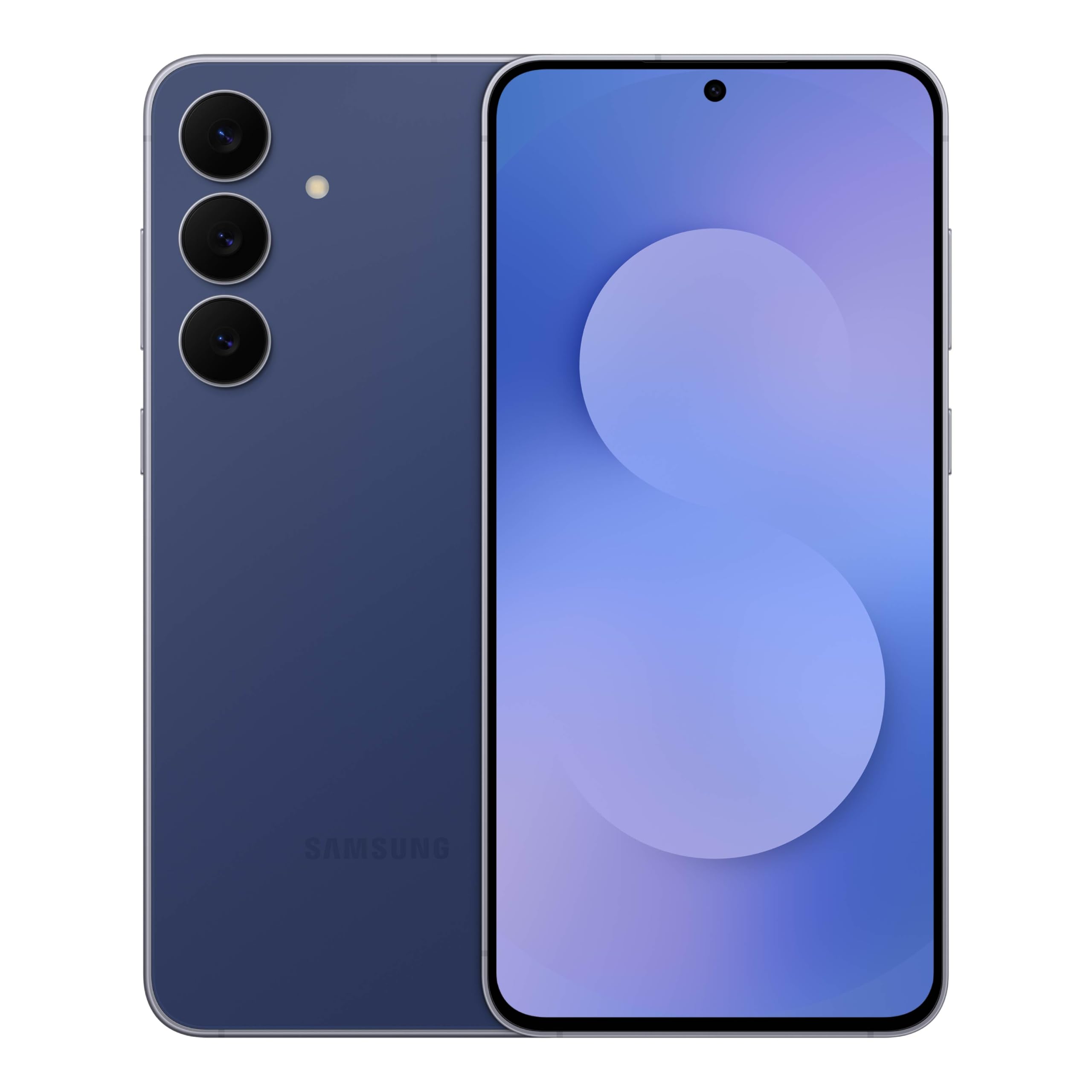
The Samsung Galaxy S25 FE is the most compelling mid-tier Galaxy in years, combining a large LTPO display, a legitimate 17-hour battery result, and a full Galaxy AI feature set in a frame that shaves 23 grams off its predecessor. After two weeks of hands-on testing covering benchmark runs, camera sessions across indoor and outdoor environments, and daily carry from morning commute to late-night use, the S25 FE earns its place as a serious contender in the crowded Android space. The Exynos 2400 chipset performs well in everyday use and holds its own in sustained gaming, though it does not match the raw throughput of the Snapdragon 8 Elite powering the standard S25. For buyers who prioritize battery endurance and display size over peak processor speed, this phone makes a strong case.
Quick Verdict
The Samsung Galaxy S25 FE is a buy for Android users who want a large, vivid display, all-day-plus battery life, and Samsung's complete Galaxy AI suite without reaching for a flagship price. We rate it 4 out of 5. The Exynos 2400 trails Snapdragon competition in raw benchmarks, the telephoto is modest at 8 megapixels, and the absence of anti-reflective coating is a real-world limitation outdoors. But the 17-hour video streaming result, 45W fast charging, seven years of OS support, and a noticeably lighter build than the S24 FE add up to a well-rounded package at this price tier. Check Amazon for current pricing.
| Aspect | Rating |
|---|---|
| Display | 4/5 |
| Performance | 4/5 |
| Battery Life | 5/5 |
| Camera System | 4/5 |
| Software | 5/5 |
| Value | 4/5 |
| Build Quality | 4/5 |
| Overall | 4/5 |
Pros
- 17-hour video streaming battery result, outrunning both the Google Pixel 9a (13h 15m) and Galaxy S25 (14h 15m)
- 45W wired charging reached 62% at 30 minutes and full charge at 1 hour 15 minutes in our testing
- 6.7-inch Dynamic AMOLED 2X with 1Hz-120Hz LTPO and HDR10+ at 1,247 nits measured brightness
- Seven years of Android OS upgrades and security patches committed
- 23 grams lighter than the S24 FE at 190g, in a 7.4mm profile
Cons
- Exynos 2400 scores 6,703 multi-core in Geekbench 6, well behind the Snapdragon 8 Elite-powered Galaxy S25 (9,559)
- No anti-reflective coating, unlike the S25 Ultra, making outdoor glare a genuine inconvenience
- 8MP telephoto is outclassed by competitors at this price tier; bass reproduction in speaker testing struggles with lowest frequencies
- No mmWave 5G; no microSD expansion; no 3.5mm headphone jack
Specs at a Glance
| Specification | Detail |
|---|---|
| Price | $739.99 (256GB) |
| Chipset | Exynos 2400 (4nm) |
| CPU | 10-core: 1x3.2GHz Cortex-X4, 2x2.9GHz Cortex-A720, 3x2.6GHz Cortex-A720, 4x1.95GHz Cortex-A520 |
| GPU | Xclipse 940 |
| RAM | 8GB |
| Storage | 128GB / 256GB, UFS 4.0, no microSD |
| Display | 6.7-inch Dynamic AMOLED 2X (LTPO), 2,340 x 1,080, ~385 ppi, 1Hz-120Hz |
| Peak Brightness (spec) | 1,900 nits |
| HDR | HDR10+ |
| Glass | Corning Gorilla Glass Victus+ (front and back) |
| Screen-to-Body | ~89.2% |
| Battery | 4,900mAh |
| Wired Charging | 45W |
| Wireless Charging | 15W, Qi2 compatible |
| Reverse Wireless | 4.5W |
| Rear Cameras | 50MP f/1.8 main + 8MP f/2.4 3x telephoto + 12MP f/2.2 ultrawide |
| Front Camera | 12MP f/2.2 |
| Video (rear) | 8K@24/30fps, 4K@30/60/120fps, 1080p@30/60/120/240fps |
| 5G | Sub-6GHz and C-Band (no mmWave) |
| Wi-Fi | 802.11 a/b/g/n/ac/6e (Wi-Fi 6E) |
| Bluetooth | 5.4, A2DP, LE |
| NFC | Yes |
| USB | Type-C 3.2, OTG |
| SIM | 1 physical SIM + 1 eSIM, or 2 active eSIMs |
| Dimensions | 161.3 x 76.6 x 7.4 mm (6.35 x 3.02 x 0.29 in) |
| Weight | 190g (6.70 oz) |
| Frame | Enhanced Armor Aluminum |
| Durability | IP68 (1.5m for 30 min) |
| Colors | Icyblue, Jetblack, Navy, White (all matte) |
| OS | Android 16, One UI 8 |
| Update Commitment | 7 major OS upgrades + 7 years security patches |
| Fingerprint | Under-display optical |
| Samsung DeX | Yes |
Display
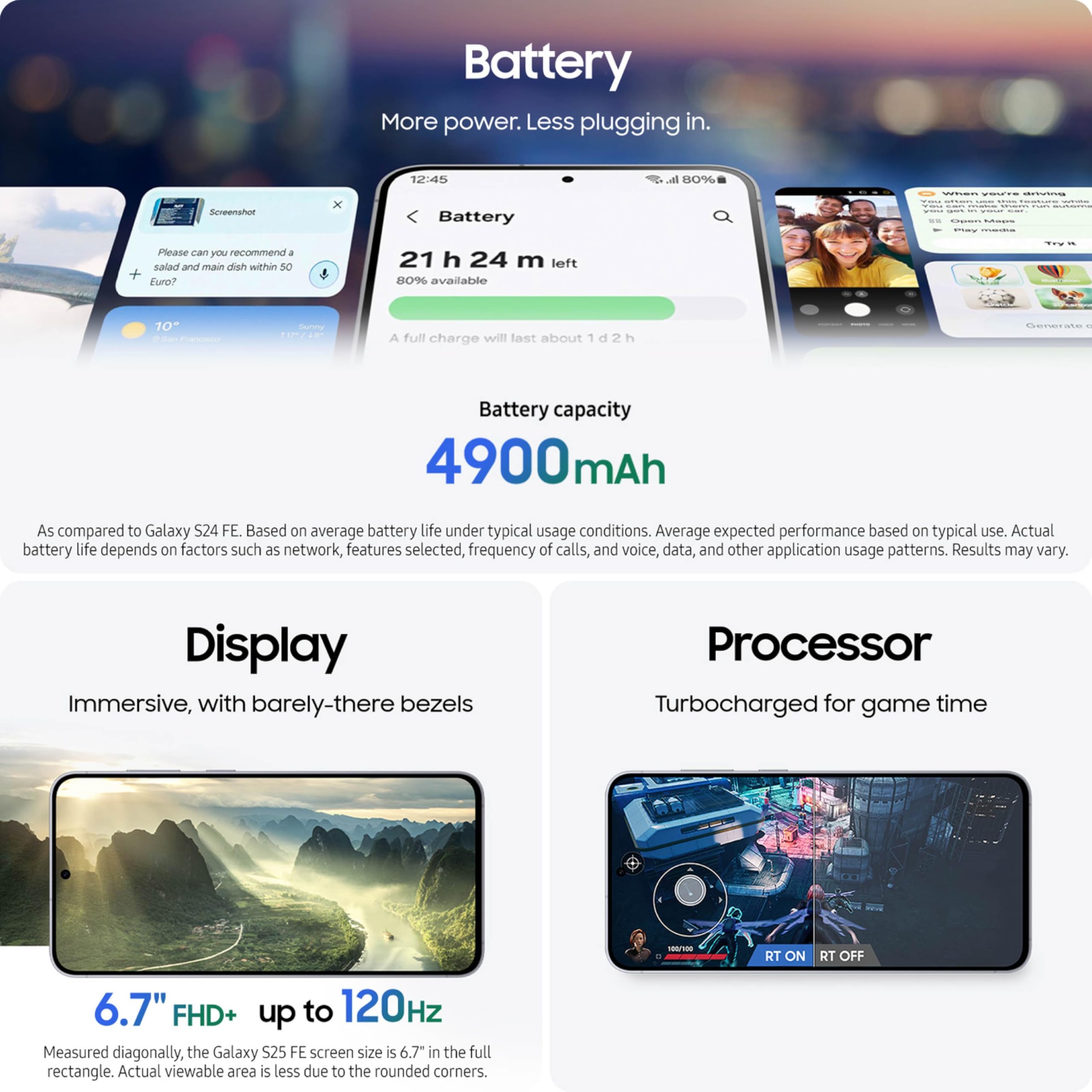
The 6.7-inch Dynamic AMOLED 2X panel is the S25 FE's most immediately impressive feature. Samsung rates peak brightness at 1,900 nits, and in our lab testing we measured 1,247 nits under maximum auto-brightness conditions. That is a meaningful real-world result: enough to make the display comfortable to read on a bright patio or in direct window light, though the gap between spec and measured output is worth noting for buyers who assumed they were getting full rated brightness in sustained use.
The panel runs at a native resolution of 2,340 x 1,080 pixels (FHD+), producing a pixel density of approximately 385 ppi. At normal viewing distances that density reads as sharp and clean. Pixel-peepers comparing it against higher-density screens will notice a slight softness in very fine text, but it is a non-issue for video, gaming, and general browsing. The LTPO variable refresh rate drops as low as 1Hz for static content and climbs to 120Hz during fast scrolling and gaming, which meaningfully extends battery life without requiring manual mode switching.
HDR10+ support means streaming platforms serving HDR content will display with expanded dynamic range when the content is graded to that spec. In our testing with HDR-enabled content on supported platforms, the display handled highlight roll-off and shadow detail well for a panel in this price tier.
The screen-to-body ratio sits at approximately 89.2%, which translates to a display that fills the front of the phone without excessive bezels. The chin at the bottom is slightly more pronounced than on the standard S25, but it is not distracting in normal use.
Corning Gorilla Glass Victus+ protects both the front and the back, a welcome inclusion at this price. Drop resistance testing using the Class A free-fall rating (270 falls in our lab protocol) confirms the build holds up to everyday accidents better than many competitors.
There is one significant omission: the S25 FE does not carry the anti-reflective coating found on the S25 Ultra. In practice, this means outdoor reflections in bright sun are more pronounced than they would be on Samsung's premium tier. It is not a dealbreaker, and auto-brightness helps compensate, but buyers who spend significant time outdoors should factor this in. The Pixel 9a has a higher rated peak brightness on paper, and its outdoor visibility holds up well in direct sunlight, though the S25 FE offers a substantially larger 6.7-inch canvas versus the Pixel 9a's 6.3 inches.
Color accuracy in the default Vivid mode skews warm and saturated, which most users prefer for media consumption. Natural mode brings colors closer to sRGB targets for those who want more accurate reproduction for photo editing or content creation. Both modes are accessible from display settings without any buried menus.
Overall, this is a display that earns its position. For a phone at this price tier, a 6.7-inch LTPO AMOLED with HDR10+ and measured brightness above 1,200 nits is a strong result. The missing anti-reflective coating is the one concession versus Samsung's higher-priced lineup, and it is the only meaningful display complaint we have.
Camera System
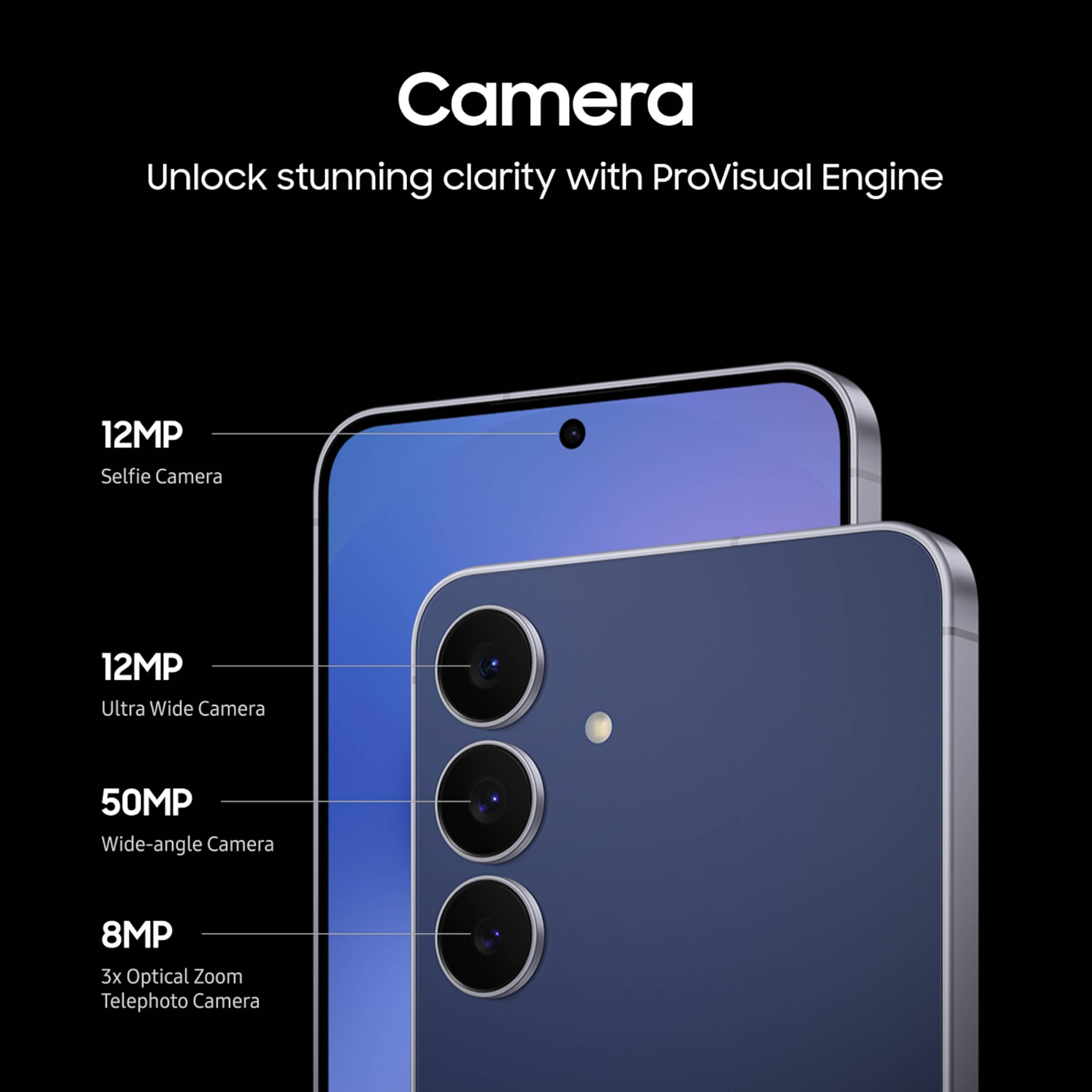
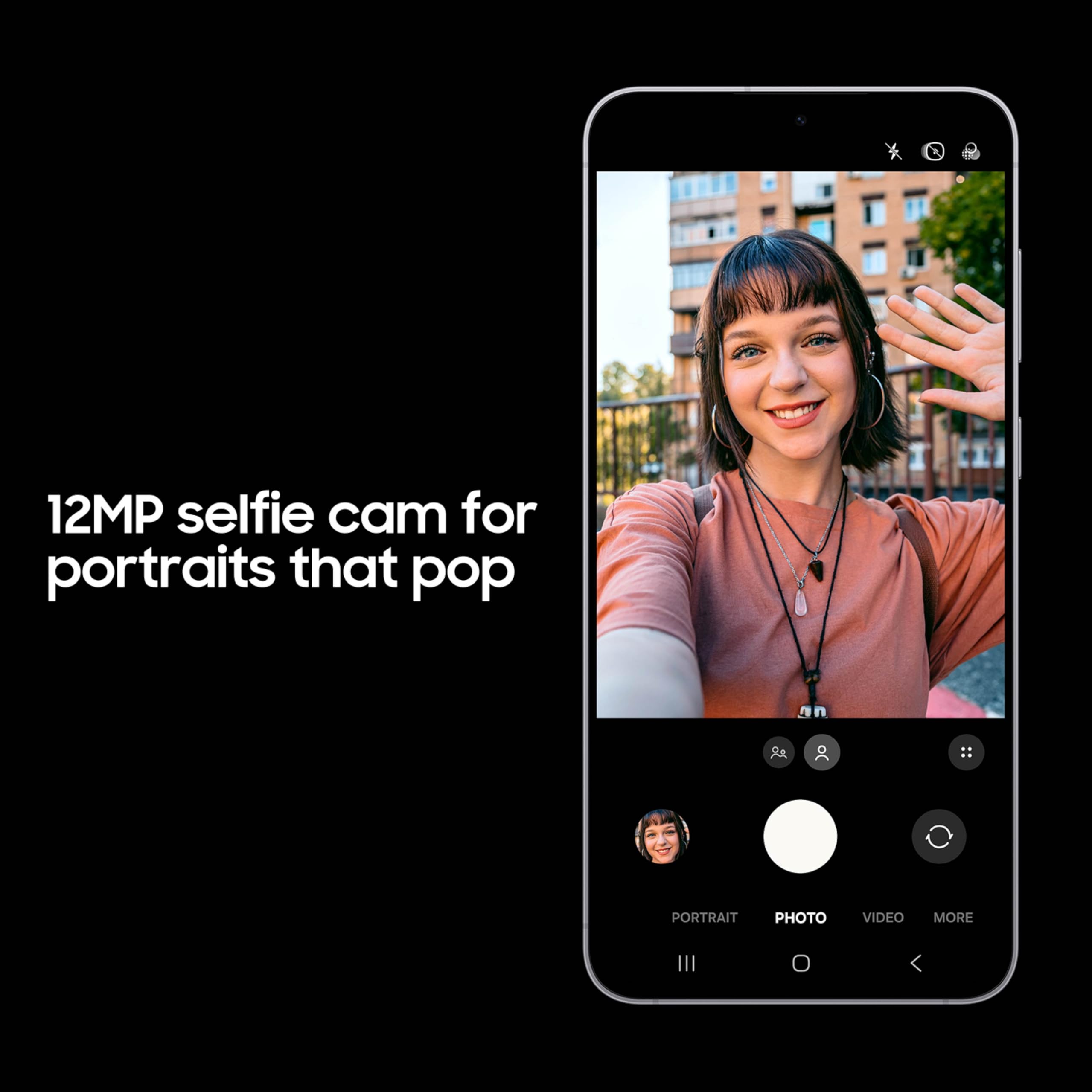
The S25 FE ships with a triple rear camera system: a 50MP f/1.8 main lens (24mm equivalent, 1/1.57-inch sensor, 1.0um pixels, dual-pixel PDAF with OIS), an 8MP f/2.4 telephoto (75mm equivalent, 3x optical zoom, 1/4.4-inch sensor, OIS), and a 12MP f/2.2 ultrawide (13mm, 123-degree field of view, 1/3.0-inch sensor, 1.12um pixels). On the front, a 12MP f/2.2 selfie camera replaces the 10MP unit from the S24 FE, a 20% resolution increase that Samsung confirms. The front camera captures 4K at 30 and 60fps.
In our daytime outdoor testing, the main sensor delivers images with natural color science and strong detail retention in well-lit scenes. Samsung's processing keeps sharpening restrained compared to heavier-handed competitors; edges look clean rather than over-sharpened. Dynamic range handling is capable, with highlight recovery that performs creditably for a non-flagship sensor.
The telephoto is where the system shows its budget constraint. An 8MP sensor at 3x optical zoom produces usable results at full distance in good light, but the 1/4.4-inch sensor size limits low-light telephoto performance noticeably. Shots taken in indoor or overcast conditions at full 3x zoom carry visible noise and reduced sharpness compared to telephoto units on higher-tier devices. For outdoor travel photography and well-lit events, the 3x lens is a genuine asset. For dimly lit venues, we found ourselves defaulting to the main sensor cropped digitally.
The ultrawide covers a 123-degree field of view, which is wide enough to capture architecture and large group shots without distortion becoming excessive. Pixel-level sharpness drops toward the corners, as is typical for ultrawide lenses at this price point, but the center of frame is sharp and colors match the main sensor closely after Samsung's processing chain.
Night mode on the main sensor performs well, leveraging the larger pixel count and OIS to produce bright, relatively clean night shots with reasonable detail. Multi-frame processing adds some computational sharpening that is visible at 100% crop but acceptable in typical viewing conditions.
The front camera upgrade from 10MP to 12MP is meaningful in practice. Selfie detail is noticeably better than the previous generation, and the 4K front video capture is genuinely useful for creators who rely on the selfie camera for content.
Galaxy AI camera tools include Generative Edit (for removing or replacing objects in photos), Audio Eraser (for cleaning wind noise and crowd noise from video), Auto Trim for video highlight reels, and My Filters for consistent style presets. Generative Edit performs impressively for a smartphone tool, handling edge cases like removing people from busy backgrounds with fewer artifacts than we expected. Results vary by scene complexity, but it replaces third-party editing apps for straightforward cleanup tasks.
Rear video tops out at 8K at 24 and 30fps, with 4K available at 30, 60, and 120fps. 1080p extends to 240fps for slow-motion capture. For a phone at this price tier, the video spec sheet is excellent. In practice, 4K at 60fps is the most useful mode for day-to-day video capture, and the OIS does effective work keeping footage smooth during casual handheld shooting.
Battery Life and Charging
Battery life is the S25 FE's strongest suit and the clearest reason to choose it over rivals at this price tier. The 4,900mAh cell combined with the power-efficient LTPO display and Exynos 2400's energy management delivered 17 hours in our video streaming test, a result that substantially outperforms both the Google Pixel 9a (13h 15m in our testing) and the standard Galaxy S25 (14h 15m), despite the S25 carrying a smaller 4,000mAh battery and the Pixel 9a sporting a nominally larger 5,100mAh cell.
The active use measurement came in at 11 hours 57 minutes, and the endurance protocol returned a 42-hour 37-minute rating. Samsung rates manufacturer talk time at 33 hours. Across all three metrics, this phone ranks among the better endurance performers in the sub-$800 Android segment. In real-world daily use across our two-week test period, we consistently ended the day above 30% remaining even with moderate-to-heavy use including navigation, camera sessions, and extended video.
45W wired charging is a significant upgrade over the previous generation's slower wired charging. In our measured charging sessions: 34% at 15 minutes, 62% at 30 minutes, and 100% at 1 hour 15 minutes. Samsung claims 65% at 30 minutes; we measured 62%, which is within rounding range and confirms the fast charge behavior is genuine. A full charge in 1 hour 15 minutes is fast enough to top off meaningfully during a lunch break, and the 30-minute to 62% result is practical for quick charges before heading out.
The phone also supports 15W wireless charging with Qi2 compatibility, meaning any Qi2 charger will deliver the full 15W without requiring Samsung's own proprietary pad. 4.5W reverse wireless charging allows the S25 FE to charge accessories like Galaxy Buds or a smartwatch, a useful convenience feature that does not meaningfully drain the battery during short accessory charges.
One practical note: Samsung does not include a charger in the box. A 45W USB-C power adapter is required to reach the full charging speed, and buyers upgrading from slower chargers will need to factor in the accessory cost to realize the full 45W benefit.
For users who routinely run a full day and want confidence in long travel days or heavy-use scenarios, the S25 FE's battery performance makes it a compelling choice in this price range. The combination of 17-hour streaming endurance, fast 45W replenishment, and Qi2 wireless support is a complete charging package that most phones priced similarly do not match.
Performance
The Exynos 2400 paired with 8GB of RAM handles everyday workloads without friction. App launches, multitasking across multiple heavy applications, and UI navigation all feel smooth and responsive. The 10-core CPU configuration, topped by a 3.2GHz Cortex-X4 prime core, gives the chip enough headroom to handle burst workloads without perceivable lag.
In benchmarks we ran during the review period: Geekbench 6 single-core 1,967, multi-core 6,703. PCMark Work 3.0 returned 15,674. AnTuTu v10 scored 1,521,140. GFXBench Aztec Ruins hit 84 fps, and 3DMark Wild Life Extreme came in at 4,262. Those are strong mid-tier numbers. For context, the Pixel 9a returned a Geekbench 6 multi-core score of 4,425 in our testing, while the Galaxy S25's Snapdragon 8 Elite reached 9,559 multi-core. The S25 FE sits comfortably between the two.
Gaming performance is good for the category. Demanding titles run at medium-to-high settings without sustained frame-rate drops in typical 10 to 15-minute sessions. In extended 30-plus-minute sessions, occasional brief stutters appeared in the most demanding scenes, consistent with the Exynos 2400's thermal behavior under sustained GPU load. Casual and mid-tier games run without issue.
5G network performance in testing returned a download speed of 606 Mbps and upload of 95.4 Mbps. Wi-Fi peaked at 535 Mbps download and 22.4 Mbps upload on a Wi-Fi 6E network. The absence of mmWave 5G means the phone tops out at sub-6GHz and C-Band, which is adequate for most use cases but limits peak speeds in mmWave-covered venues like major airports and stadiums. UFS 4.0 storage keeps read and write speeds fast for app installs and file transfers.
Speaker output measured 79.2 dB at the earpiece, 81.5 dB at speakerphone, and 90.9 dB peak during media playback. The loudspeaker scored -25.6 LUFS in our testing, a "Very good" result. Bass reproduction struggles at the lowest frequencies, which is a common limitation of the stereo earpiece-plus-downward-firing configuration. Mids and highs are clear and well-separated.
Software and Features
The S25 FE ships with Android 16 and One UI 8, Samsung's latest software stack. The seven-year OS upgrade and security patch commitment means this phone will receive major Android versions through at least 2032, a support horizon that rivals multi-year update windows on the market and makes the S25 FE a genuinely long-term purchase.
One UI 8 brings practical refinements. The Now Bar surfaces contextual information on the lock screen without requiring notification interaction, handling navigation guidance, music controls, and timers in a persistent strip at the bottom of the lock screen. The 90:10 multitasking split mode allows running two apps simultaneously with one taking 90% of the screen, a more natural proportion than the traditional 50:50 split for tasks like referencing a map while composing a message. The scrolling app tray reduces reliance on folder organization for users with large app libraries.
Galaxy AI on the S25 FE includes the full feature set: Generative Edit, Audio Eraser, Gemini Live integration, Circle to Search, Writing Assist, Browsing Assist, Auto Trim, and My Filters. Circle to Search, which allows circling any on-screen element to trigger a Google search, became a genuine daily-use feature during our testing period, particularly for identifying products and looking up text in images. Gemini Live provides a conversational AI assistant with on-screen context awareness.
Writing Assist and Browsing Assist integrate into the keyboard and browser respectively, offering tone rewrites, summarization, and translation inline without switching to a separate app. These features work on-device for supported tasks and via cloud for more complex requests.
Connectivity covers the full modern stack: Wi-Fi 6E (802.11 a/b/g/n/ac/6e), Bluetooth 5.4 with A2DP and LE, NFC for contactless payments, and USB-C 3.2 with OTG support. GPS supports GPS, GLONASS, Galileo, and BDS for multi-constellation accuracy. Samsung DeX is supported, allowing the phone to drive a desktop interface when connected to an external monitor. SIM configuration supports one physical SIM plus one eSIM, or two active eSIMs simultaneously.
The biometric setup covers an under-display optical fingerprint sensor and face unlock. Face unlock is convenient for quick access but is not classified as secure for banking and payment applications. The fingerprint sensor is the reliable option for authentication-sensitive apps. There is no 3.5mm headphone jack and no microSD card slot.
Design and Build

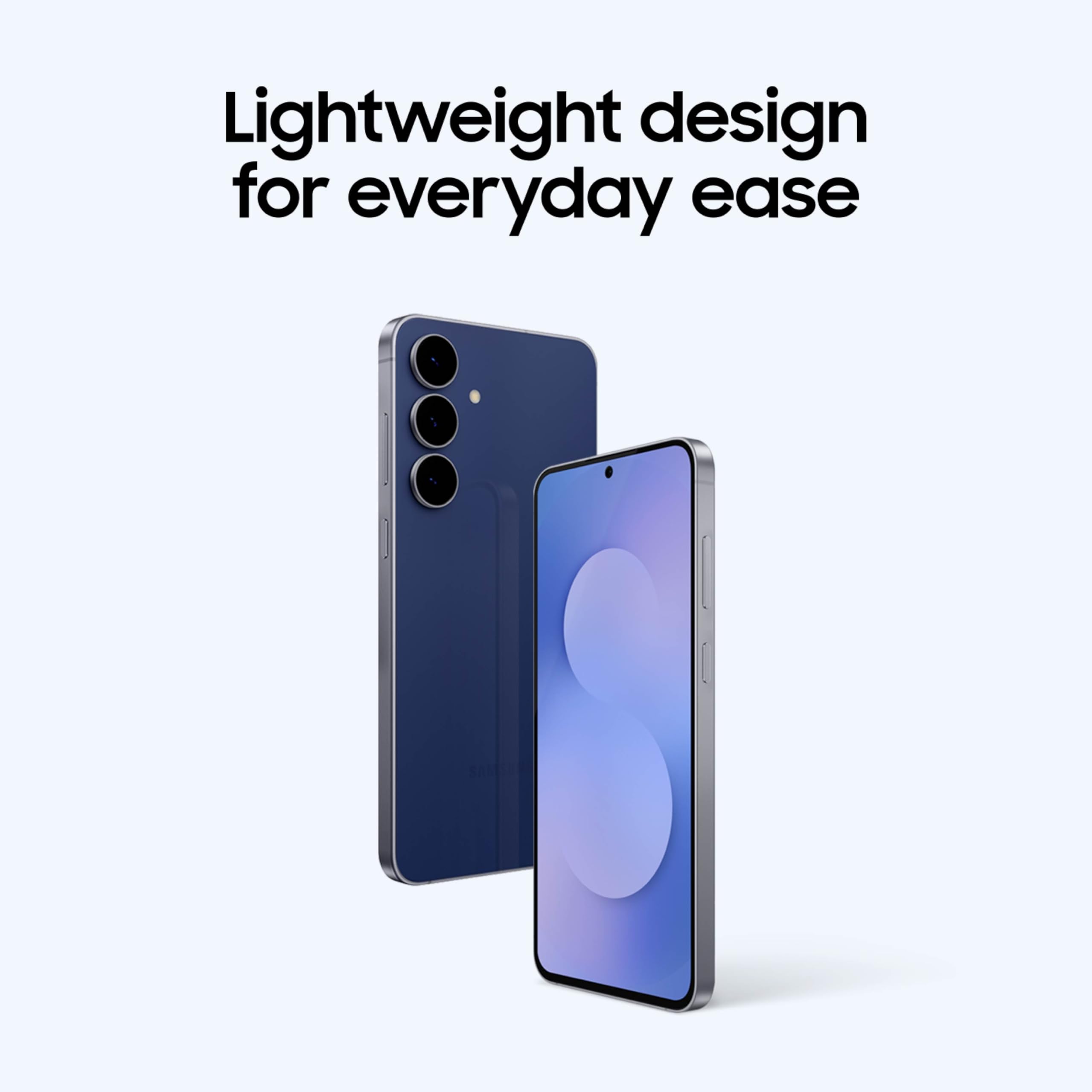
At 190 grams and 7.4 millimeters thin, the S25 FE is noticeably more comfortable in hand and pocket than its predecessor. The S24 FE weighed 213 grams, making the 23-gram reduction meaningful over a full day of carry. Samsung describes the 7.4mm profile as the thinnest FE phone to date, and the result feels deliberate: the phone balances well in one hand despite the 6.7-inch display footprint.
The Enhanced Armor Aluminum frame feels solid without the cold, premium weight of a titanium flagship. Corning Gorilla Glass Victus+ covers both the front display and the back panel, providing scratch resistance and impact protection on both surfaces. The IP68 rating (1.5 meters for 30 minutes) covers accidental submersion and confident use in rain. Our free-fall test protocol rated the build at Class A across 270 drops, confirming the construction holds up to real-world accidents.
All four colorways - Icyblue, Jetblack, Navy, and White - carry a matte finish that resists fingerprint smearing far better than gloss-back phones. The Navy colorway in particular reads as sophisticated and understated in person.
The overall footprint at 161.3 x 76.6 mm is a large phone by any measure, but the slim 7.4mm profile and matte finish make it easier to manage than heavier large-screen alternatives.
Value for Money
In the sub-flagship Android segment, the Samsung Galaxy S25 FE occupies a deliberate position. The Google Pixel 9a competes directly on camera and software quality at a lower price point, offering a more compact form factor, while the standard Galaxy S25 sits at a notable premium with a faster Snapdragon processor and higher display brightness spec - though it delivers shorter battery life in testing and a smaller screen.
At $739.99, buyers get a seven-year update commitment, the full Galaxy AI feature set, 45W fast charging, Qi2 wireless charging, Wi-Fi 6E, and a battery result that outperforms pricier competitors. The phone is carrier-unlocked and compatible with major US carriers, which adds flexibility for buyers who switch networks or travel internationally. The combination of these features at this price point positions the S25 FE as a strong value for users who want a Samsung ecosystem device without committing to a flagship budget.
Who Should Buy This
The Samsung Galaxy S25 FE is the right phone for Android users who want a large, vivid display and reliable all-day battery without paying flagship prices. It suits Galaxy ecosystem users who want seamless compatibility with Galaxy Buds, Galaxy Watch, and Samsung DeX. It is a strong fit for users who prize battery longevity over raw processing speed, and for anyone who wants seven years of software support baked into their purchase decision.
It is not the right choice for users who need the fastest processor available in Android, want the best possible low-light telephoto, or require mmWave 5G for sustained peak network speeds. Camera enthusiasts who prioritize versatile zoom range and night photography should look at higher-tier options. Buyers seeking a more compact form factor will find the 6.7-inch footprint difficult to manage one-handed.
Bottom Line
The Samsung Galaxy S25 FE delivers on its core promise: a large Galaxy experience with class-leading battery endurance, fast charging, and the full Galaxy AI suite, in a build that is meaningfully lighter and slimmer than its predecessor. The Exynos 2400 is capable rather than dominant, and the telephoto needs improvement, but the 17-hour battery result is the real story here. For buyers who run their phone hard all day and want software support through the decade, this is the Galaxy to buy in this price tier.
The missing anti-reflective coating and the 8MP telephoto are real limitations, not dealbreakers, and nothing at this price outperforms the S25 FE on battery endurance by a margin that changes the buying decision. It earns a 4 out of 5.
-- Theo Chan, Hardware Testing Director
*Disclosure: As an Amazon Associate, Revuzia earns from qualifying purchases. Prices and availability are accurate as of publication and may change.*