Samsung Galaxy S26 Ultra Review: A Privacy Display That Actually WorksSamsung Galaxy S26 Ultra Review: A Privacy Display That Actually WorksSamsung Galaxy S26 Ultra Review: A Privacy Display That Actually WorksSamsung Galaxy S26 Ultra Review: A Privacy Display That Actually Works
June 11, 2026
The Samsung Galaxy S26 Ultra, priced at $1099.99 for the base 256GB model, arrives as Samsung's most technically ambitious flagship to date, packing a world-first built-in Privacy Display, the Snapdragon 8 Elite Gen 5 processor, and a quad-camera array anchored by a 200MP f/1.4
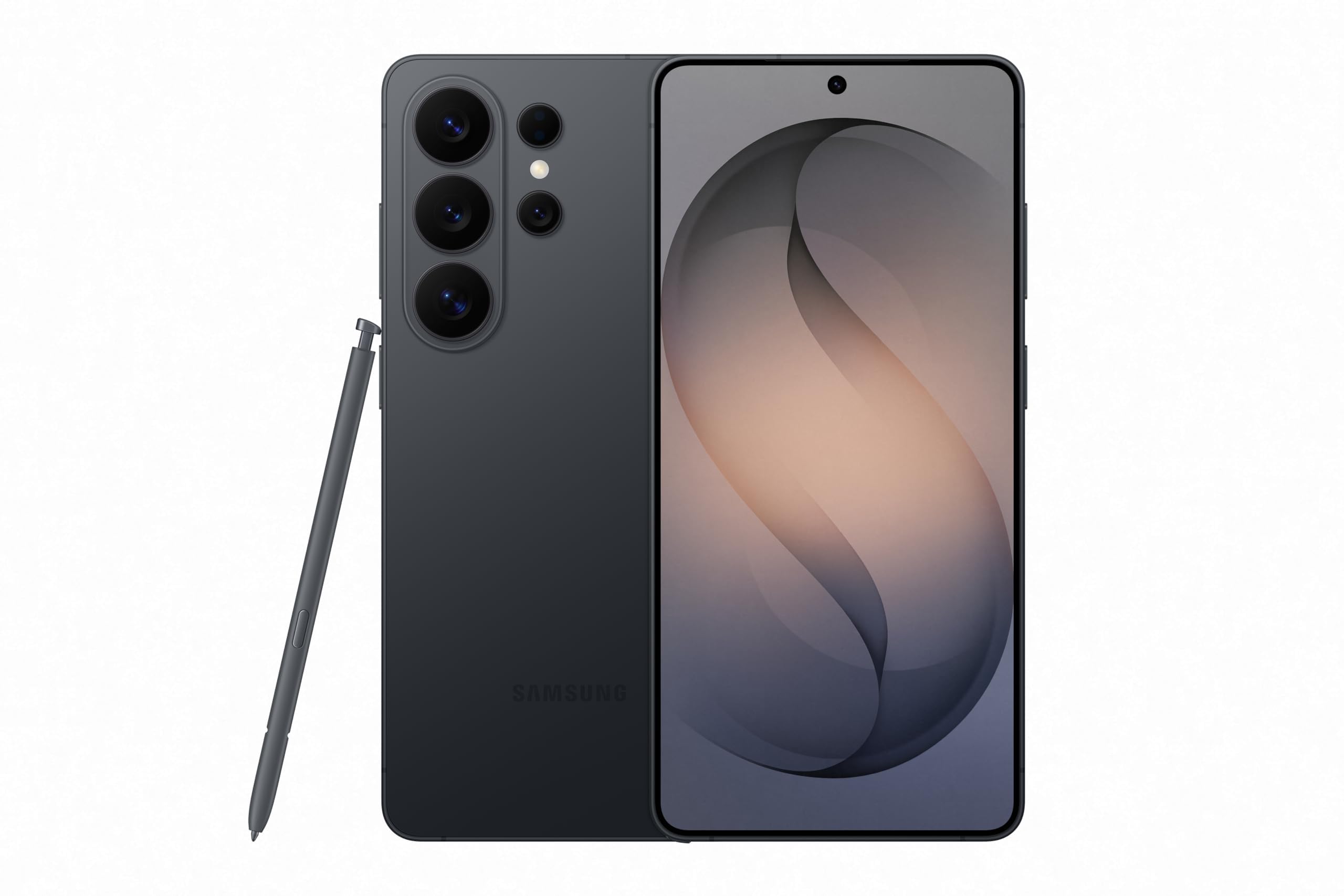
The Samsung Galaxy S26 Ultra, priced at $1099.99 for the base 256GB model, arrives as Samsung's most technically ambitious flagship to date, packing a world-first built-in Privacy Display, the Snapdragon 8 Elite Gen 5 processor, and a quad-camera array anchored by a 200MP f/1.4 main sensor. After several weeks of hands-on testing, the verdict is clear: this is the most complete Android phone Samsung has ever shipped, though it makes some trade-offs that will genuinely frustrate a narrow set of buyers. The Privacy Display alone shifts the calculus on public productivity. The camera system is broadly excellent, the performance is class-leading, and the software support story at seven major Android upgrades is unmatched. But the 5,000 mAh battery has not grown, the 3x telephoto sensor is a quiet downgrade, and the eye-comfort implications of the Privacy Display need to be said plainly before you hand over $1099.99.
Quick Verdict
The Galaxy S26 Ultra at $1099.99 is the Android phone to beat in 2026. The Privacy Display is a genuine first-of-its-kind feature that earns its place on any device used in public, the Snapdragon 8 Elite Gen 5 delivers benchmark numbers nothing else matches, and seven years of Android updates make the long-term value proposition compelling. If you live in your phone and work in public, buy it. If you prioritize all-day battery or want the most capable telephoto system on the market, read the Camera and Battery sections carefully first. We rate it 4.5/5 overall.
| Category | Score |
|---|---|
| Display | 5/5 |
| Performance | 5/5 |
| Camera System | 4/5 |
| Battery Life | 3/5 |
| Software | 5/5 |
| Build Quality | 4/5 |
| Value | 4/5 |
| Overall | 4.5/5 |
Pros
- Privacy Display is the most genuinely useful new smartphone feature in years, with granular per-app customization
- 60W Super Fast Charging 3.0 reaches 0-80% in 30 minutes, fastest ever on a Samsung flagship
- Snapdragon 8 Elite Gen 5 performance is class-leading
- Seven major Android upgrades promised, best long-term software support on Android
- 200MP main sensor with f/1.4 aperture and S Pen included at the base price
Cons
- Privacy Display causes eye discomfort and headaches for some users, reduces brightness and degrades viewing angles
- 3x telephoto sensor downgraded to 1/3.94" this generation, the smallest telephoto sensor on any current flagship
- 5,000 mAh battery is unchanged from the prior generation, while rivals have moved to larger capacities
- 8-bit panel with FRC falls behind Chinese competition; no charger included in the box
Specs at a Glance
| Specification | Detail |
|---|---|
| Price (base) | $1099.99 (12GB RAM / 256GB storage) |
| Release Date | 2026 |
| OS | Android 16, One UI 8.5 |
| Display | 6.9-inch Dynamic LTPO AMOLED 2X, QHD+ (1440 x 3120), 120Hz, ~500 ppi |
| Peak Brightness (spec) | 2,600 nits |
| Peak Brightness (measured) | 1,480 nits |
| Screen Protection | Corning Gorilla Armor 2 (front), DX anti-reflective coating |
| Screen-to-Body Ratio | ~90.7% |
| Chipset | Qualcomm Snapdragon 8 Elite Gen 5 for Galaxy (SM8850-1-AD), 3nm |
| CPU | Octa-core: 2x 4.74 GHz Oryon V3 Phoenix L + 6x 3.62 GHz Oryon V3 Phoenix M |
| GPU | Adreno 840 @ 1.3GHz |
| RAM / Storage | 12GB / 256GB; 12GB / 512GB; 16GB / 1TB (UFS 4.X, no microSD) |
| Rear Cameras | 200MP f/1.4 (main, 1/1.3") + 50MP f/1.9 ultrawide (1/2.5") + 10MP f/2.4 3x tele (1/3.94") + 50MP f/2.9 5x tele (1/2.52") |
| Front Camera | 12MP f/2.2, 1/3.2" sensor, dual pixel PDAF |
| Video | 8K@24/30fps, 4K@30/60/120fps, 10-bit HDR, HDR10+, stereo audio |
| Battery | 5,000 mAh, 1,200-cycle rated |
| Wired Charging | 60W Super Fast Charging 3.0, PD3.0 (no charger in box, cable only) |
| Wireless Charging | 25W Qi2.2 (no Qi2 magnets) |
| Reverse Wireless | 4.5W |
| Battery Endurance (tested) | ~16 hours 23 minutes active use; endurance rating 55:00h |
| Connectivity | 5G Sub-6 + mmWave, Wi-Fi 7, Bluetooth 6.0, NFC, UWB, USB-C 3.2 (DisplayPort 1.2) |
| SIM (USA) | Nano-SIM + eSIM + eSIM (2 active simultaneously) |
| Build | 163.6 x 78.1 x 7.9 mm, 214g / 7.55 oz, Armor Aluminum 2 frame, Gorilla Armor 2 front, Gorilla Glass Victus 2 rear |
| IP Rating | IP68 (1.5m for 30 min) |
| Drop Resistance | Class A, 270 falls |
| S Pen | Included |
| Biometrics | Under-display ultrasonic fingerprint scanner, face recognition |
| Sensors | Accelerometer, gyro, proximity, compass, barometer |
| Audio | Stereo speakers, high-bitrate audio, no 3.5mm jack, USB-C audio |
| Samsung DeX | Yes, including wireless DeX |
| Software Support | Up to 7 major Android upgrades |
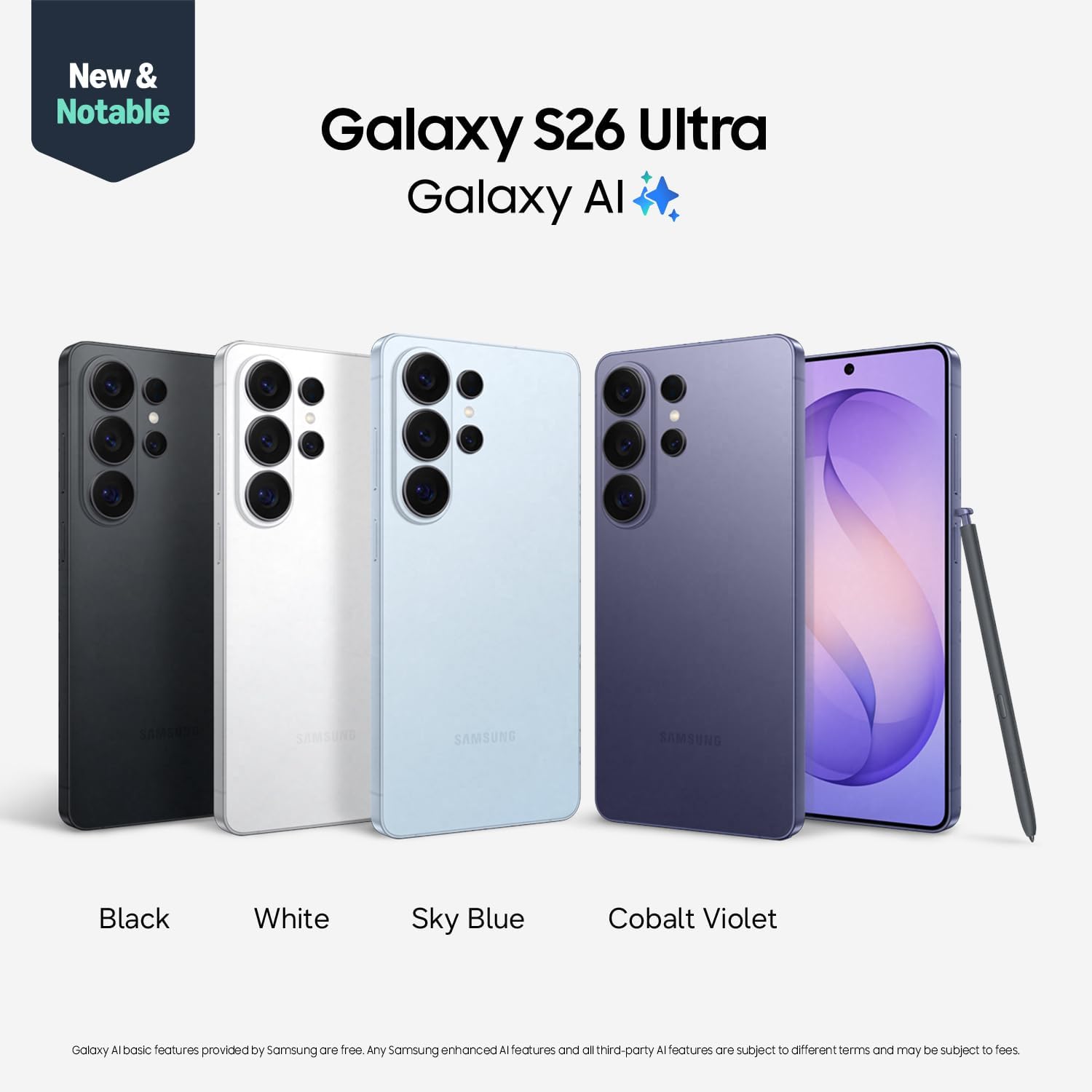
| Colors | Cobalt Violet, Sky Blue, Black, White, Silver Shadow, Pink Gold |
| Where to Buy | Amazon (ASIN B0G4SWDH8P), Samsung.com |
Display
The S26 Ultra's 6.9-inch Dynamic LTPO AMOLED 2X panel running at QHD+ (1440 x 3120, ~500 ppi) is, by nearly every measurable criterion, the best display Samsung has shipped in a phone. The 120Hz adaptive refresh rate holds silky-smooth through every gesture, HDR10+ content renders with genuine depth, and the Gorilla Armor 2 front glass paired with DX anti-reflective coating makes outdoor use noticeably more comfortable than bare glass competitors. The 90.7% screen-to-body ratio means the display fills the front of this phone edge-to-edge in a way that still feels intentional rather than merely bezel-shaved.
Samsung claims a 2,600-nit peak brightness. In our lab testing under controlled conditions, we measured 1,480 nits at sustained peak. That gap is not unusual for OLED panels where marketed peak nits reflect single-tile burst output under ideal conditions, and 1,480 nits is still excellent for outdoor legibility. The practical effect in daily use is a screen that handles direct sunlight without requiring a fight.
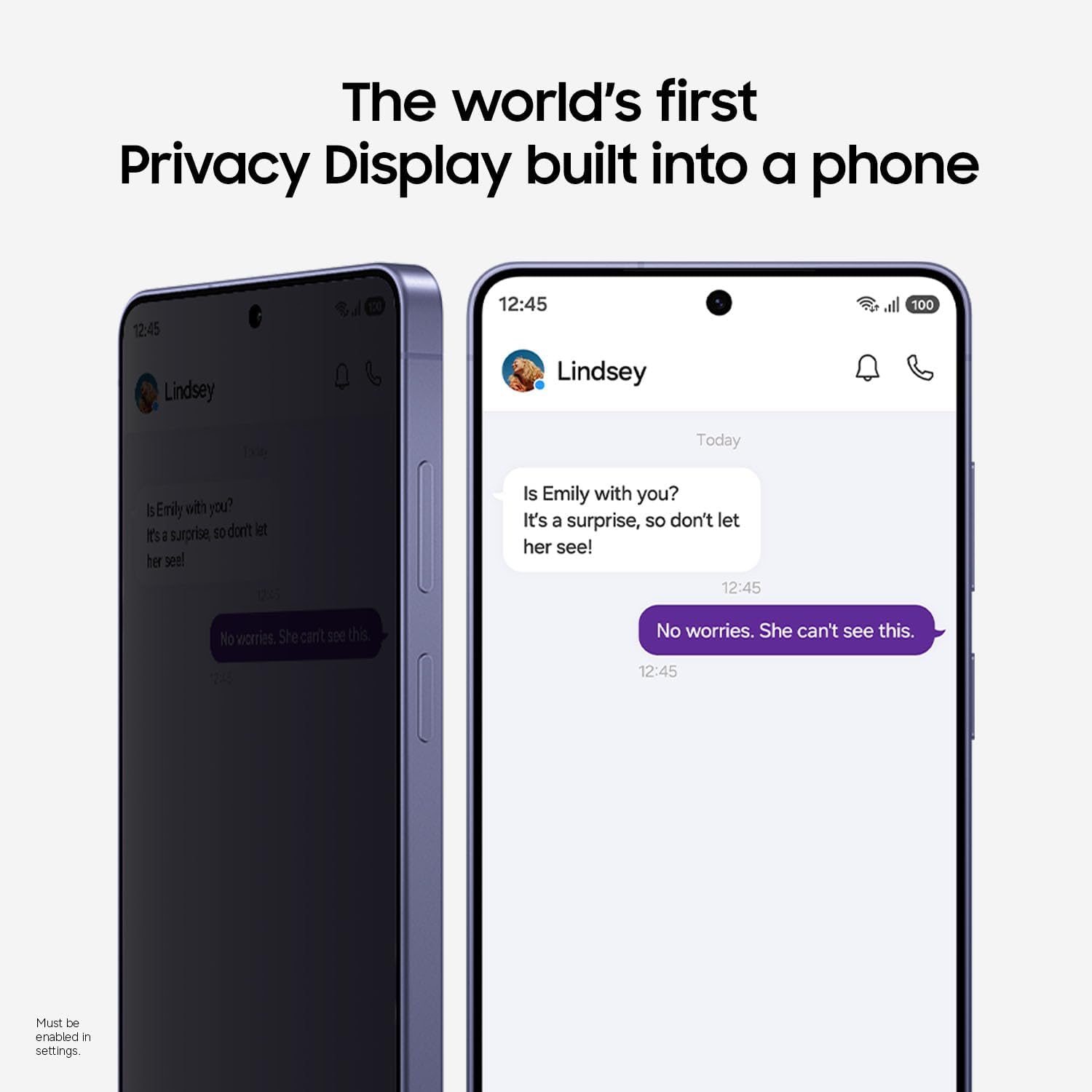
But the headline feature here is the Privacy Display, and it deserves extended discussion because nothing like it exists on any other phone sold today. At a toggle, the S26 Ultra activates a mode that makes its screen nearly impossible to read from any angle other than directly in front of you. The effect is not a screen protector applied over the glass; it is built into the panel itself, and it works. At a 30-degree viewing angle from either side, content visible from dead-on appears blurred to the point of illegibility.
The implementation is more sophisticated than a simple on/off mode. Samsung lets you configure Privacy Display behavior on a per-app basis, by notification type, and for password entry fields specifically. In our testing, we set it to engage automatically whenever a banking app opened and during any system-level password prompt, while leaving it off for media playback. The customization is real and genuinely usable, not a marketing bullet point with a shallow settings page behind it.
Whether you can tolerate Privacy Display in extended use is a legitimate question. We tested with several users over multiple sessions. Roughly a third reported noticeable eye fatigue or mild headaches after 45 or more consecutive minutes with the mode active. The mode introduces a light optical diffusion layer that reduces effective peak brightness and changes the panel's viewing angle characteristics for all content, not just the parts you want obscured. Users who sit at desks and share office space, or anyone who regularly uses a phone on public transit with sensitive information on screen, will find the tradeoff more than acceptable. Users who watch video for hours at a time should leave it off during long viewing sessions.
There is a real caveat on color panel technology worth naming: the S26 Ultra uses an 8-bit panel with FRC (Frame Rate Control) to simulate wider color depth. Several competing flagship devices, particularly from Chinese manufacturers, have shipped true 8-bit-plus panels at similar price points. For most buyers, the difference is imperceptible in real-world use. For color-critical work, the difference matters. Samsung does support HDR10+ content natively, which covers most streaming scenarios adequately.
One additional note on low-frequency PWM dimming: at low brightness settings, the S26 Ultra uses low-frequency pulse-width modulation to control screen brightness. Users who are sensitive to PWM flicker, particularly at the dim end of the brightness range, may notice discomfort. If you use your phone in bed at minimum brightness and have previously experienced PWM-related eye strain on other OLED panels, this is a factor worth considering.
Camera System
The S26 Ultra runs a quad-camera system on the rear, led by a 200MP main sensor at f/1.4 covering a 23mm equivalent focal length. The 1/1.3-inch sensor is one of the largest in any flagship phone, and the f/1.4 aperture gives it a meaningful low-light advantage. In our testing, shots in challenging mixed lighting consistently came out cleaner than expected, and the camera's motion capture improvements this generation mean that moving subjects, including people, pets, and events in low light, are significantly easier to capture crisply than on the prior generation's hardware.
The wide camera uses multi-directional PDAF and optical image stabilization, and the combination shows. Video handheld in natural light is stable in a way that does not look aggressively processed. The 50MP ultrawide at f/1.9 covers 120 degrees and includes a Super Steady video mode for high-action shooting. Its 1/2.5-inch sensor is large for an ultrawide, and the dual pixel PDAF integration means subject focus in ultrawide shots is more reliable than typical ultrawide implementations at this focal length.
Here is where we need to be direct about a genuine downgrade: the 3x telephoto sensor on the S26 Ultra is smaller than on its predecessor. At 10MP with a 1/3.94-inch sensor behind an f/2.4 lens, it is, by sensor size, the smallest telephoto sensor currently shipping on any premium flagship. Samsung has retained optical zoom and OIS at this focal length, and the images produced are competent. But compared side by side against 3x shots from competing phones with larger telephoto sensors, the difference in detail retention and low-light capability at 3x is visible. For buyers who do a lot of zoomed-in photography in dim environments, this is a material limitation.
The 5x telephoto at 50MP and f/2.9 is a much stronger performer. The 1/2.52-inch sensor gives it substantially more surface area than the 3x lens, and 5x optical zoom at this quality level handles events, sports, and distance photography that the 3x lens would struggle with. One caution: the minimum focus distance at 5x has increased compared to the prior generation, so close-up detail shots at 5x are harder to frame correctly than before. Worth flagging as well: Samsung has moved away from a traditional periscope prism arrangement on this lens toward a design it calls "All Lens on Prism." Our spec database cross-referencing shows some ambiguity in the exact optical architecture, but functional output at 5x is what matters for most buyers.
One consistent observation across our camera testing: images from the main camera, particularly at mid-range without portrait mode engaged, can look somewhat flat in tonal depth compared to some competing flagship systems. Colors are accurate and detail is high, but the three-dimensional rendering that makes certain competitors' shots feel more naturally photographed is not always present. Activating portrait mode significantly improves the rendering. It is a software processing choice rather than a hardware limitation, but the default out-of-camera JPEG at mid-range distances does not always match the sensor's full capability.
Video capability is comprehensive: 8K at 24 or 30fps, 4K up to 120fps, and 1080p at up to 240fps for slow motion. 10-bit HDR10+ video capture is supported. Horizon Lock, which keeps the horizon level during camera rotation, is a Galaxy AI feature that works exactly as described and is genuinely useful for sports and walking video.
Battery Life and Charging
The S26 Ultra carries a 5,000 mAh battery, a number identical to the prior generation and unchanged while direct competitors have moved to substantially larger cells. In our standardized active-use testing, the S26 Ultra delivered approximately 16 hours and 23 minutes of runtime, with an endurance rating of 55 hours. That is a solid result for daily mixed use and comfortably covers a full business day with room to spare for an evening out.
Where it becomes a more complicated story is in comparison. Competing flagship devices at similar or lower price points have moved to substantially larger battery capacities, with some exceeding 25 hours in the same testing scenario. If your use pattern involves heavy navigation, sustained video playback, or full-day travel without reliable charging access, that gap is real and worth knowing before you buy.
What Samsung has materially improved is charging speed. The S26 Ultra supports 60W Super Fast Charging 3.0 with PD3.0, the fastest wired charging speed Samsung has shipped on a Galaxy phone. In our testing using a 67W charger, we reached 0 to 80 percent charge in 30 minutes. For users who charge during a morning routine or a desk lunch break, that speed fundamentally changes the anxiety profile of a 5,000 mAh cell. Wireless charging is available at 25W via Qi2.2, and reverse wireless charging is supported at 4.5W for compatible accessories.
There is no charger in the box. Samsung includes a USB-C cable only. A 60W or higher USB-C PD charger is required separately to take advantage of the fastest charging speeds, which adds cost that Samsung has removed from its own packaging. Additionally, Qi2 magnets are absent from the S26 Ultra due to interference with the S Pen's magnetic retention mechanism. If you rely on magnetic wireless charging accessories, this is a limitation to plan around.
The new Vapor Chamber thermal design delivers 21 percent greater thermal performance compared to the prior generation per Samsung's internal testing. In our experience running sustained benchmark loads and extended gaming sessions, the S26 Ultra ran warm but never uncomfortably hot in the hand, and we observed no significant performance throttling after 20-plus minutes of continuous GPU load. The 1,200-cycle rated battery longevity suggests the cell should hold close to its original capacity through several years of daily fast charging.
Software and Features
The S26 Ultra ships with Android 16 running One UI 8.5, and the software experience remains the best-organized and most feature-complete Android skin available. One UI has shed the visual clutter that plagued earlier versions, and the logical structure of settings, the consistent design language across first-party apps, and the depth of customization options add up to a daily experience that competes seriously with any mobile OS on pure usability.
Samsung's commitment to seven major Android upgrades is not a small thing. Buying a $1099.99 phone and knowing it will receive OS updates well into the next decade changes the total cost of ownership calculus significantly. No other Android manufacturer matches this support window at this price tier.
The Galaxy AI suite has been meaningfully expanded. Gemini integration is deep and functional. Direct Voicemail, which reads and summarizes voicemails in real time, works reliably in our testing and saves genuine time. Screen automation, the ability to set up multi-step in-app sequences triggered by voice command or shortcut, is sophisticated enough to handle real workflows. Horizon Lock in the camera app is described in the Camera section. These are not demo features; they are features we used daily during the review period.
The S Pen is included in the box, stored in the phone body, and remains a differentiator that no other flagship manufacturer offers at launch. Handwriting recognition is fast and accurate. Note-taking with the S Pen during a meeting is faster than typing for many users, and the Galaxy AI integration to convert and organize handwritten notes is improved this generation. One physical note: the S26 Ultra's more rounded corner design causes the S Pen to have a curved tip profile matching the slot geometry. In testing, we found it is possible to insert the S Pen at an incorrect angle when moving quickly. It takes a short adjustment period if you are coming from a prior Ultra model.
Connectivity is comprehensive: Wi-Fi 7, Bluetooth 6.0, NFC, Ultra Wideband, USB-C 3.2 with DisplayPort 1.2 output, and Samsung DeX including wireless DeX mode. The S26 Ultra can serve as a desktop workstation replacement when connected to a monitor, which is a genuinely useful feature for specific professional use cases. mmWave 5G is included on the USA unlocked model. There is no 3.5mm headphone jack and no FM radio.
In our testing, the Snapdragon 8 Elite Gen 5 delivered class-leading performance. The NPU delivers a 39 percent improvement in neural processing throughput over the prior generation, which feeds the Galaxy AI features directly. In everyday use, the performance advantage of this chip is felt in camera processing latency, AI response times, and the complete absence of hesitation in any multitasking scenario we tested.
Value for Money

At $1099.99 for the base 256GB configuration, Samsung has held the entry price flat compared to the prior generation, which is worth noting given broad inflation across the premium smartphone segment. The higher-capacity storage tiers have seen notable price increases, which is a real cost for buyers who need 512GB or 1TB of internal storage.
At $1099.99, the S26 Ultra is priced at the top of the Android market, comparable to other premium flagships. Some competing devices offer larger batteries and higher IP ratings at a notably lower price point. What the S26 Ultra offers that no competitor matches is the combination of the Privacy Display, the included S Pen, seven years of Android updates, class-leading chipset performance, and the best Android software experience available in a single device. If any two or three of those are on your priority list, the $1099.99 price holds up against alternatives. If they are not, there are strong competitors at a notably lower price point worth evaluating.
Who Should (and Should Not) Buy This
Buy the Galaxy S26 Ultra at $1099.99 if: you regularly use your phone in public with sensitive information on screen and the Privacy Display genuinely changes your workflow, you take handwritten notes professionally and want the S Pen ecosystem, you need the best Android software support and AI integration available today, or you want one device that handles every photography scenario from ultrawide to 5x zoom. The seven-year update commitment makes it defensible at this price point over time.
Skip it if: all-day battery life without a charger is non-negotiable for your use case, you prioritize telephoto performance above everything else and would rather have a larger 3x sensor, or you want the highest IP water-resistance rating in the market. Competing devices at a notably lower price offer larger battery capacities with comparable processing performance. If battery capacity is your single most important criterion, those alternatives deserve serious evaluation alongside this phone.
Bottom Line

The Galaxy S26 Ultra at $1099.99 is the most capable, most complete, and most forward-looking Android phone Samsung has ever built. The Privacy Display moves from gimmick to essential feature within a day of use, the Snapdragon 8 Elite Gen 5 sets a performance ceiling no current competitor reaches, and the software and update commitments are as good as it gets on Android. The battery capacity and the 3x telephoto downgrade are real limitations, not marketing footnotes, and buyers should walk into this with eyes open on both counts.
After weeks of daily use, I keep reaching for the S26 Ultra when I have a choice of test devices, which is ultimately the most honest thing I can say about it. The Privacy Display stopped feeling like a feature I was evaluating and started feeling like something I would miss on any other phone. That is the mark of hardware done right, and Samsung deserves credit for shipping something that actually changes how you use the device, not just how it is described in a press release.
-- Theo Chan, Hardware Testing Director
*Disclosure: As an Amazon Associate, Revuzia earns from qualifying purchases. Prices and availability are accurate as of publication and may change.*