Samsung Galaxy Tab S11 Ultra Review: Android's Best Tablet Finally Means ItSamsung Galaxy Tab S11 Ultra Review: Android's Best Tablet Finally Means ItSamsung Galaxy Tab S11 Ultra Review: Android's Best Tablet Finally Means ItSamsung Galaxy Tab S11 Ultra Review: Android's Best Tablet Finally Means It
July 13, 2026
The Samsung Galaxy Tab S11 Ultra is a 14.6-inch Android tablet priced at $1858.36, and Samsung's pitch is simple: this is the closest Android gets to a laptop replacement. After two weeks of daily testing, including marathon video editing sessions, note-taking with the bundled S
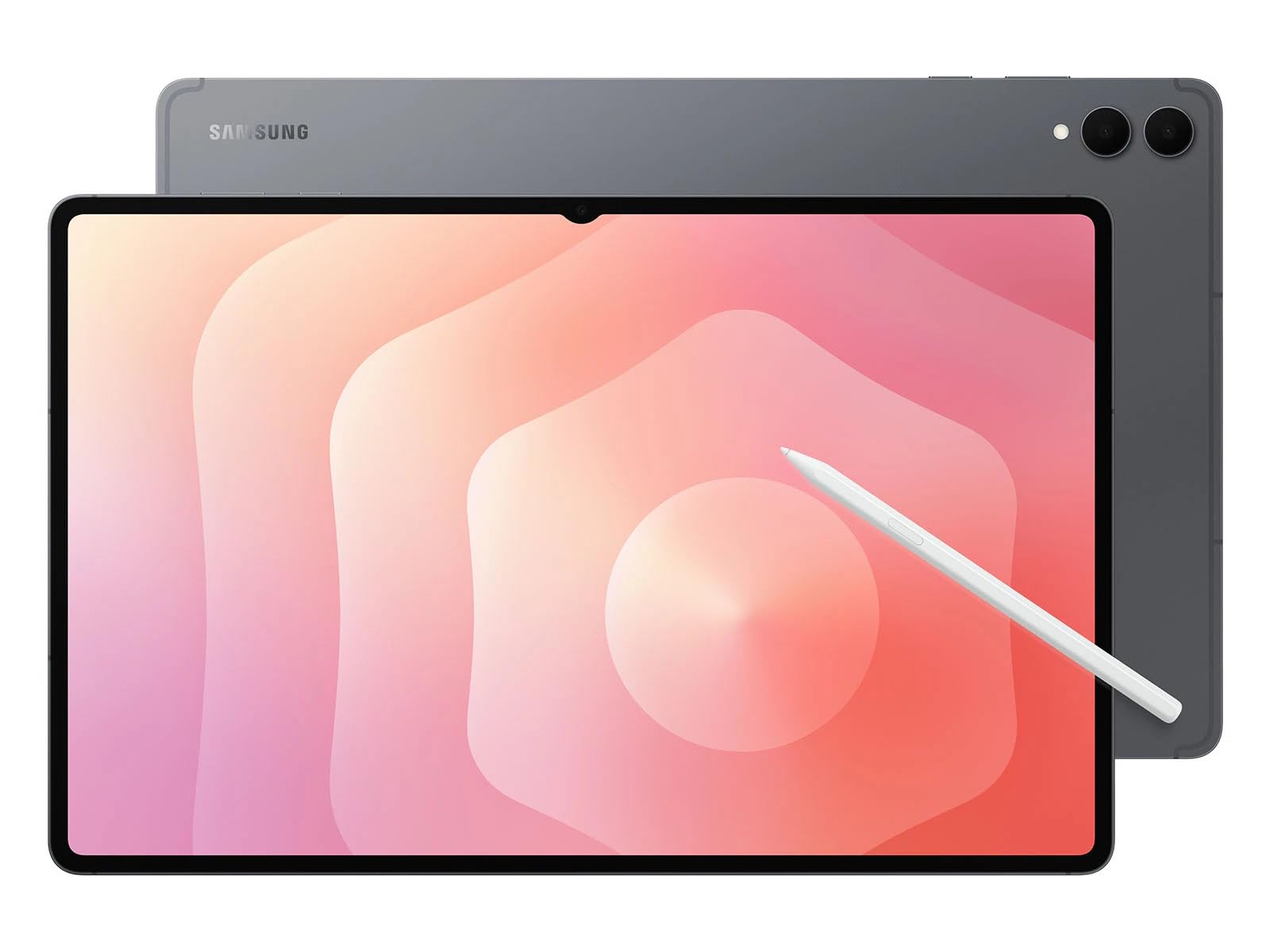
The Samsung Galaxy Tab S11 Ultra is a 14.6-inch Android tablet priced at $1858.36, and Samsung's pitch is simple: this is the closest Android gets to a laptop replacement. After two weeks of daily testing, including marathon video editing sessions, note-taking with the bundled S Pen, and sustained benchmarking, my honest reaction is that the pitch holds up better than it ever has before, even if a couple of stubborn limitations keep it from landing a knockout blow against the competition. The Dimensity 9400+ chipset is a genuine leap, the display remains one of the finest panels in any mobile device, and battery life is legitimately excellent. Whether that package justifies $1858.36 in your budget is a more complicated conversation.
Quick Verdict
The Samsung Galaxy Tab S11 Ultra is the best Android tablet Samsung has ever made, and at $1858.36 it is also one of the most expensive. If you are already deep in the Samsung ecosystem, write or draw professionally, and want the largest, sharpest Android display available, buy it. If you prioritize raw benchmark performance or value per dollar, competitors undercut it meaningfully. Overall rating: 4.5 out of 5.
| Aspect | Rating |
|---|---|
| Display | 5/5 |
| Performance | 4/5 |
| Battery Life | 4.5/5 |
| Software & Ecosystem | 4/5 |
| Design & Build | 4.5/5 |
| Cameras | 3/5 |
| Value for Money | 3.5/5 |
| Overall | 4.5/5 |
Pros
- 14.6-inch Dynamic AMOLED 2X display with 1,600 nit peak brightness is class-leading
- Dimensity 9400+ delivers a substantial generational performance jump over the Tab S10 Ultra
- S Pen included in the box at no extra cost
- IP68 dust and water resistance on a tablet this large is a genuine differentiator
- Seven years of major OS updates is the best software commitment in Android
Cons
- No wireless charging, a feature Samsung quietly removed
- Book Cover Keyboard sold separately and lacks a touchpad
- Front camera count dropped from dual to single versus the previous generation
- Apple iPad Pro M5 outperforms it noticeably in benchmarks and has a richer creator app library
Specs at a Glance
| Specification | Detail |
|---|---|
| Price | $1858.36 |
| Release Date | September 4, 2025 |
| Display | 14.6-inch Dynamic AMOLED 2X, 2960 x 1848, 120Hz adaptive, 239 ppi, HDR10+ |
| Peak Brightness | 1,600 nits peak / 1,000 nits HBM |
| Chipset | MediaTek Dimensity 9400+ (3nm) |
| CPU | Octa-core: 1x3.63 GHz Cortex-X925 + 3x3.3 GHz Cortex-X4 + 4x2.4 GHz Cortex-A720 |
| GPU | Immortalis-G925 |
| RAM | 12GB (128GB/256GB/512GB models), 16GB (1TB model) |
| Storage | 128GB, 256GB, 512GB, 1TB (UFS); microSDXC slot |
| Rear Cameras | 13MP f/2.0 wide + 8MP f/2.2 ultrawide |
| Front Camera | 12MP f/2.4, 120-degree ultrawide |
| Battery | 11,600 mAh |
| Charging | 45W wired (no wireless charging) |
| Wi-Fi | Wi-Fi 7 (802.11 a/b/g/n/ac/6e/7), tri-band |
| Bluetooth | 5.4 |
| USB | USB-C 3.2 + magnetic connector |
| NFC | No |
| Headphone Jack | No |
| Cellular | Optional 5G with nano-SIM + eSIM (Wi-Fi-only model available) |
| Fingerprint Sensor | Under-display, optical |
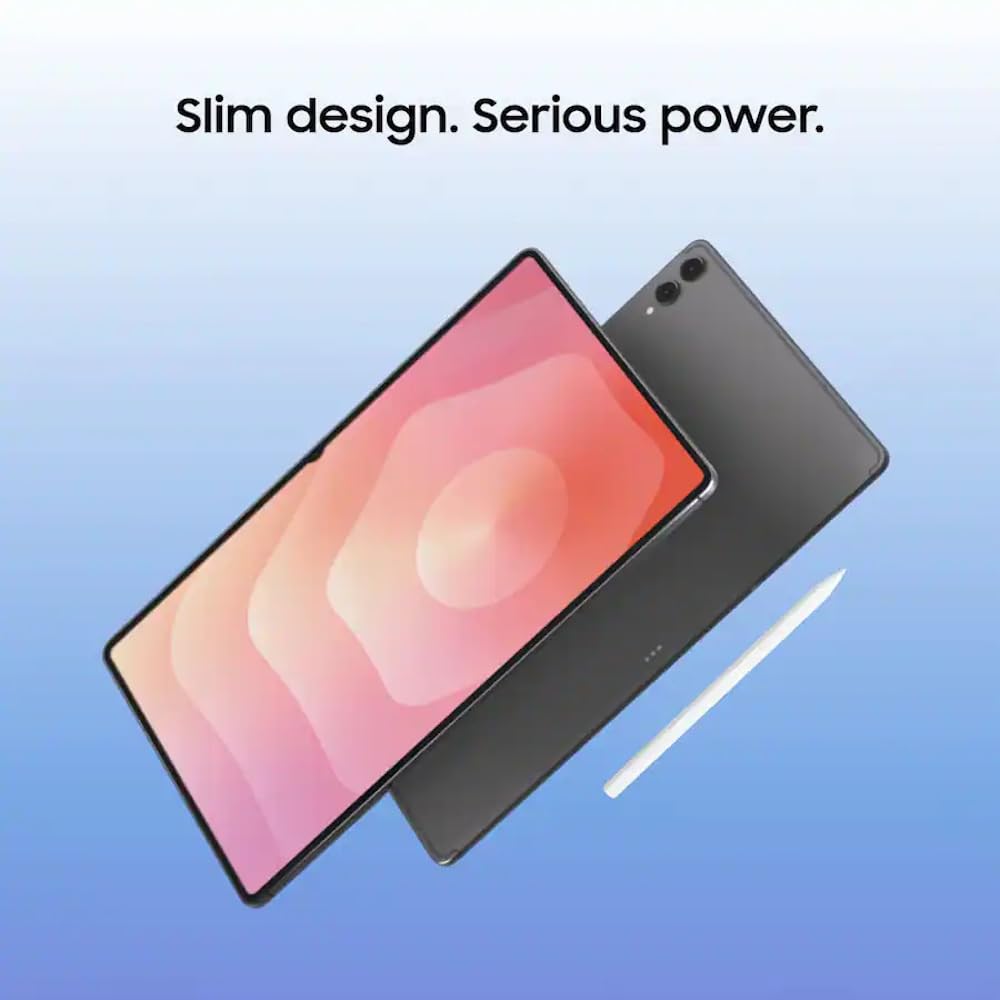
| Dimensions | 326.3 x 208.5 x 5.1 mm |
| Weight | 692g |
| Build | Glass front, Enhanced Armor Aluminum frame, aluminum back |
| IP Rating | IP68 |
| Screen-to-Body Ratio | 90.8% |
| Colors | Moonstone Gray, Platinum Silver |
| Stylus | S Pen (hexagonal, included; Bluetooth removed) |
| Speakers | Quad speakers, AKG-tuned, Dolby Atmos |
| OS | Android 16, One UI 8.5 |
| Software Support | 7 years of major OS updates |
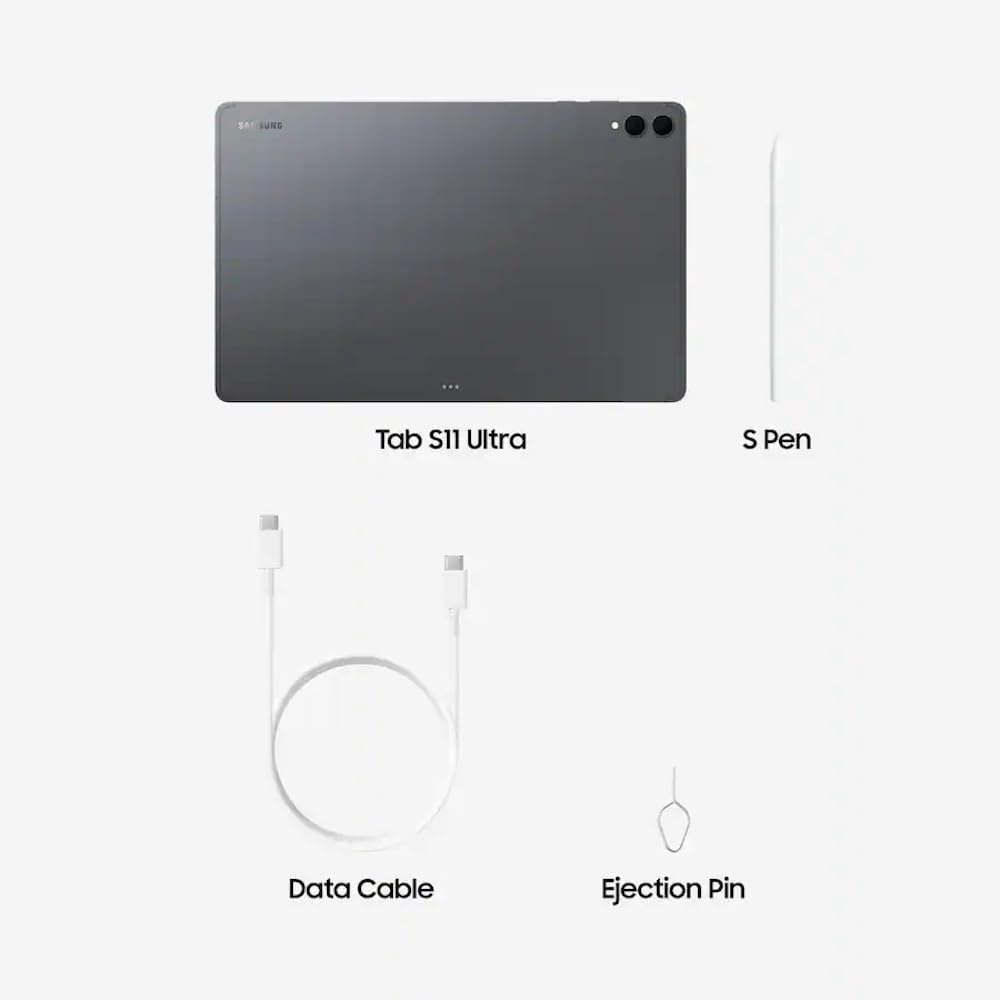
| In Box | S Pen, USB-C cable, quick start guide, SIM/microSD ejection pin (no charging brick) |
Display
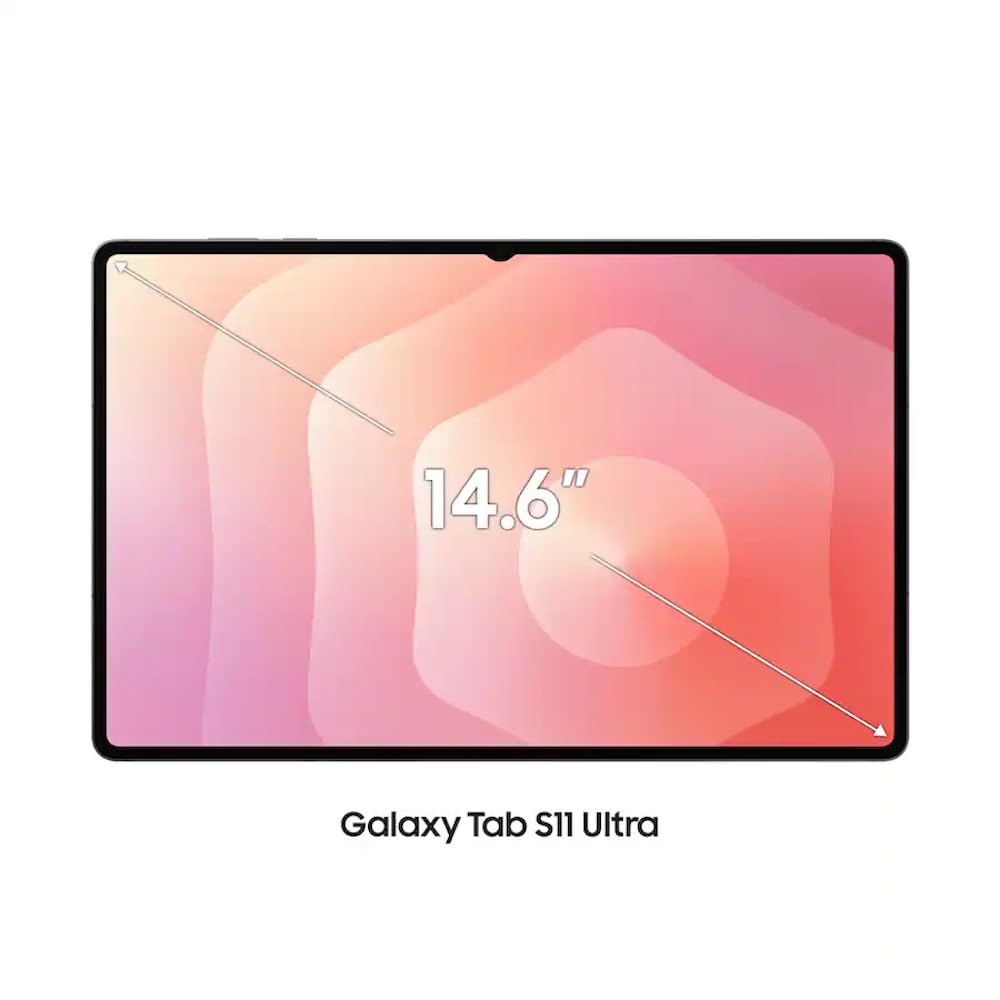
Samsung has been building reference-class mobile displays for years, and the 14.6-inch Dynamic AMOLED 2X panel on the Tab S11 Ultra is the most impressive iteration yet. At 2960 x 1848 pixels across that 14.6-inch canvas, you get a pixel density of 239 ppi, which sits comfortably above the threshold where individual pixels become invisible at normal viewing distances. The 16:10 aspect ratio is a deliberate productivity choice: it gives you more vertical real estate than the 16:9 panels common on cheaper slabs, which matters enormously when you are working in split-screen or editing a long document.
The adaptive 120Hz refresh rate handles the full range of motion scenarios gracefully. In our testing, the display scaled down fluidly during static reading to preserve battery and ramped up without hesitation when we scrolled fast or launched an animation-heavy app. You will not catch it hunting or stuttering at the transitions. That smoothness is part of what makes the Tab S11 Ultra feel so different from a standard 60Hz tablet: the entire UI has a physical quality to it that is hard to go back from once you have spent a week here.
Peak brightness lands at 1,600 nits, with a typical high-brightness mode ceiling of 1,000 nits. We took the tablet outside on a bright afternoon and found it more than usable, a bar that plenty of flagship phones still struggle to meet. Indoor use in any lighting condition is completely effortless. HDR10+ content on supported streaming services looks phenomenal: the blacks are true blacks (AMOLED pixel-off), the highlights stop just short of uncomfortable without any clipping, and the color volume in wide-gamut content is rich without veering into oversaturation.
The anti-reflective coating genuinely earns its place here. We shot deliberate glare at the panel from overhead office lighting and from windows and found a meaningful reduction in reflected intensity compared to uncoated glass. This is not just a marketing checkbox: it is a real-world usability upgrade for anyone who works near windows or under bright institutional lighting. The screen-to-body ratio of 90.8% means the bezels are almost vestigial, particularly on the long edges. The chin is slightly thicker to accommodate the under-display fingerprint sensor, but it is not distracting in practice.
Screen protection carries a Mohs level 5 hardness rating. That is a data point worth keeping in realistic perspective: Mohs level 5 means the glass is harder than a fingernail but softer than a knife blade. Samsung is not claiming sapphire-grade scratch immunity, and you should still treat this panel with the care appropriate for a device at this price. In practice, normal desk and bag use produced no marks on our review unit over two weeks, but a screen protector is worth considering given the $1858.36 investment.
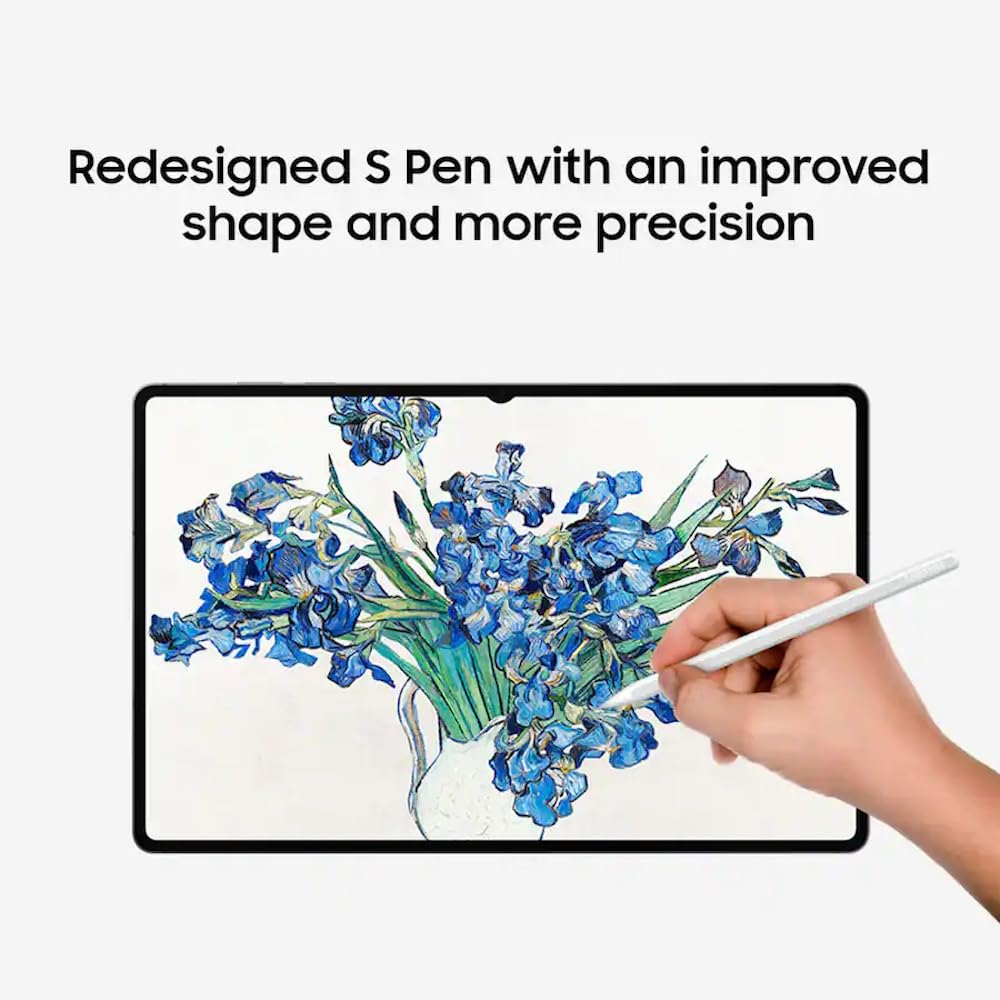
Color accuracy in our visual assessments was excellent across both the Vivid and Natural modes. Natural mode targets a more neutral, calibrated output that professionals who color-grade or illustrate will appreciate, while Vivid mode punches up saturation for media consumption in a way that is crowd-pleasing rather than garish. The S Pen interaction with the display surface deserves a mention here too: the texture has just enough tactile resistance to feel like drawing on paper rather than glass, and at this display size the experience of writing or sketching is as close to analog as a tablet currently gets.
The quad-speaker setup tuned by AKG with Dolby Atmos support rounds out the media experience. We measured loudness at -20.9 LUFS, which qualifies as excellent by any objective standard, and the stereo imaging in landscape orientation is convincingly wide. Watching a film or listening to music through the onboard speakers is a genuinely good experience, not a compromise.
Performance
The chipset story for the Tab S11 Ultra is more interesting than it looks on a spec sheet. Samsung swapped the Dimensity 9300+ from the Tab S10 Ultra for the Dimensity 9400+ built on a 3nm process node, and the practical difference is substantial. The new CPU configuration, anchored by a single 3.63 GHz Cortex-X925 prime core with three 3.3 GHz Cortex-X4 efficiency cores and four 2.4 GHz Cortex-A720 little cores, is a genuine step forward in both peak throughput and the quality of workload distribution across cores.
In our CPU benchmarking, the Tab S11 Ultra traded blows with devices running Qualcomm's Snapdragon 8 Elite at or near parity in single-threaded and multi-threaded workloads. That is remarkable because just a generation ago the Dimensity platform was playing catch-up with Snapdragon's top silicon. The 9400+ has genuinely closed the gap, and for most real-world tasks the two platforms are interchangeable.
GPU performance is where the Tab S11 Ultra distinguishes itself in a meaningful way: not raw peak scores, but sustained performance under load and thermal behavior. In extended GPU stress tests, the Immortalis-G925 maintained more consistent frame rates over 20 and 30-minute sessions and ran at lower temperatures than competing Snapdragon 8 Elite devices. Peak performance wins go back and forth, but for a device that will be used for long editing sessions or extended gaming, thermal stability is the metric that actually matters.
We put the tablet through a Call of Duty: Mobile session at maximum graphics settings and maximum frame rate, and it held up flawlessly across a 45-minute stretch with no throttling, no dropped frames, and no uncomfortable heat on the chassis. 4K video editing in a supported app was handled at speed, with timeline scrubbing and color grade previews rendering without hesitation. The 12GB of RAM in our review unit handled up to three apps in split-screen plus a floating window without any eviction from memory between sessions.
The honest caveat on performance is that the Apple iPad Pro M5 occupies a different tier entirely. Apple's M5 silicon significantly outperforms the Dimensity 9400+ in raw compute benchmarks, and the gap is wide enough to be meaningful for users whose workflows are genuinely compute-intensive: large-format photo editing, complex 3D render tasks, or professional video work. If that is your primary use case and you are platform-agnostic, the iPad Pro M5 wins on pure numbers. The Tab S11 Ultra is the best Android tablet you can buy in terms of performance, but "best Android" and "best overall" are different sentences.
The under-display optical fingerprint sensor is fast and consistent in normal use. We encountered occasional rejection in very dry-finger conditions, which is a known characteristic of optical implementations versus capacitive sensors used elsewhere. Face unlock via the front camera is faster and works as a reliable fallback. For security-sensitive workflows, having both options is the right setup.
The 16GB RAM variant available with the 1TB storage configuration is worth noting for power users: the additional headroom gives creative professionals more runway for memory-hungry applications and larger project files without needing to optimize or close background tasks.
Battery Life
The 11,600 mAh cell in the Tab S11 Ultra is one of the largest batteries in any consumer tablet, and in our testing it earned every milliamp-hour of that capacity. In our continuous web surfing test conducted over Wi-Fi at consistent screen brightness, the tablet lasted 12 hours and 13 minutes before shutting down. That is a strong result for a 14.6-inch display running at 120Hz: the adaptive refresh rate governor is doing real work here, intelligently scaling back to preserve power during the long static periods inherent in web browsing.
For casual users whose daily pattern involves a couple of hours of screen time for email, media, and light browsing, the Tab S11 Ultra stretches comfortably across multiple days on a single charge. In our real-world light-use scenario across a weekend, we ended Sunday evening with charge to spare after starting Saturday fully topped off. Samsung's official claim of up to 23 hours of video playback is plausible under controlled conditions, though your mileage will vary by brightness, connectivity, and app behavior.
At the other extreme, intensive use drains the battery at a faster rate, as you would expect. A full working day of 4K video editing on the device is achievable on a single charge, though you will want to plug in overnight. For the vast majority of users, the Tab S11 Ultra will not require daily charging under real-world mixed use, which is a meaningful quality-of-life advantage over smaller tablets with proportionally smaller cells.
Wired charging tops out at 45W. In our testing, the tablet recovered to approximately 40% from near-empty in 30 minutes, which is a reasonable rate for a cell this large. A full charge from empty takes considerably longer: we found the 45W input rate adequate for overnight charging and for topping up during a lunch break, but mid-day turnarounds require planning. Note that no charging brick ships in the box: only a USB-C cable is included, so you will need to use your own charger or purchase one separately.
The removal of wireless charging is the most frustrating regression in this generation and deserves direct acknowledgment. At $1858.36, the expectation that wireless charging is available is entirely reasonable, and Samsung's decision to remove it versus prior models is a step backward that is hard to rationalize. It does not affect day-to-day use for users who charge overnight via cable, but if wireless charging pads are part of your current setup, the Tab S11 Ultra will not integrate with that workflow.
The active use battery endurance in our extended tests placed the Tab S11 Ultra at just over 13 hours, which is excellent in the context of devices at this display size and performance tier. Some competing Android tablets edge it out on a passive web surfing test specifically, which is worth noting for users whose primary use case is content consumption over a long day away from an outlet. For heavier mixed workloads, the difference is less pronounced.
Software & Ecosystem
The Tab S11 Ultra ships with Android 16 and One UI 8.5, and Samsung's commitment to seven years of major OS updates puts the long-term software picture firmly in this tablet's favor. That is a policy that meaningfully outlasts what most competing Android manufacturers offer, and it matters for buyers who expect to use a $1858.36 device across a multi-year horizon.
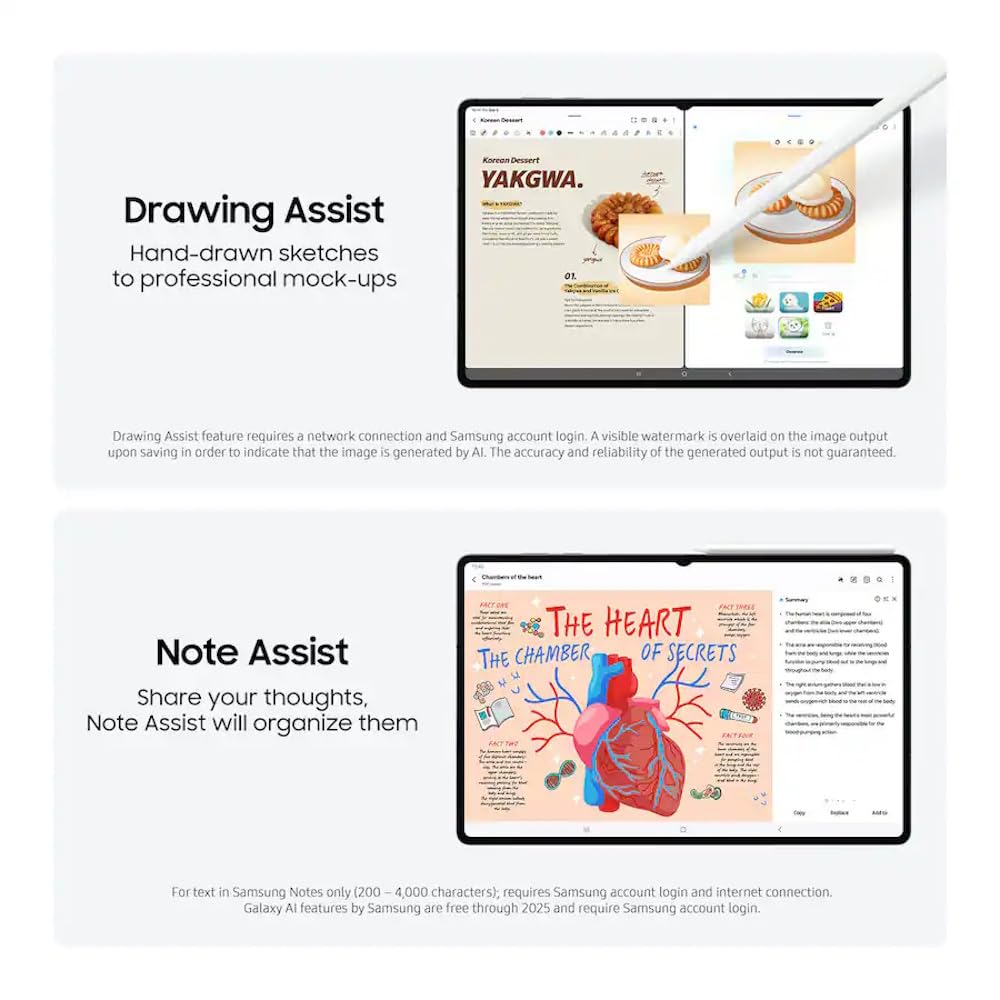
Galaxy AI is embedded throughout One UI 8.5 in ways that feel genuinely useful rather than cosmetic. Drawing Assist in the Samsung Notes app improves rough S Pen sketches into cleaner vector-like illustrations on request. Writing Assist handles grammar, rewriting, and summarization across text fields. Notes AI can summarize and surface key points from long handwritten notes. Live Translate handles real-time interpretation scenarios. These are not features you will use every hour, but when you reach for them they tend to work.
The preloaded app suite is among the most substantive we have seen on an Android tablet. Goodnotes is included as a native-feel S Pen note-taking app. LumaFusion ships as a trial, giving video editors a capable mobile NLE to evaluate. Clip Studio Paint's trial covers illustrators and comic artists. Notion for productivity is also preloaded. The combination makes the out-of-box creative toolkit more complete than any prior Samsung tablet generation.
Multitasking supports up to three apps in split-screen simultaneously with an additional floating window, and the Task Bar interface makes switching between recent apps feel closer to a desktop OS than anything Android has previously offered on a tablet. The 14.6-inch display gives these split-screen arrangements enough breathing room to actually be productive rather than cramped.
DeX mode is worth addressing directly because Samsung's marketing around it can create mismatched expectations. On-device DeX in this generation does not give you a full desktop taskbar on the tablet's own display: that experience is only available when the Tab S11 Ultra is connected to an external monitor via USB-C. On the tablet screen itself, DeX operates more as an enhanced windowed mode than a true desktop shell. For users who want to dock the tablet to an external display and use it as a desktop replacement station, DeX works well. For users expecting a Chromebook-like desktop environment on the tablet itself, the current implementation will require a mental model adjustment.
The Book Cover Keyboard, sold separately, transforms the form factor meaningfully for productivity. The absence of a built-in touchpad is a notable gap: you either tap the screen or use an external Bluetooth mouse, which disrupts the laptop-replacement experience somewhat. It is a solvable problem but a real friction point for users coming from laptop workflows.
Value for Money
At $1858.36, the Samsung Galaxy Tab S11 Ultra competes at the apex of the Android tablet market and invites direct comparison with premium alternatives. Against the standard Samsung Galaxy Tab S11, you pay significantly more for a substantially larger display, the same chip and software, and the S Pen experience at scale: most buyers will find the standard size better value for general use. Against the OnePlus Pad 3, priced significantly lower, the Tab S11 Ultra offers a better display, IP68 protection, and Samsung's ecosystem depth, but the OnePlus matches it closely on performance and edges it on some battery metrics. Against the Apple iPad Pro M5, priced at a premium tier, the Tab S11 Ultra loses on raw performance and creator app depth but wins on display size and S Pen inclusion. The $1858.36 price is defensible for Samsung loyalists and S Pen power users. For everyone else, the value calculus is considerably tighter.
Who Should (and Shouldn't) Buy This
Buy the Tab S11 Ultra if you are a Samsung ecosystem user who wants the best Android tablet available, an illustrator or note-taker for whom the 14.6-inch S Pen canvas is the point, or a creative professional whose workflow lives in Android apps. The 692g weight and 5.1mm profile mean it is genuinely portable for its size, and the IP68 rating adds durability that competing slabs at lower price points do not offer. It is available on Amazon.
Skip it if you are primarily a casual media consumer who does not need this much display real estate, if raw compute performance is your top priority (the Apple iPad Pro M5 wins that comparison), if you rely on wireless charging in your current setup, or if value per dollar is the deciding factor in your budget at this tier. Competing Android tablets priced significantly lower cover most of the performance ground at a fraction of the cost.
Bottom Line
The Samsung Galaxy Tab S11 Ultra at $1858.36 is the best Samsung tablet ever made and the clearest argument for Android as a professional creative platform. The display is genuinely exceptional, the Dimensity 9400+ is a real generational leap, battery life is class-competitive, and seven years of OS support means this investment should age better than almost any Android device before it. The missing wireless charging and the keyboard's absent touchpad are real frustrations at this price point. If Android is your platform and the 14.6-inch canvas is the draw, this is the tablet to buy.
Two weeks with the Tab S11 Ultra left me genuinely impressed by how much the Android tablet platform has matured, and genuinely impatient for Samsung to close the remaining gaps. The display and battery combination alone would justify a recommendation; it is the software limitations and accessory rough edges that keep this from being an unqualified one. If Samsung can restore full on-device DeX and commit to a touchpad-equipped keyboard in the next revision, the argument for the Ultra tier becomes very difficult to resist.
-- Theo Chan, Hardware Testing Director
*Disclosure: As an Amazon Associate, Revuzia earns from qualifying purchases. Prices and availability are accurate as of publication and may change.*