Notion Custom Agents gain private Slack channel access with granular controlsNotion Custom Agents gain private Slack channel access with granular controlsNotion Custom Agents gain private Slack channel access with granular controlsNotion Custom Agents gain private Slack channel access with granular controls
May 6, 2026
Notion's Custom Agents can now read and respond in private Slack channels as of May 1, 2026, expanding AI assistant access beyond the public-channel limitation that shipped with the initial integration. But the feature requires explicit workspace admin configuration for each
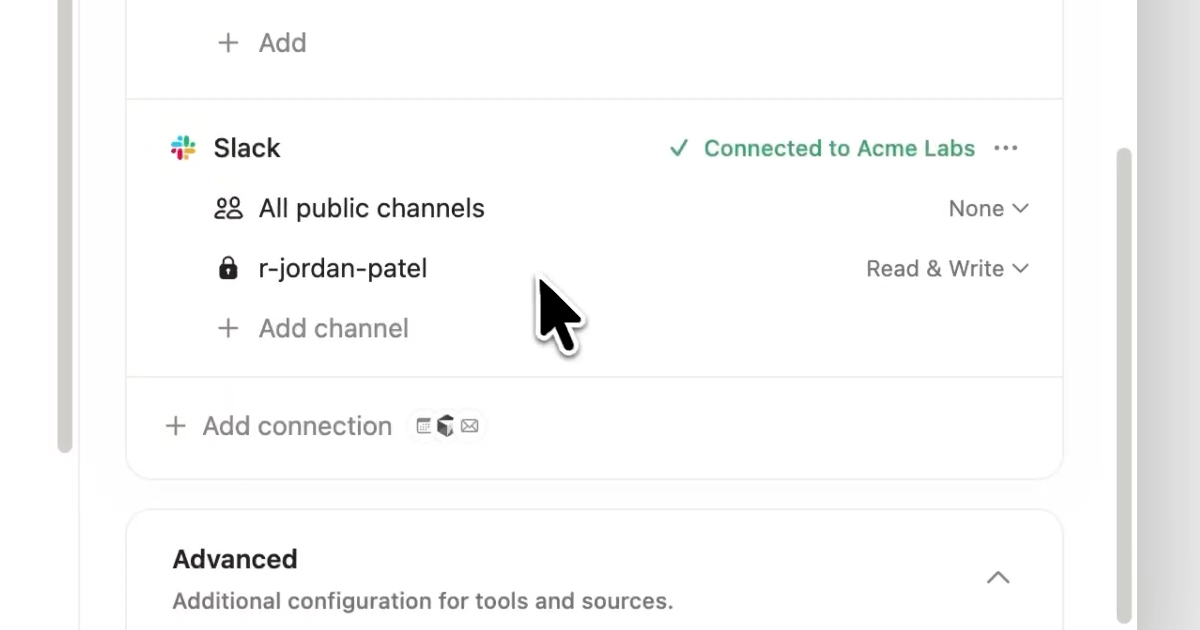
Notion's Custom Agents can now read and respond in private Slack channels as of May 1, 2026, expanding AI assistant access beyond the public-channel limitation that shipped with the initial integration. But the feature requires explicit workspace admin configuration for each private channel, and Notion has not disclosed whether this permission model applies uniformly across Slack's free, Pro, Business+, and Enterprise Grid tiers. For IT teams balancing productivity automation against data exposure in compliance-heavy environments, the channel-by-channel invitation model represents the first granular permission control for third-party AI participants in Slack workspaces.
The update positions AI agents not as passive search tools scanning public repositories, but as active conversation participants with selective visibility into sensitive internal discussions. That shift matters for organizations that have avoided AI integrations specifically because the technology required wholesale access to communication archives.
What's new
Notion launched Custom Agents on February 24, 2026 as part of the Notion 3.3 release, allowing users to create task-specific AI assistants trained on internal documentation, project wikis, and team knowledge bases. The initial Slack integration restricted agents to public channels.
The May 1 release removes that restriction. Custom Agents can now access private channels when workspace administrators enable the feature through Settings → Notion AI → AI connectors → Enable access to private content. Agents see only the channels they are explicitly invited to, preserving the principle of least privilege. An agent invited to the #finance-planning private channel cannot access #legal-review unless separately added.
This differs from Slack's native Slackbot, which has direct access to all messages a user can see. Notion's Custom Agents operate as third-party integrations, meaning their permissions are governed by Slack's OAuth app framework rather than native Slack AI policies. Custom Agents appear in workspace app directories alongside other installed integrations, making them visible to IT administrators reviewing data access logs.
The announcement does not specify what actions Custom Agents can perform in private channels beyond reading messages and posting replies. The permission model suggests agents can search message history within invited channels, tag users, and post threaded responses, but Notion has not disclosed rate limits, data retention policies, or whether agents can react with emoji or upload files.
Why it matters
The private channel access model addresses a specific enterprise objection: AI assistants that require blanket read access to all communications create unacceptable audit exposure. Financial services firms, healthcare organizations operating under HIPAA, and government contractors subject to FedRAMP compliance have rejected AI integrations that cannot demonstrate message-level access controls. Notion's channel-by-channel invitation model gives IT teams a defensible answer when auditors ask, "Which systems can read attorney-client privileged conversations?"
A Custom Agent invited to a #contract-negotiations private channel could surface relevant pricing precedents from past deals stored in Notion databases, without gaining visibility into unrelated private channels discussing personnel issues or M&A strategy. A product team could invite an agent to #beta-testers-feedback to auto-categorize bug reports and feature requests, while excluding it from #roadmap-confidential where unannounced product plans are discussed.
The limitation is that granular permissions require granular management. Organizations with hundreds of private channels face a configuration burden: each channel owner must explicitly add the agent, and workspace admins must audit which agents have been invited where. The permission model prevents accidental over-exposure, but it also prevents centralized policy enforcement. There is no disclosed mechanism for an admin to preemptively block Custom Agent invitations to channels tagged with specific sensitivity labels.
Competitive Landscape

Microsoft Teams, the largest commercial alternative by enterprise seat count, bundles Microsoft Copilot as a native AI assistant with direct access to all Teams channels, SharePoint sites, and Outlook inboxes a user can see. Teams does not offer a third-party AI connector framework equivalent to Notion's Custom Agents; Copilot is the only sanctioned AI participant in private channels, and its permissions inherit from Azure Active Directory role assignments rather than per-channel invitations.
Zoom Chat offers Zoom AI Companion with private channel access governed by workspace-level toggles. Administrators enable or disable AI Companion for entire user groups, not individual channels. Discord allows custom bots in private channels through OAuth app installs, but Discord's permission model grants bots either full channel access or none. Bitrix24 does not currently offer AI assistant integrations beyond basic chatbot templates.
The differentiator in Notion's approach is the hybrid permission model: Custom Agents act as invited participants rather than privileged system services, making their data access auditable in the same logs that track human user activity. That design choice aligns with zero-trust security frameworks, where every access request must be explicitly granted rather than implicitly inherited from role hierarchies.
What's next
Notion has not published a roadmap for Custom Agents beyond the May 1 private channel expansion. Open questions include whether the feature will extend to Slack Connect channels (shared spaces between two organizations), whether agents will gain file upload permissions, and whether workspace admins will receive centralized dashboards showing which agents have been invited to which private channels. The announcement does not specify whether private channel access is available on Slack's free tier or requires paid plans.
The broader trajectory points toward AI assistants as persistent team members rather than on-demand tools. If Custom Agents can participate in private channels, the next logical step is proactive notifications: an agent that monitors a #customer-escalations private channel and auto-pings the on-call engineer when specific keywords appear. That shift from reactive lookup to proactive alerting would move AI assistants from search-engine replacements to workflow orchestrators.
Pricing implications are clearer than the announcement suggests. As of early 2026 Notion AI is bundled into the Business plan ($18 per user per month, or $15 annual) and Enterprise tier rather than sold as a standalone $10 add-on, and the Slack AI Connector help documentation specifies the feature is available on Notion's Business and Enterprise plans only. Custom Agents themselves transitioned from a free trial to credit-based pricing on May 4, 2026 — three days after the private-channel feature shipped — at $10 per 1,000 Notion credits monthly with no rollover, layered on top of the Business or Enterprise subscription. Organizations evaluating the integration should budget for both the per-seat Business plan cost and the credit consumption from each Custom Agent run, since routine writing tools and AI search do not burn credits but agent invocations do.
For a security architect renewing a $150K Slack Enterprise Grid contract and evaluating third-party AI integrations, this update is the first time channel-by-channel AI access controls come packaged with audit-log visibility instead of as a vendor promise buried in a 40-page SOC 2 report. The permission model gives you a defensible answer when the CISO asks, "Can the AI read our M&A planning channel?" The answer is no, unless someone explicitly invited it, and you can prove that with timestamped invite logs. That shifts the risk conversation from "Do we trust the AI vendor?" to "Do we trust our channel admins to follow policy?"
The real test of Notion's channel-by-channel model will come when a mid-sized enterprise tries to audit which of their 400 private channels have Custom Agents invited, discovers there is no centralized dashboard, and realizes they are back to exporting access logs and running grep commands. Granular permissions are only as useful as the tools for enforcing them at scale, and Notion has not yet shown whether that tooling exists.
-- Aria Lin, Enterprise Technology Analyst
Sources: Slack · Notion Release Notes · Notion
More on Revuzia
Cohere and Aleph Alpha Merge Into $20 Billion Transatlantic AI Firm
AWS Agent Registry Launches to Tame AI Agent Sprawl, But Only Within AWS
OpenAI Grants 8,000 Developers 10x Codex Rate Limits Through June 5