Soap Film Droplets Mimic Galaxy Mergers With Verified Gravitational Force LawSoap Film Droplets Mimic Galaxy Mergers With Verified Gravitational Force LawSoap Film Droplets Mimic Galaxy Mergers With Verified Gravitational Force LawSoap Film Droplets Mimic Galaxy Mergers With Verified Gravitational Force Law
May 15, 2026
Place a horizontal soap film over a container, rest a water droplet on it, add a second droplet nearby, and within one second you have watched the equivalent of 460 million years of galactic evolution play out on your lab bench. That time-compression ratio is the sharpest way to
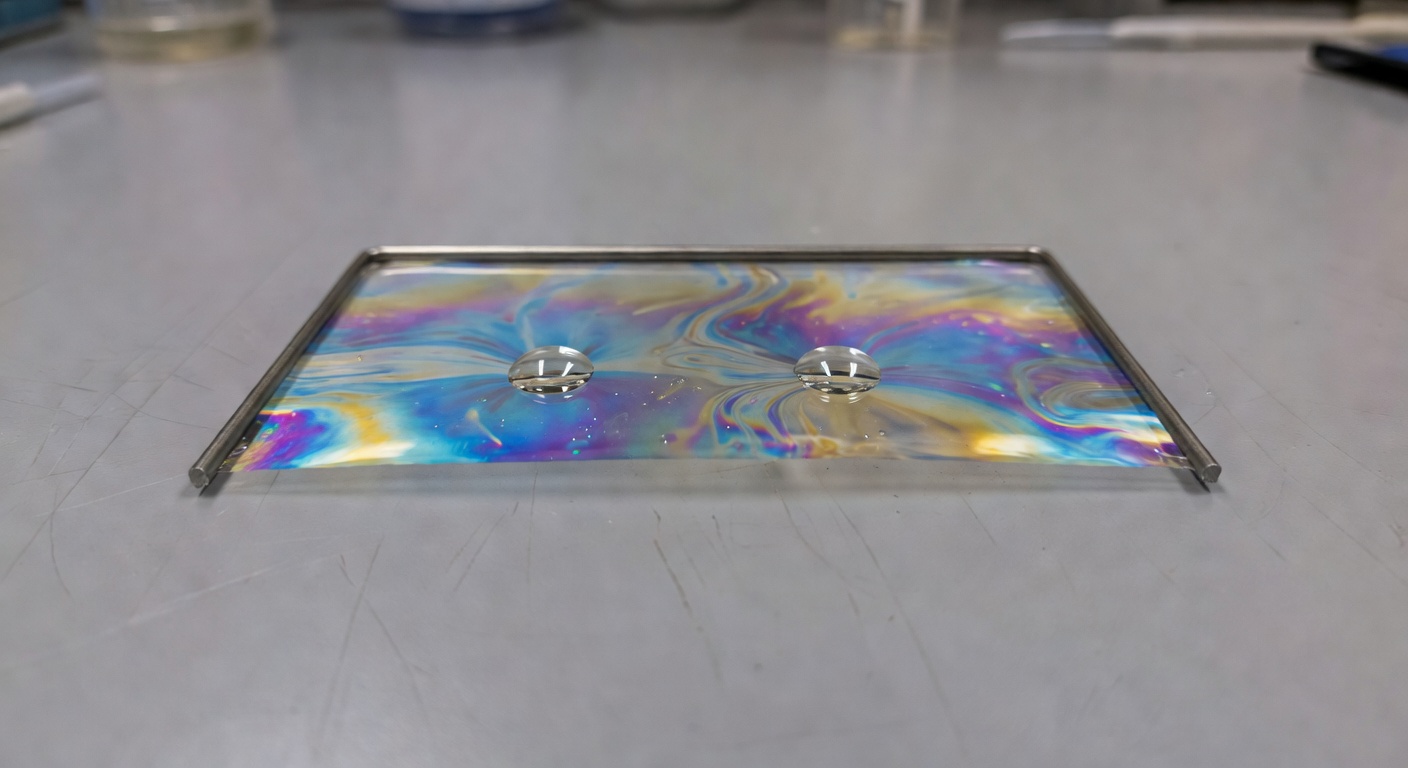
Place a horizontal soap film over a container, rest a water droplet on it, add a second droplet nearby, and within one second you have watched the equivalent of 460 million years of galactic evolution play out on your lab bench. That time-compression ratio is the sharpest way to grasp what physicist Jean-Paul Martischang and colleagues at the University of Lille, France, have demonstrated in the April 2026 issue of PNAS Nexus: water droplets sitting on a soap film deform it into a shared gravitational-style well, orbit one another, and eventually coalesce, producing bridges and spiral arms that match astronomical images of colliding galaxies. The finding matters now because it hands researchers a tabletop proxy for a class of astrophysical events that no telescope can capture from start to finish and no human lifetime can bracket.
The core claim is precise: the attractive force drawing two droplets together on a horizontal soap film is mathematically analogous to gravitational attraction between two masses, but it operates in two dimensions rather than three. The merger structures the droplets produce - bridges connecting the bodies and spiral arms trailing outward - are not metaphorical resemblances; they are structural matches to images of colliding galaxies. The paper does not claim to have solved galactic dynamics. It claims to have found a tractable physical system that reproduces the orbital-attraction phase of a galaxy merger at a timescale humans can observe directly.
What the Researchers Found
When a single water droplet is placed on a horizontal soap film, it does not sit flat. The droplet deforms the film into a hammock-shaped depression roughly one centimeter wide, sagging downward under the droplet's weight. The film does not break because surfactant molecules in the soap stabilize both surfaces, creating repulsion that prevents the film from thinning to the point of rupture. What remains is a curved, bowl-like geometry localized around each droplet.
Place a second droplet nearby and the geometry of both depressions interacts. The curved film between them creates a net attractive force, drawing the droplets toward each other. The droplets do not simply slide together in a straight line; they orbit, tracing curved paths before eventually coalescing into a single larger droplet. This inter-droplet attraction is formally analogous to gravitational attraction between two masses, expressed in two dimensions rather than the three dimensions governing real galaxy mergers.
The merger itself produces structures the team compared directly to astronomical observations of colliding galaxies:
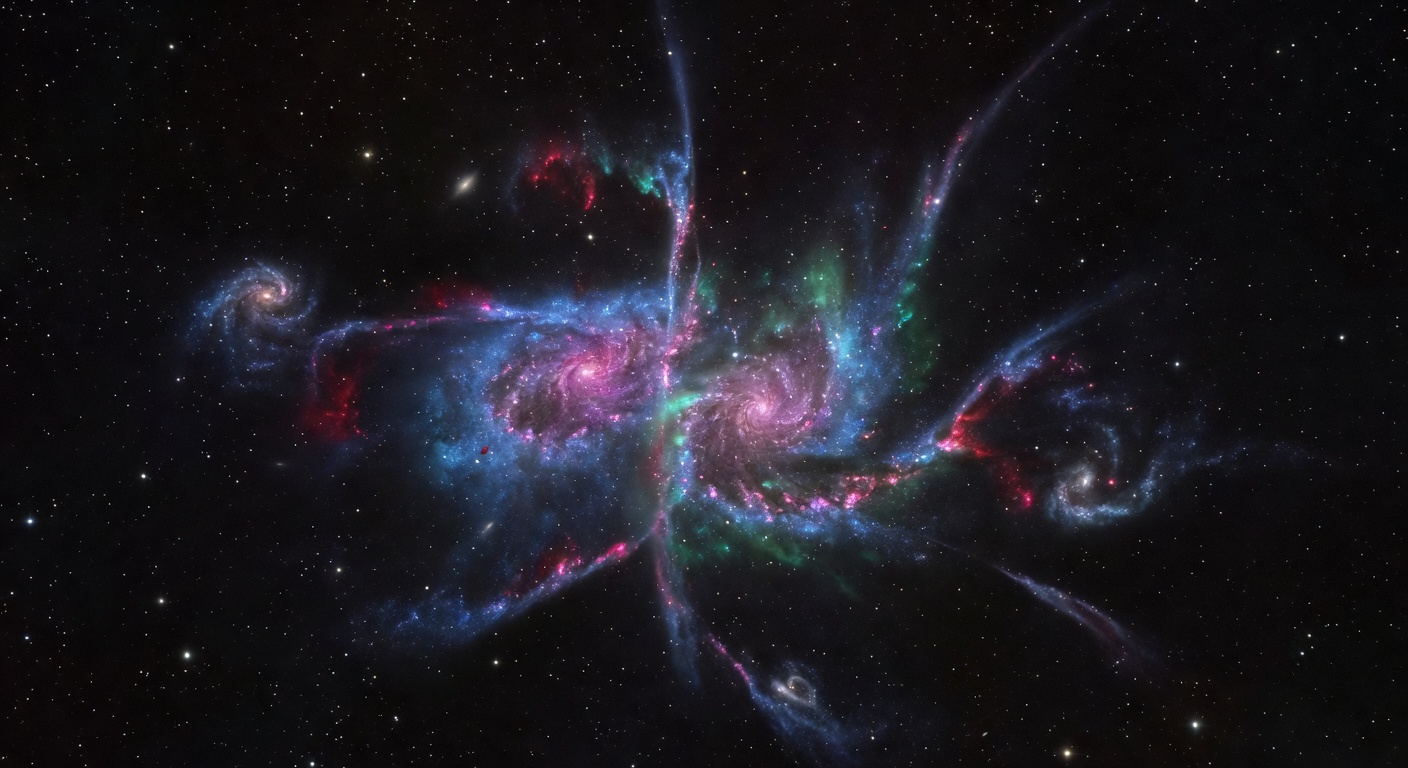
- Bridges: thin filaments of liquid connecting the two droplets as they approach coalescence, matching the luminous bridges seen between interacting galaxy pairs.
- Spiral arms: trailing material drawn outward from the merging bodies, replicating the tidal arms visible in well-known colliding-galaxy images such as those of the Antennae Galaxies - a pair whose ongoing interaction has been extensively studied as a reference case for merger morphology.
The time-compression ratio the experiment achieves is extreme. One second of laboratory time corresponds to 460 million years of galactic evolution. A process that astrophysicists can only reconstruct through snapshots of different galaxy pairs at different collision stages, or through lengthy computer simulations, runs to observable completion in the time it takes to blink twice.
The Methodology
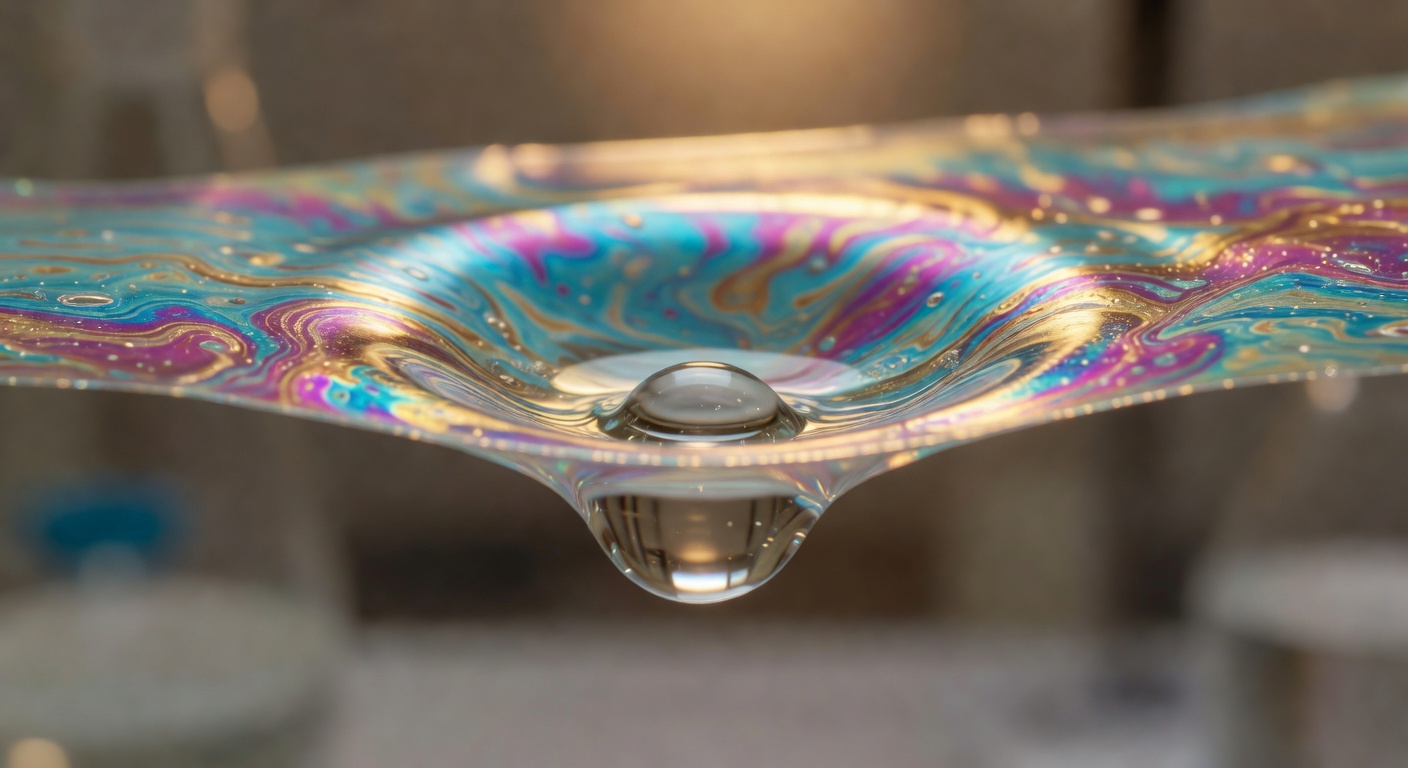
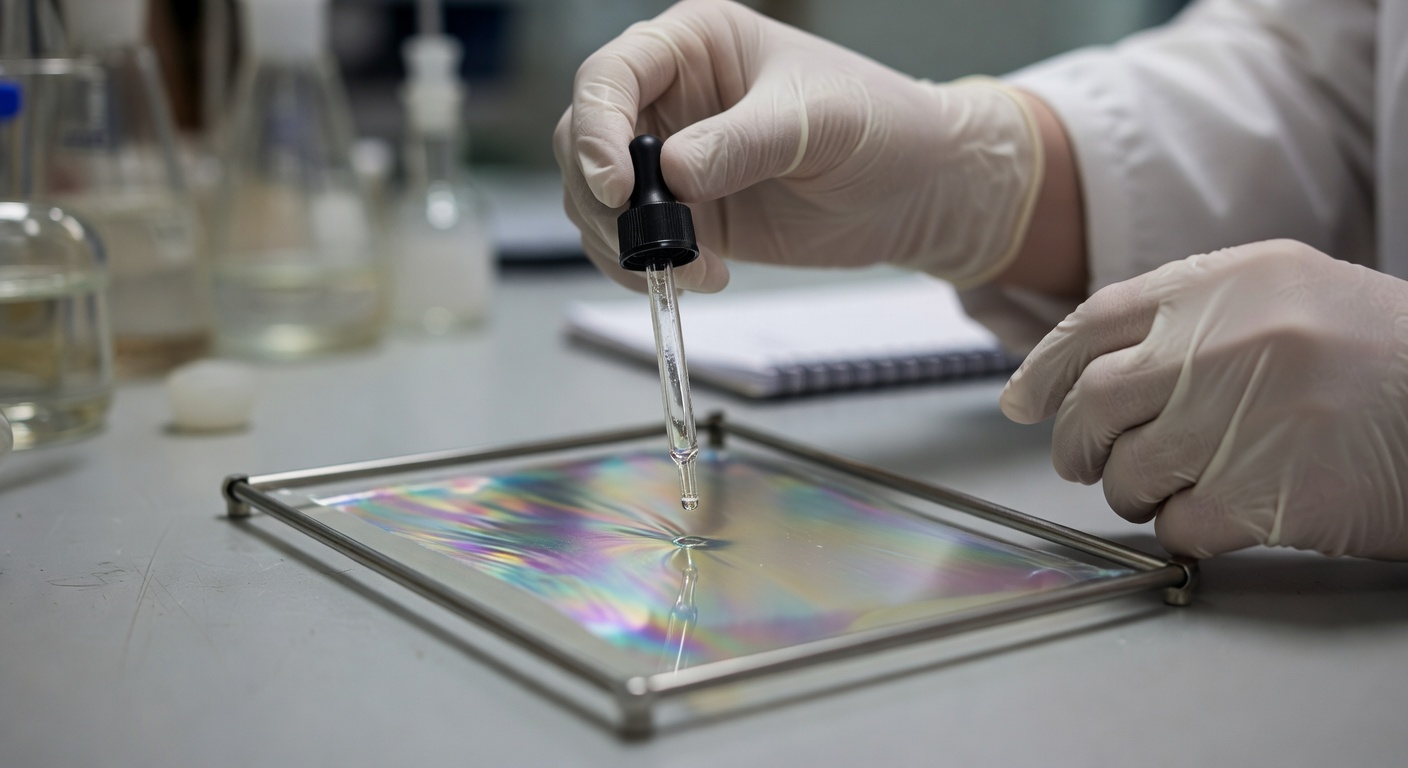
The experimental setup depends on an indirect lensing visualization technique rather than direct imaging of the film's surface geometry. The team placed a randomized dot pattern beneath the horizontal soap film. Each water droplet, acting as a curved refractive lens, distorts the apparent positions of the dots seen through the film. By mapping where and how severely the dot pattern blurs or shifts, the researchers could reconstruct the precise position, shape, and curvature of each droplet and the depression it creates in the film.
This approach bypasses a core measurement problem: the droplets and the film deformations are small, the geometry is dynamic, and direct contact measurement would disturb the system. The blur-mapping method is non-invasive and captures the full spatial structure of the droplet-film interaction frame by frame.
Mathematical analysis of the mapped positions confirmed that the inter-droplet force law matches a two-dimensional gravitational analogue. In three-dimensional Newtonian gravity, the force between two masses falls off with the square of the distance between them. The precise functional form of the 2D analogue governs the droplets' orbital behavior before merger. The paper's mathematical derivation establishes the formal correspondence, though the team has not yet published a plain-language explanation of why the soap-film geometry produces this specific force law.
The discovery was not the result of a targeted search for a gravity analogue. Martischang's group was already studying other properties of soap films when they first tried placing water droplets on the surface. "Once we tried putting water on it and we saw those lenses, we just thought 'Let's go with that,'" Martischang said. Serendipity gave them the system; deliberate mathematical analysis gave them the interpretation.
Why It Matters
Galaxy mergers are the most violent category of interaction between large astronomical bodies. During a major merger, star formation rates can reach thousands of solar masses worth of new stars each year - against a baseline of roughly 2 per year in a typical spiral galaxy like the Milky Way under current conditions. The process reshapes both galaxies structurally and chemically. Yet the full arc of a merger - from first gravitational contact through tidal distortion, orbital decay, bridge and arm formation, and final nuclear coalescence - spans billions of years.
Computer simulations can model merger events across long timescales, but simulations require assumptions, and those assumptions require validation against physical systems. A tabletop experiment that reproduces the orbital-attraction phase with confirmed mathematical fidelity to the gravitational force law offers something simulations cannot: a real physical system whose dynamics can be measured, perturbed, and repeated under controlled conditions.
The soap-film setup is accessible, cheap, and fast. Researchers can vary droplet size, separation, soap composition, and film tension systematically in ways that would require entirely new telescope surveys to replicate observationally. If the merger-dynamics phase proves as mathematically rigorous as the orbital-attraction phase, the system becomes a useful tool for generating and testing hypotheses about galactic collision physics.
Competitive Landscape
The University of Lille team presents the finding as a novel direction, and no prior experimental work using soap films as a gravity analogue for galactic mergers is cited in the paper. The broader field of analogue gravity - in which researchers construct physical systems that reproduce the mathematical structure of gravitational phenomena - has produced a substantial body of published work over the past decade, using platforms ranging from surface water waves to quantum fluids.
What distinguishes the Martischang result is the target: not black hole thermodynamics or quantum vacuum effects, but the large-scale tidal dynamics of galaxy mergers - a regime prior analogue-gravity platforms have not addressed. The soap film's ability to produce the bridges-and-spiral-arms morphology seen in real colliding galaxies, via a confirmed 2D gravitational force law, positions it as a distinct platform within that tradition.
Independent analyst commentary specifically on this announcement was not publicly available at publication time.
Limitations and Caveats
The University of Lille team is explicit about where the analogy currently ends. The mathematical correspondence has been confirmed for the orbital-attraction phase: the period during which two droplets orbit each other and approach coalescence. Whether the merger dynamics themselves - bridge and spiral-arm formation, and final coalescence - also follow the same gravitational rules is an open question the paper leaves unresolved.
This matters because the two phases involve different physical processes. Orbital attraction is governed by long-range curvature of the film. The merger phase involves short-range fluid dynamics, surface tension at the droplet boundary, and film-topology changes. There is no guarantee the gravitational analogy extends into the merger regime without modification.
The two-dimensional nature of the system is a second constraint. Real galaxy mergers occur in three dimensions. The force law governing real gravity falls off with the square of distance in 3D; the 2D analogue follows a different functional form. Mapping soap-film results onto 3D galactic dynamics requires a theoretical bridge the current paper does not fully construct.
The soap film itself is a simplified medium whose surface tension and viscosity differ substantially from the interstellar medium and dark matter halos that determine real galactic collision dynamics.
What Comes Next
The immediate open question is whether the merger phase also conforms to the gravitational analogy. Answering it requires a more detailed mathematical treatment of the short-range fluid dynamics at coalescence, combined with high-resolution experimental measurements of the film geometry during and after the droplets make contact.
If the merger phase follows gravitational rules as cleanly as the orbital phase does, the soap-film platform would cover the full arc of a galactic collision in a single experimental system - from first mutual attraction through tidal distortion to final merger - strengthening the case for using it to generate and test hypotheses before committing to expensive computational simulations.
The April 2026 publication in PNAS Nexus establishes the mathematical foundation and the visualization method. The lensing technique is itself portable: it can be applied to other soap-film geometries and droplet configurations. Future work could explore how varying droplet mass, initial separation, and film tension affects orbital decay rates, or whether multiple droplets reproduce features of multi-body galactic interactions.
For the Research Community
For fluid-dynamics and astrophysics researchers: the Martischang group has demonstrated a 2D gravitational analogue in which the inter-droplet force law is formally isomorphic to Newtonian gravity in two dimensions, recoverable via lensing inversion of a randomized dot pattern placed beneath the film. The time-compression factor of 460 million years per second makes the system experimentally relevant to merger-timescale astrophysics. The open question - whether merger-phase dynamics also satisfy the 2D gravitational equations of motion - is a tractable mathematical and experimental problem. The soap-film geometry is a well-controlled, tunable platform whose parameters (surface tension, droplet volume, initial separation) can be varied systematically. The connection to the broader analogue-gravity literature suggests possible theoretical frameworks for extending the analogy into the merger regime.
The most striking thing about this result is not the galaxy imagery, vivid as it is. It is the implication that the mathematical structure of gravity does not care very much what medium it is expressed in. A soap film and a galaxy are separated by roughly 20 orders of magnitude in scale, and the same force law governs both. Martischang's team found that by accident, while working on something else entirely - which is exactly how the most durable results tend to arrive.
-- Zara Velez, Emerging Technology Editor
Sources: Science News: Water droplets on soap films behave like merging galaxies
More on Revuzia
Bird Retinas Run Without Oxygen, Upending Vertebrate Metabolism Assumptions
Quantum computer breakthrough tracks qubit fluctuations in real time
India Adds 44.6 GW of Solar in One Year While US Falls Further Behind