Tiny Supercurrent Could Read Andreev Qubits Without Destroying Their Quantum State
November 6, 2026
Researchers in Brazil and China have proposed a way to read an Andreev qubit (a qubit whose 0 and 1 states live in the quantum levels of a superconducting weak link) from the supercurrent the qubit itself produces, and their simulations reconstruct its state with accuracy of up
Researchers in Brazil and China have proposed a way to read an Andreev qubit (a qubit whose 0 and 1 states live in the quantum levels of a superconducting weak link) from the supercurrent the qubit itself produces, and their simulations reconstruct its state with accuracy of up to 99.85%. That figure comes with a large asterisk: it is the best of three simulated results, the technique has not been demonstrated in any experiment, and the unsexy problem it targets, how to read a qubit without destroying what it holds, is one most quantum roadmaps do not headline. For developers and researchers, the relevant question is whether readout can shed the auxiliary qubits that today's nondestructive methods require.
What Happened
The study is co-led by José Carlos Egues, a full professor at the São Carlos Institute of Physics, University of São Paulo (IFSC-USP), Brazil, and Yugui Yao of the School of Physics at the Beijing Institute of Technology, China. It was supported by FAPESP, the São Paulo state research foundation, and its release was written by José Tadeu Arantes.
The problem the team addresses is the basic one in quantum measurement. Egues explains: "In the conventional formulation of quantum mechanics, a projective measurement causes the system to assume one of the states associated with the measured quantity. Thus, if a qubit has been prepared in a certain superposition of 0 and 1, its direct measurement tends to destroy that superposition and, consequently, the information it contained."
Their answer departs from the usual workaround. Egues says: "Our strategy is different. Instead of transferring the information to an auxiliary qubit, we seek to obtain it from a signal produced by the qubit under study itself."
The Technical Breakthrough
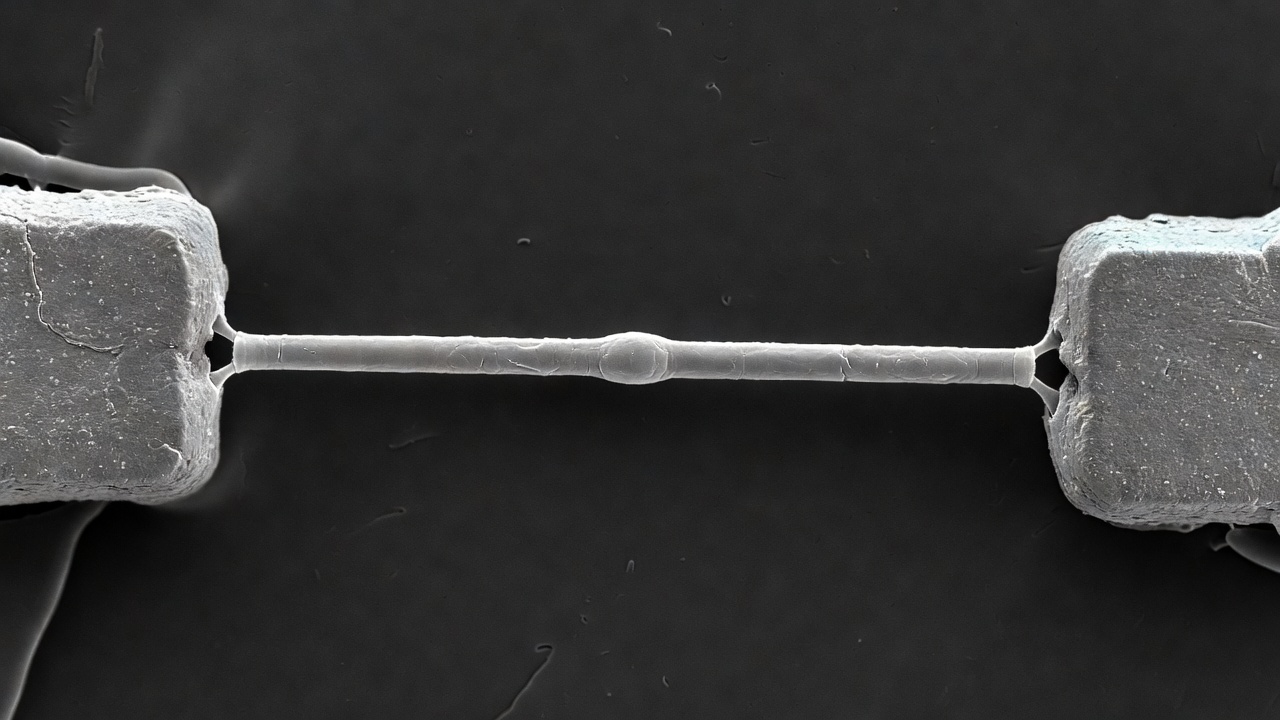
The device is built around a quantum dot (a nanoscale structure in which electrons are spatially confined). Egues describes it this way: "In the system under consideration, this region is a quantum dot - that is, a nanoscale structure in which electrons are spatially confined - formed in an indium arsenide [InAs] nanowire connected to superconducting materials on both sides. It's in this environment that the states characterizing the Andreev qubit are formed." The qubit's Andreev bound states (discrete quantum states of electrons trapped between two superconductors) encode 0, 1 and superpositions of the two.
The readout signal is the supercurrent (a current that flows through a superconducting junction without resistance). Egues: "It's precisely that property that we use to read the qubit. It's that supercurrent that lies at the heart of our proposal." When the qubit sits in a superposition, quantum interference between the states gives the supercurrent a time-oscillating component. Egues says: "Our system generates a supercurrent that varies over time like an alternating current but without voltage. It's the very evolution of the qubit's state that produces that oscillation." Ordinarily an oscillating supercurrent requires an applied voltage, the AC Josephson effect, so the voltage-free oscillation is the distinctive feature here.
The mapping from current to state is direct. Egues: "The supercurrent has a constant component and a fluctuating component. The value of the constant component and the amplitude of the oscillation reveal the proportion of each state (0 and 1) in the superposition, and the moment when that oscillation begins reveals the phase relationship between them. Thus, by measuring how the current varies over time, it's possible to reconstruct the initial state of the qubit." Those are the two angles on the Bloch sphere (the geometric picture of a single qubit's state) that fully specify a pure single-qubit state: the population balance and the relative phase.
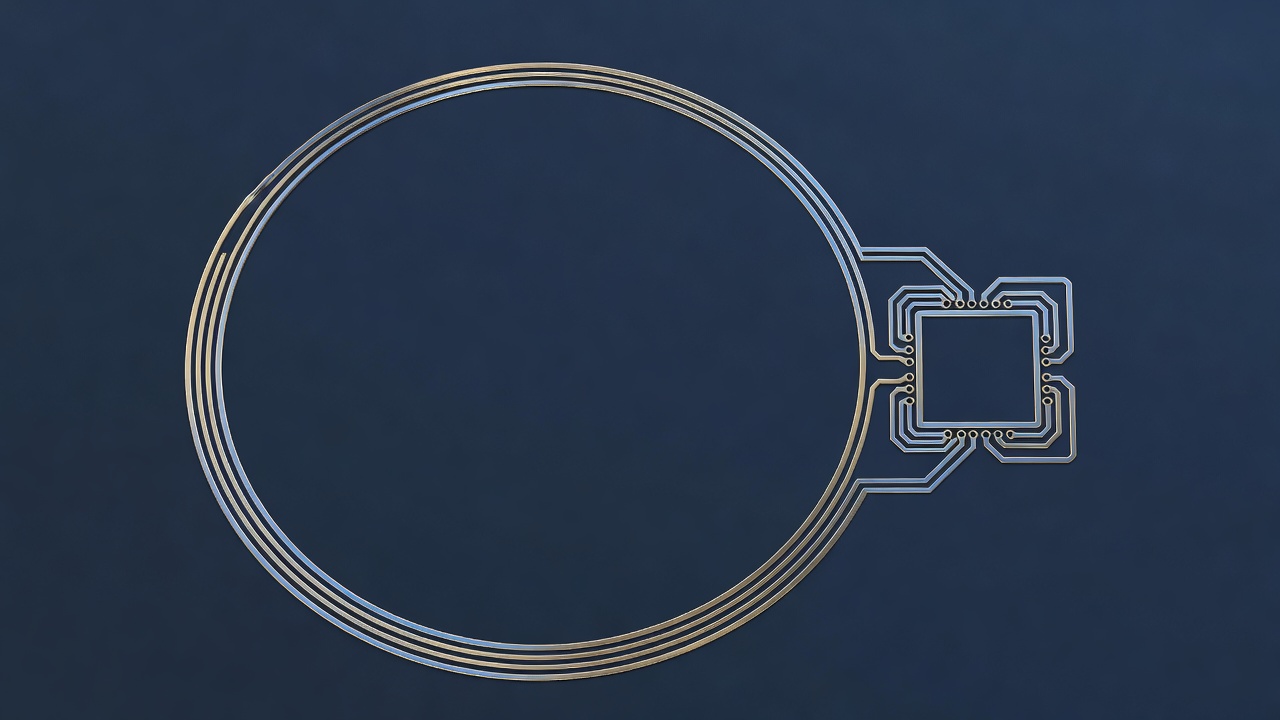
In the proposed geometry, the qubit sits in a closed superconducting loop where the supercurrent circulates, and a nearby SQUID (a superconducting loop sensor that detects tiny magnetic fields) picks up the oscillating field. The simulations included measurement noise and the small feedback from the detection coil. Depending on the number of measurements used, they produced accuracies of 99.52%, 99.81% and 99.85%.
Why It Matters for Industry
Readout sits on the critical path of error correction, and the authors say the simulated accuracies fall within the standard thresholds used in quantum error correction schemes.
The practical appeal is in what the scheme leaves out. Existing quantum nondemolition (QND) methods, which read a qubit without disturbing the quantity being measured, often move the qubit's information onto an ancilla (an auxiliary helper qubit) and measure that instead. That requires preparing auxiliary qubits, coupling them to the target qubits, transferring information and repeating measurements, with overhead that grows with qubit count. The Andreev approach claims to need no extra qubits, state transfer or resets. Because the qubit need not be reset after each measurement, repeated observations could also track its evolution over time.
The implications are therefore about hardware simplification and continuous monitoring, not near-term products. The source contains no cost, market or timeline figures, and none are offered here.
Competitive Landscape
The direct comparison is between this self-signal readout and ancilla-based QND readout. Egues frames the trade: "Our method doesn't eliminate the fundamental problem of quantum measurement. But it can approach the limit of a non-destructive readout and, at the same time, avoid the use of auxiliary qubits - the ancillas - employed in other non-destructive quantum measurement protocols."
What the source does support is a structural contrast among three approaches:
- Direct projective measurement: reads the qubit but, per Egues, tends to destroy the superposition and the information in it.
- Ancilla-based QND readout: the incumbent the proposal aims to replace; it needs auxiliary qubits, coupling, state transfer and repeated measurements.
- Supercurrent self-readout: simulated only, with 99.52% to 99.85% accuracy and no ancillas.
The 99.85% figure is a simulation result and is not directly comparable to experimental readout fidelities.
The Bigger Picture
The qubit carries the name of Alexander Andreev, the Soviet physicist who identified the underlying quantum process in 1964 and who lived from 1939 to 2023. Six decades on, the process he described is being proposed as a window into a qubit's own state.
The conceptual target is the measurement problem Egues describes in his first quote: direct measurement collapses a superposition. The proposal does not escape it, a point Egues concedes. Instead it relies on weak coupling, and he offers an analogy: "We can think of the qubit as one compass and the SQUID as another compass. The current in the circuit produces a magnetic field, and the SQUID 'senses' that field. Since the coupling between the two is very weak, the effect of the measuring instrument on the qubit tends to be very small." Some feedback from the SQUID still reaches the qubit, but simulations suggest it can be made effectively negligible.
The platform matters too. The qubit lives in a quantum dot in an indium arsenide nanowire flanked by two superconductors, a hybrid semiconductor-superconductor arrangement, and Egues says the simulations drew their parameters from existing systems. The idea is built from familiar parts, not exotic ones.
What's Next
Zero experimental demonstrations exist. Egues is direct about the gap: "All the numbers we used are realistic. In principle, this can be achieved. In fact, we used parameters from existing systems in our calculations. What doesn't yet exist is that geometry, that setup that we proposed." The sensors and device parameters are established; only the specific arrangement is unbuilt.
The next step is therefore a test in a real InAs nanowire device.
The irony is hard to miss: the oldest complaint in quantum mechanics is that looking changes the thing looked at, and this proposal answers by letting the qubit do the talking. Whether the compass analogy survives contact with a real nanowire is the only question that matters now, and simulation cannot settle it.
For developers and researchers working on superconducting-semiconductor hardware, the near-term translation is narrow but concrete: a candidate readout scheme to benchmark against ancilla-based protocols once someone fabricates the loop-plus-SQUID geometry, with ancilla qubits per logical qubit as the overhead metric to compare.
-- Aria Lin, Enterprise Technology Analyst
Sources: arXiv · Google · Agência FAPESP release (via ScienceDaily)