TechCrunch Disrupt Panel on OpenAIs Roadmap Skips OpenAI EntirelyTechCrunch Disrupt Panel on OpenAIs Roadmap Skips OpenAI EntirelyTechCrunch Disrupt Panel on OpenAIs Roadmap Skips OpenAI EntirelyTechCrunch Disrupt Panel on OpenAIs Roadmap Skips OpenAI Entirely
September 15, 2026
TechCrunch Disrupt 2026 will host a Builders Stage panel titled "What Happens When OpenAI Ships Your Roadmap," pairing Airbyte CEO and co-founder Michel Tricot, whose open source data integration platform serves more than 7,000 customers including 18% of the Fortune 500, with
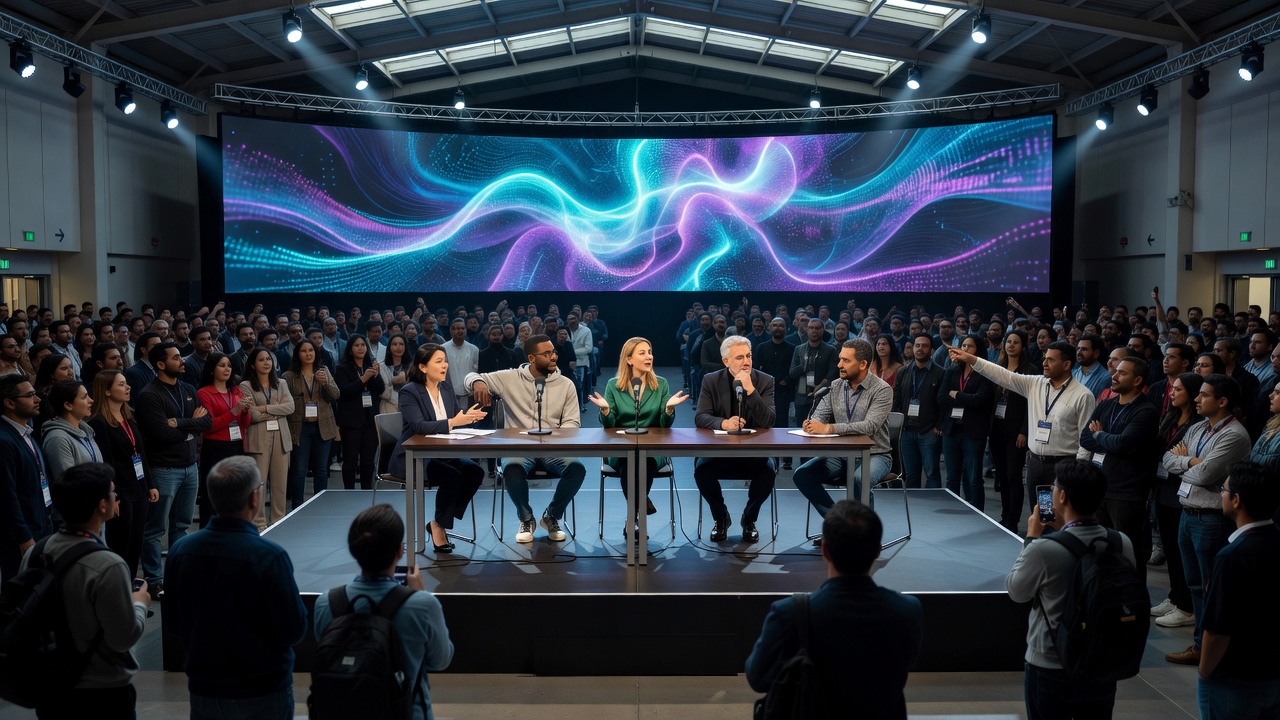
TechCrunch Disrupt 2026 will host a Builders Stage panel titled "What Happens When OpenAI Ships Your Roadmap," pairing Airbyte CEO and co-founder Michel Tricot, whose open source data integration platform serves more than 7,000 customers including 18% of the Fortune 500, with Radical Ventures partner Rob Toews and Webflow CEO Linda Tong. The panel's title promises more than its lineup actually delivers: no representative from OpenAI, Anthropic, or Google sits on the stage, and no specific startup is named as a casualty of a foundation model update. What is actually being staged, October 13-15 at Moscone West in San Francisco, is an industry anxiety session for more than 10,000 founders and investors, not a disclosed case study.
What Happened
TechCrunch confirmed the panel as part of Disrupt 2026, its flagship conference running October 13-15 at Moscone West in San Francisco. The event is built at scale: organizers expect more than 10,000 founders, investors, and operators across more than 250 sessions over the three days.
The Builders Stage session brings together three people with different vantage points on the same question:
- Michel Tricot, CEO and co-founder of Airbyte, an open source data integration platform that moves information between databases, SaaS (software-as-a-service) applications, and analytics systems. Airbyte counts more than 7,000 customers, including businesses representing 18% of the Fortune 500.
- Rob Toews, partner at Radical Ventures, a venture capital firm that evaluates which software companies hold a durable competitive advantage and which are at risk of becoming a feature inside someone else's product.
- Linda Tong, CEO of Webflow, a visual development platform for building and managing websites; she previously held roles at Google, Cisco, and the NFL.
Tricot's inclusion is the clearest signal of what the panel is actually arguing. Airbyte's customer base, spanning thousands of companies and nearly a fifth of the Fortune 500, is offered as evidence that infrastructure-layer software can hold ground even as the model layer above it moves fast. Tong's presence adds a second data point from a different category: a visual development platform navigating what organizers describe as one of software-as-a-service's biggest technology shifts.
Why It Matters
The panel's working premise is that foundation models (Stanford's Center for Research on Foundation Models defines the category as "any model that is trained on broad data, generally using self-supervision at scale, that can be adapted, for example fine-tuned, to a wide range of downstream tasks") are absorbing product categories that used to require a standalone company to build. OpenAI, Anthropic, and Google are referenced only generically in the framing, with no specific product or statement from any of the three cited, but the implication is direct: a feature that took a startup a funding round and a year to ship can arrive as a checkbox in the next model release.
The rhetorical question organizers use to frame the session, "Can we build something customers will still value after the next model release?", is not attributed to any of the three panelists as a direct quote. It is the industry question the session exists to address, and it applies unevenly. A company selling a thin interface on top of a model's existing capability has little to defend. A company like Airbyte, moving data for more than 7,000 customers, is arguing its value sits in the plumbing, not the model call.
That distinction, infrastructure versus interface, is the axis the entire panel is built around, and it is why Tricot, Toews, and Tong were chosen instead of three generalist SaaS founders.
Competitive Landscape
No named competitors or peer companies to Airbyte, Webflow, or Radical Ventures were identified in the available reporting on this panel. Rather than speculate about a competitive set that was not disclosed, the more useful comparison is the one the two named companies draw for themselves.
Airbyte positions itself as durable infrastructure operating "beyond the foundation model," meaning its value proposition, moving and standardizing data for analytics, operations, and AI workloads, does not depend on which model a customer eventually calls. Webflow positions itself differently: as a visual development platform navigating one of SaaS's biggest technology shifts, which implies its category, no-code and low-code website building, is more directly exposed to a model that can generate a working site from a prompt.
Independent analyst commentary specifically on this announcement was not publicly available at publication time.
The Bigger Picture
Toews' presence supplies the investor lens missing from a purely founder-to-founder conversation. Radical Ventures, where Toews is a partner, is described as evaluating where competitive advantages still exist and where products risk becoming features, without naming specific portfolio companies or deals under that framework. That is the crux tension running through the entire session: a moat (a durable competitive advantage) that survives a model update versus a product that turns out to have been a temporary wrapper around someone else's capability.
Airbyte and Webflow function as the panel's two implicit case studies in contrast, not because either has been declared a winner, but because they sit on opposite sides of Toews' dividing line. Airbyte's pitch is that data movement across more than 7,000 customer environments is infrastructure work a model release does not replace. Webflow's position, building visual tools for a category increasingly reachable through natural-language prompting, is the harder argument to make, and it is likely why Tong's Google, Cisco, and NFL background is highlighted alongside her current role: an attempt to signal operating depth beyond the product itself.
Neither company's argument is tested with data in the available material. The panel is a framing exercise, not a verdict, and Disrupt's own programming does not resolve which side of the line either company actually sits on.
What's Next
This article covers conference programming, not a reported news story. There is no incident, no dataset, and no direct quote from Tricot, Toews, or Tong underlying it, only a session description published by TechCrunch on September 14, 2026, at 8:00 AM PDT.
The logistics are concrete, even if the panel's substance is not yet disclosed:
- Disrupt 2026 runs October 13-15 at Moscone West in San Francisco.
- Attendee tickets carry a 25% discount, described as saving up to $300, with an additional tier saving up to $200 before rates increase on September 25.
- Companies wanting an exhibit table must book by September 18, 2026.
What happens on the Builders Stage itself, whether Tricot, Toews, and Tong name specific instances of a startup feature getting absorbed by a model update, will not be known until the session runs in October. Until then, the panel title is a question, not a finding.
The most useful thing about a session with no disclosed case study is what it reveals by omission: four to five years into the foundation model era, the industry still cannot point to a named startup and say, definitively, "that one got absorbed." Until it can, this remains a hallway conversation dressed up as a panel.
For an IT buyer deciding which vendors to put on a multi-year contract, this is a due-diligence question, not an abstract one: before signing a data integration or website platform contract, ask the vendor directly what happens to their core workflow if the underlying model provider ships an equivalent feature for free. Airbyte's answer, thousands of customer data pipelines already built and running, is a harder thing for a model update to erase than a thin AI-generated website builder. That is the practical version of the question the panel is asking in the abstract.
-- Aria Lin, Enterprise Technology Analyst
Sources: TechCrunch Disrupt 2026 event announcement