Ukraine's Ground Robots Survive 57 Missions Where Others Last SevenUkraine's Ground Robots Survive 57 Missions Where Others Last SevenUkraine's Ground Robots Survive 57 Missions Where Others Last SevenUkraine's Ground Robots Survive 57 Missions Where Others Last Seven
July 13, 2026
Ukraine's President Volodymyr Zelenskyy signed an order in April 2026 for the government to procure 50,000 uncrewed ground vehicles (UGVs) by the end of the year, a 25-fold increase from the 2,000 units purchased in 2024. The more telling number, however, is not the procurement
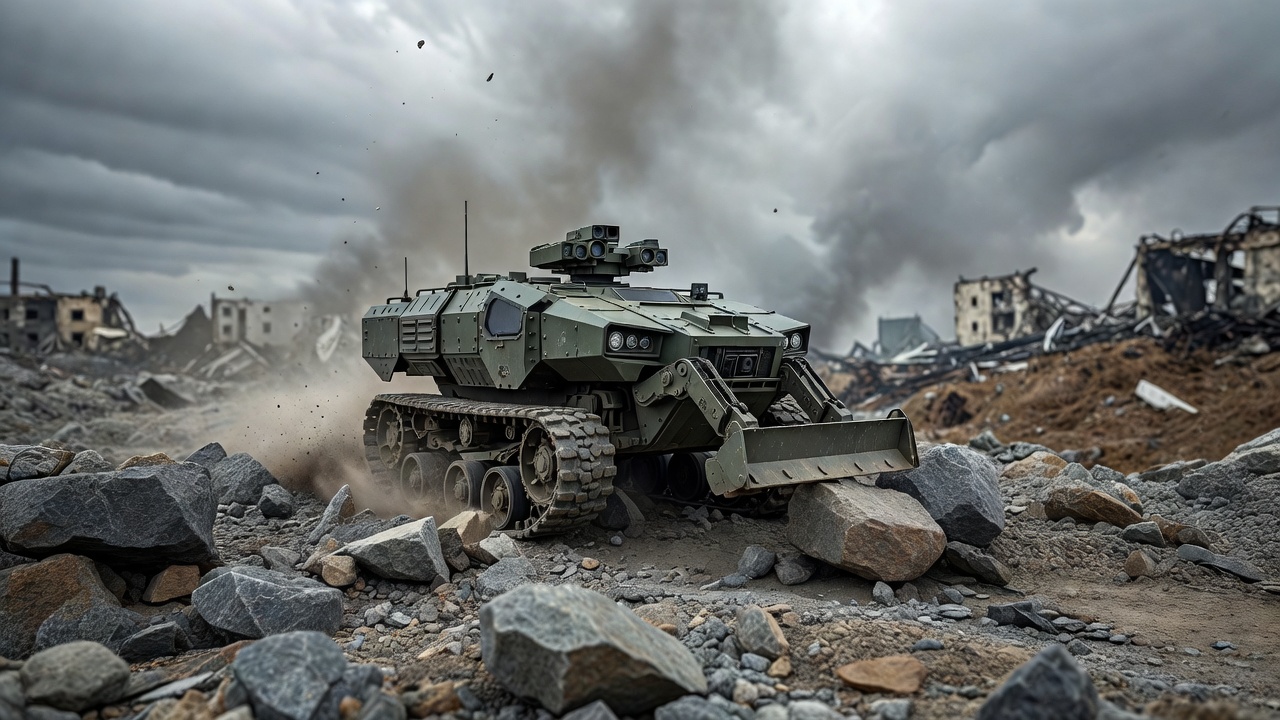
Ukraine's President Volodymyr Zelenskyy signed an order in April 2026 for the government to procure 50,000 uncrewed ground vehicles (UGVs) by the end of the year, a 25-fold increase from the 2,000 units purchased in 2024. The more telling number, however, is not the procurement target but what's driving it: RoverTech's Zmyi UGV completes an average of 57 missions across the kill zone before being destroyed, against an industry baseline of roughly 7 missions for a typical battlefield UGV. That 8-to-1 survival gap represents a doctrinal inflection point, not an iterative improvement, and it is reshaping how military planners think about the future of ground combat.
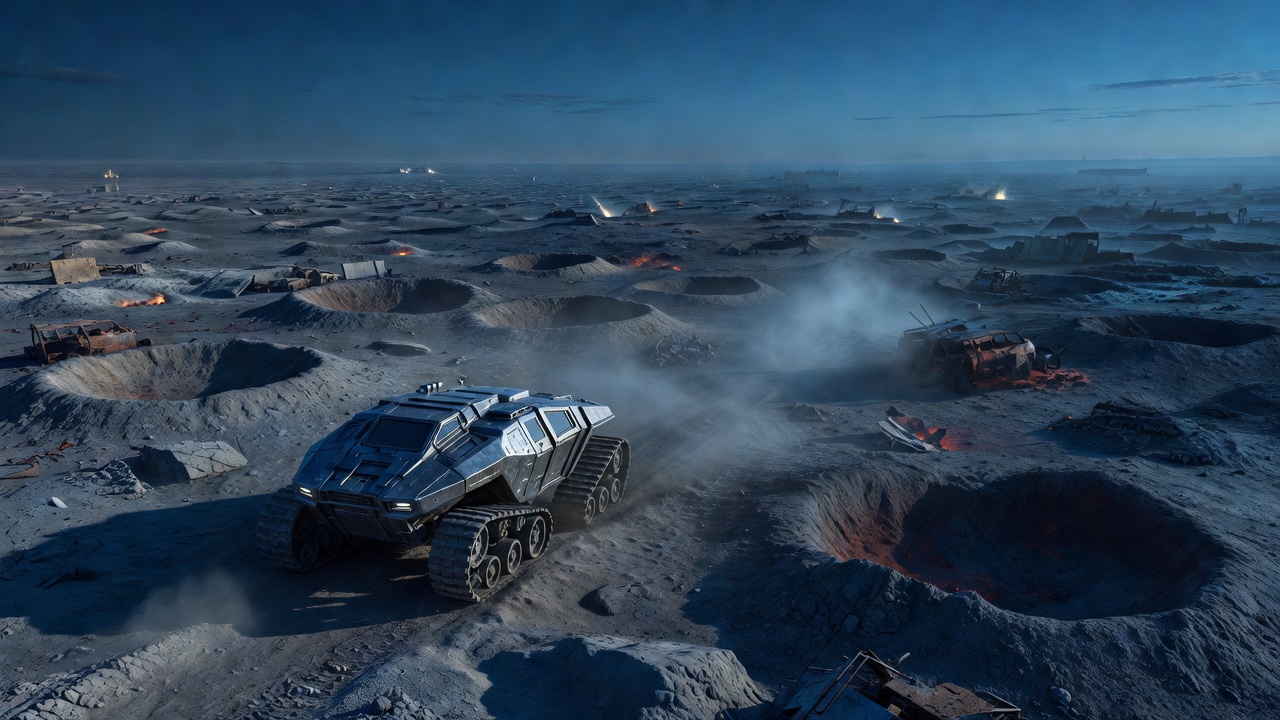
The kill zone (the roughly 35-kilometer-wide swath of contested terrain straddling the front line) has become, in the words of defense analyst Marc C. Lange, essentially unsurvivable for human forces. "Any armored formation, any resupply and logistics vehicle, and any manned formation anywhere near the edge of the battle area has between seconds to a low amount of minutes before it gets turned to dust," Lange said. That demographic pressure is the engineering brief behind every UGV rolling off a Kyiv-area production line.
What It Does
The Zmyi (Ukrainian for "snake") is an 800-kilogram, 1,700-pound rover measuring 2.15 by 1.5 meters, with 75-centimeter diameter wheels designed to continue operating even after two of its four wheels are destroyed. RoverTech, the Ukrainian company behind the vehicle, was co-founded by Borys Drozhak and Vasyl Korenovskyi, the latter a former mining engineer whose background informed the vehicle's original demining configuration.
The machine can be controlled from as far as 100 kilometers away via Starlink, LTE networks, or mesh-networked military radio systems, and can loiter in position for up to one week without needing a battery charge. Its current configurations span demining, logistics, firefighting, machine gun operation, and grenade launching. RoverTech has also developed Tarantula, an active-protection add-on that uses acoustic and visual sensors combined with AI algorithms to detect approaching killer drones before they reach the vehicle.
UGVs in the Zmyi class can carry and deploy strike UAVs, serve as communications relays for drone operations, or launch communication relay drones to extend attack range beyond the operator's direct radio horizon. The 100-kilometer control range is itself a product of Starlink connectivity, though that dependency introduces vulnerabilities: Starlink signals are disrupted by trees and buildings, and Russia is actively working to jam the network.
The Technical Achievement
"Usually, a UGV on the battlefield lasts about seven missions," said Drozhak. "The Zmyi is quite a bit bigger and stronger, and can make it back even if two of its wheels get destroyed." Seven missions is the baseline against which Ukrainian engineers have been iterating since the war began; the Zmyi's result is not a marginal gain but a categorical one.
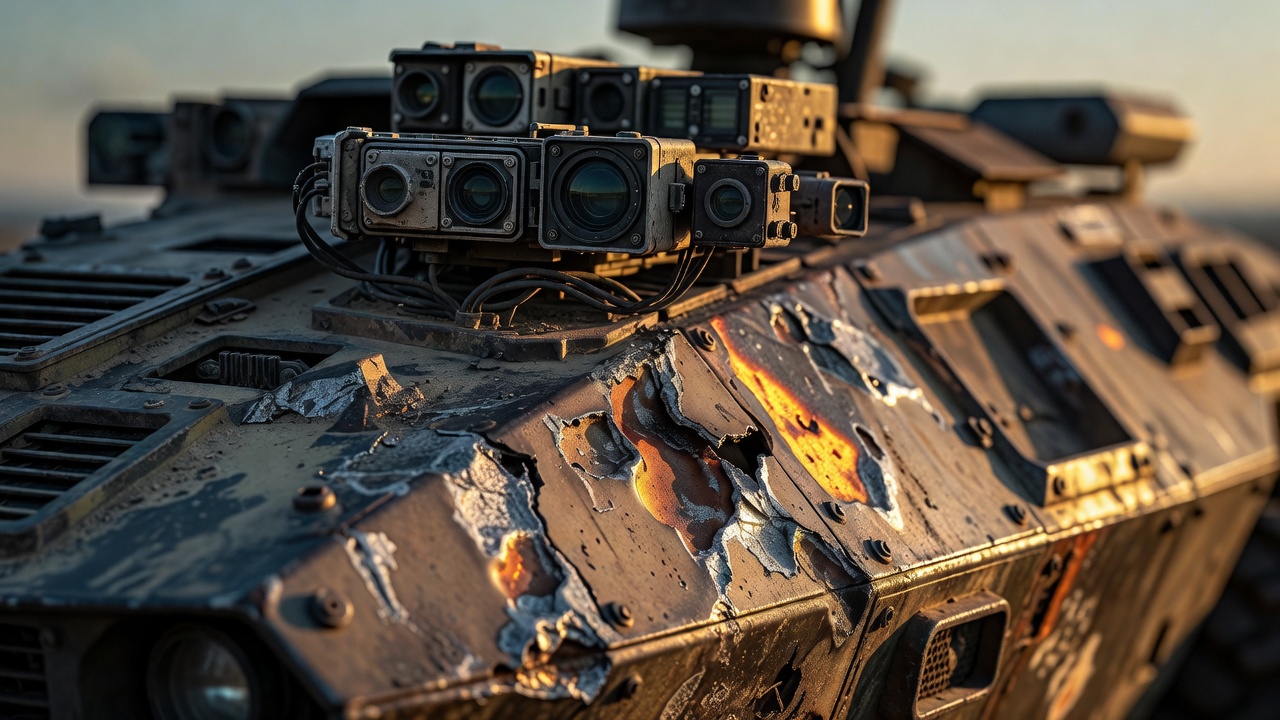
The durability stems from two deliberate design choices: the Zmyi is engineered to minimize both acoustic signature and heat emission specifically to evade Russian ISR drones (intelligence, surveillance, and reconnaissance platforms that continuously scan the kill zone). FPV kamikaze drones (first-person-view loitering munitions flown by a remote pilot into a target) can engage anything that enters the kill zone within minutes, so a vehicle that runs hot or loud becomes a targeting solution almost immediately. By suppressing those signatures, the Zmyi forces Russian drone operators to work harder for a lock.
In 2023, RoverTech rolled out its first product: a Zmyi configured for demining operations. Battlefield adaptation followed as the war's geometry shifted and commanders discovered that the kill zone's primary hazard was aerial rather than buried. The vehicle's modular payload architecture allowed RoverTech to iterate configurations without redesigning the platform.
DevDroid, another prominent Ukrainian UGV developer, took a different survivability approach with its Droid TW 12.7: a UGV fitted with a .50-caliber M2 Browning machine gun, aimed and fired via a tablet over an encrypted communications link. Oleg Fedoryshyn, DevDroid's head of research and design, frames the tradeoff plainly. "It's better than to put people there," he said. "A guy with a machine gun is always the first target for the enemy." In December 2025, the Droid TW 12.7 held a frontline position for 45 days using remote or AI-assisted operation without infantry support, according to verified reporting.
Real-World Impact
The procurement trajectory tells the clearest story. The Ukrainian government purchased 2,000 UGVs in 2024. Zelenskyy's April 2026 order targets 50,000 by year-end -- a 25-fold increase from the 2024 baseline, and more than three times as many as the government purchased in 2025. The cost structure makes that scale achievable in ways that conventional armor cannot match: UGVs run a few tens of thousands of dollars per unit, compared to millions for a traditional tank.
The human calculus behind those numbers is straightforward. Drone warfare has made traditional evacuation methods impossible in the kill zone. "The Ukrainians were losing drivers," Lange said. "Traditional methods of evacuating injured soldiers became impossible. That space is basically unsurvivable."
UGVs began ferrying supplies to frontline troops in 2024, then took over complex wounded evacuations in 2025. In early 2026, a RoverTech assault UGV participated in a widely reported operation in which Russian soldiers surrendered with no Ukrainian troops present on the ground. Ukraine's 3rd Assault Brigade confirmed the event, writing: "For the first time in history: Russian soldiers surrendered to the 3rd Assault Brigade's ground drones."
Fedoryshyn estimates that UGVs could eventually help cut the number of soldiers needed along the frontline by 30 to 40 percent. Drozhak's near-term framing is more pragmatic: "Right now, we need a lot of UGVs because there are people on the front line and we need to deliver supplies to them. But we can substitute many of them with sensor systems, servicing robots, and UGVs, and then we will not need that many for logistics. At some point, we could have only robots in the kill zone."
Competitive Landscape
Two Ukrainian companies have emerged as the primary production players in this space, each approaching the kill-zone problem from a different angle:
- RoverTech (primary platform innovator): The maker of the Zmyi, described by IEEE Spectrum as one of Ukraine's most successful ground robots. RoverTech's differentiation rests on acoustic and thermal signature suppression, platform longevity (57-mission average), and the Tarantula active-protection add-on. The Zmyi's modular payload system allows rapid configuration changes without platform redesign.
- DevDroid (firepower-forward integrator): DevDroid's Droid TW 12.7 prioritizes direct fire capability, pairing a .50-caliber M2 Browning machine gun with a tablet-based encrypted fire-control link. The verified 45-day sustained hold in December 2025 demonstrates that DevDroid's approach extends beyond remote operation toward AI-assisted position defense.
The broader competitive context sits at the intersection of cost and doctrine. Ukraine's iteration has converged UGV economics toward FPV drone logic: inexpensive enough to deploy at scale, survivable enough to return data and payload across dozens of missions.
Samuel Bendett, a defense analyst at CNA, cautions that the ground domain introduces constraints UAVs do not face. "Not every terrain would be applicable to using a UGV. So far, a lot fewer countries are seeking to integrate them into their combat operations than UAVs, which very much democratized the way of enabling short-range to mid-range strikes against adversaries," Bendett said. He points to a fundamental physics difference: "With UAVs, communication is much easier. There are no interferences between the ground station and the UAV save the distance, Earth's curvature and the radio horizon. But on Earth, there's lots of different obstacles that interfere with radio signals."
What's Next
The 50,000-unit target by December 2026 is not primarily a technology problem; it is an industrial and supply chain challenge. Producing more than three times the 2025 volume in a single year requires sustained component supply, trained assembly capacity, and logistics infrastructure capable of fielding and maintaining that many platforms simultaneously. Each unit costs a few tens of thousands of dollars, putting the total procurement value in the low billions -- a significant commitment for a wartime economy.
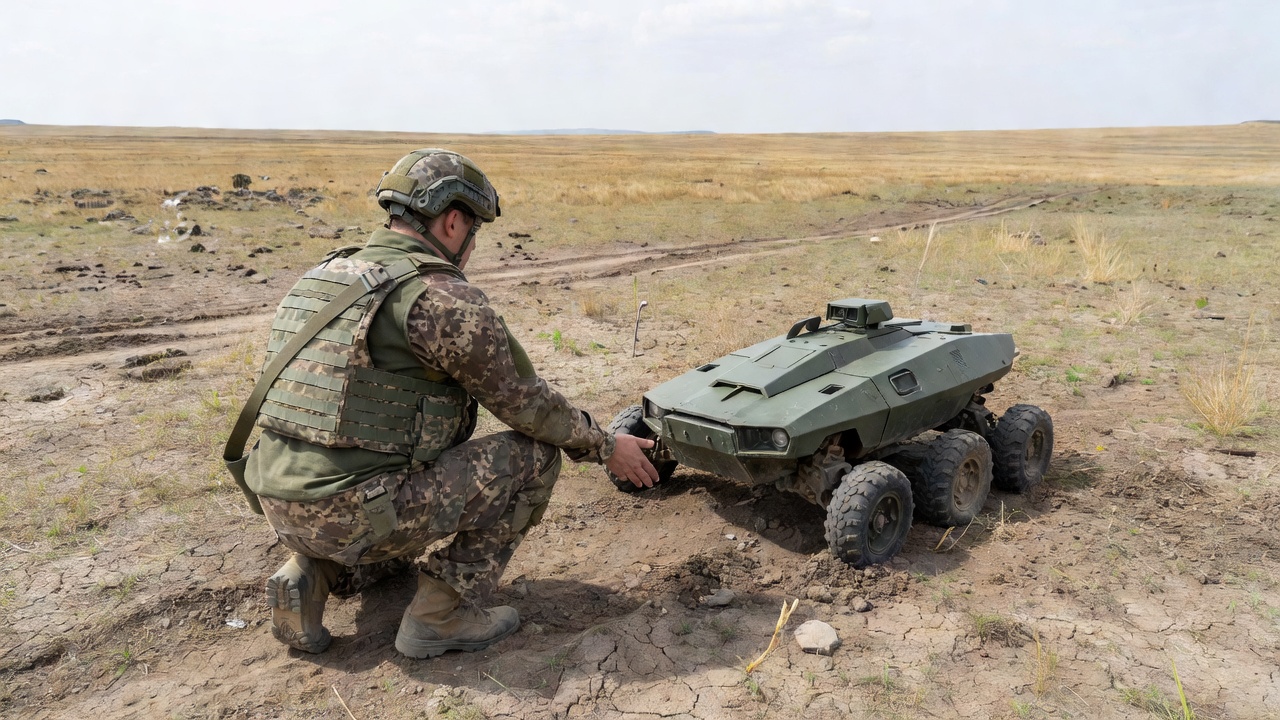
The autonomy question remains the most consequential open variable. Current UGVs are remotely operated: every mission requires a trained operator, and at a 100-kilometer control range, operator density becomes a practical constraint on scale. Drozhak's stated vision goes further: "There will be no need to push people on the battlefield anymore. Once we achieve that in Ukraine, any country with a decent economy would be able to defend themselves just with technology." No public timeline for that transition has been announced.
Lange identifies a survivability ceiling that scale alone may not solve. "The low production cost of strike drones will mean that UGVs will have to endure a barrage of strikes," he said. "That might be too much. The question is whether you can make UGVs more survivable on the frontline both in terms of command and control and the actual survivability of that many strikes." The Tarantula active-protection system is RoverTech's current answer, but no operational intercept-rate data has been released.
For defense procurement planners evaluating ground robotics investments: the Ukraine case translates into a specific unit-economics argument. A UGV costing a few tens of thousands of dollars that completes 57 missions replaces a platform at similar cost that returns from only 7. Across a 50,000-unit fleet, that 8-to-1 survivability ratio means roughly 350,000 effective missions from the same capital outlay that a baseline fleet would extract from 50,000. The cost argument for UGV scaling is not that the machines are cheap; it is that they are cheap per mission completed.
-- Zara Velez, Emerging Technology Editor
Sources: IEEE Spectrum: Ukraine's Ground Drones