JWST Finds Uranus Rings Hide Unknown Moons in Organic DustJWST Finds Uranus Rings Hide Unknown Moons in Organic DustJWST Finds Uranus Rings Hide Unknown Moons in Organic DustJWST Finds Uranus Rings Hide Unknown Moons in Organic Dust
April 22, 2026
A 12-kilometer moon that barely qualifies as a rock is producing one of the most unusual ring structures in the solar system, and new observations from the James Webb Space Telescope suggest the rings of Uranus are hiding moons we have never seen. Published April 16 in the
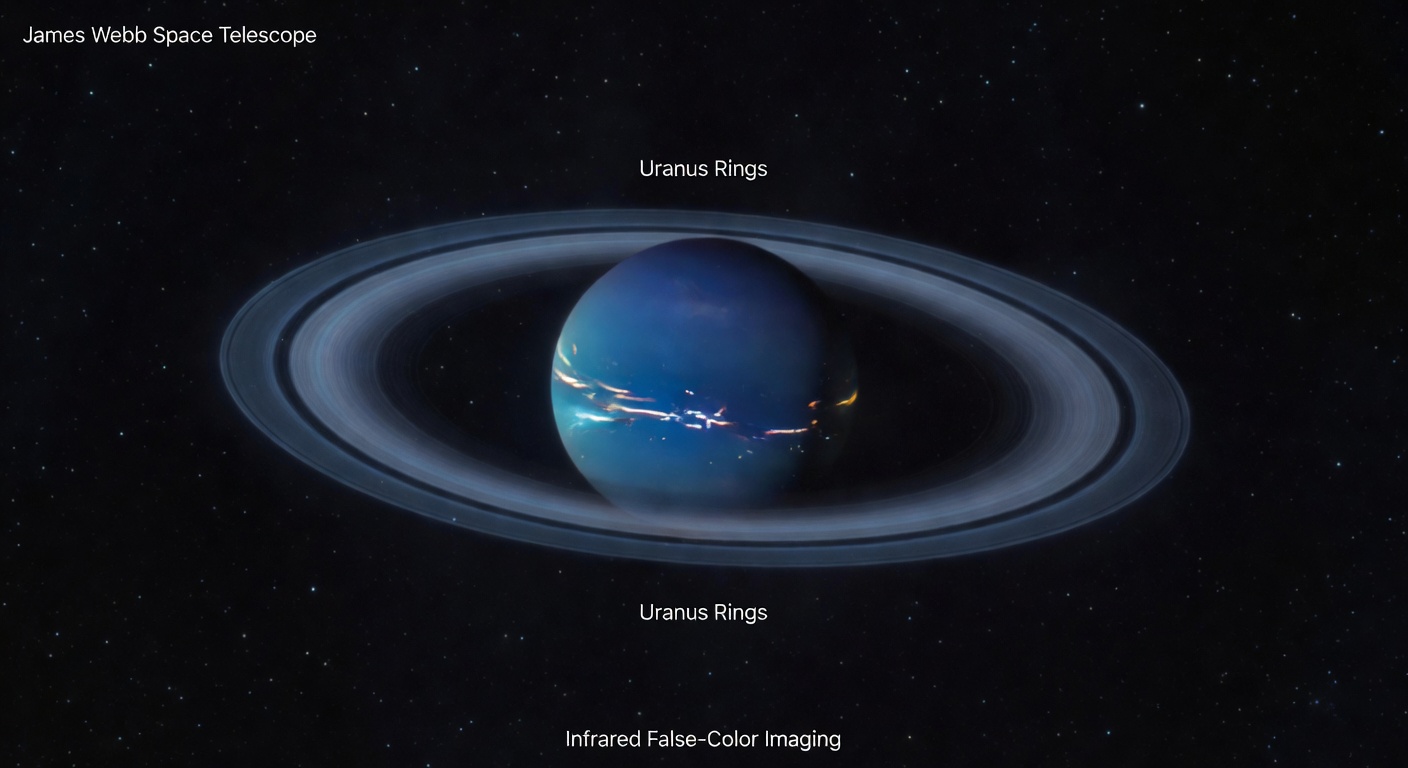
A 12-kilometer moon that barely qualifies as a rock is producing one of the most unusual ring structures in the solar system, and new observations from the James Webb Space Telescope suggest the rings of Uranus are hiding moons we have never seen. Published April 16 in the Journal of Geophysical Research: Planets, the study by a team led by Imke de Pater of the University of California, Berkeley, delivers the first complete reflectance spectrum (a measurement of how rings reflect sunlight across wavelengths, revealing their composition and particle sizes) of Uranus's two outermost rings. What the spectrum shows is both clarifying and disquieting: one ring is an exact color match for Saturn's most celebrated ring, and the other is silently advertising the existence of moons nobody has found yet.
The findings matter now because they arrive as the planetary science community pushes harder than ever for a dedicated Uranus mission, ranked the top priority in the most recent National Academy of Sciences Decadal Survey. Understanding what these rings are made of is not an academic exercise. It is the groundwork for knowing what any future spacecraft will encounter when it finally reaches the seventh planet from the sun.
What Happened
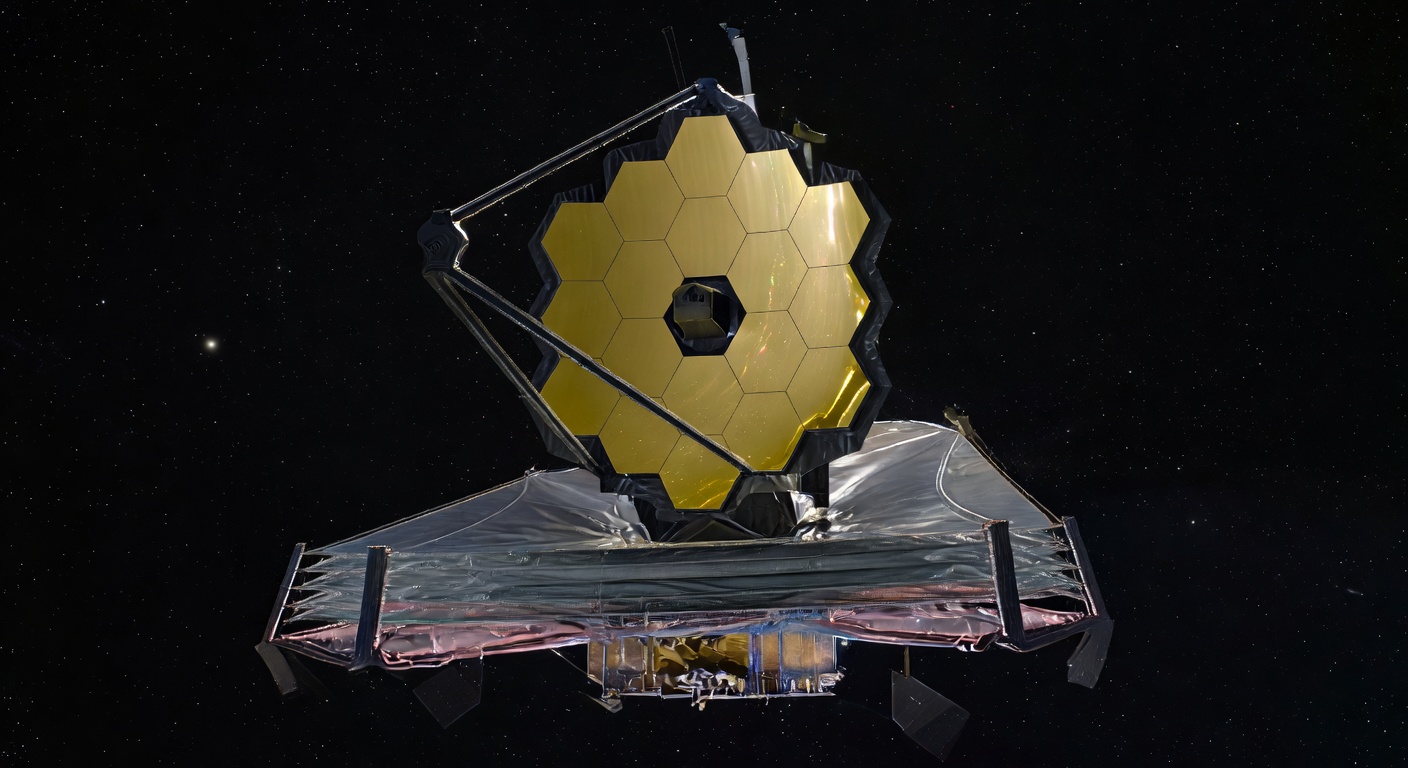
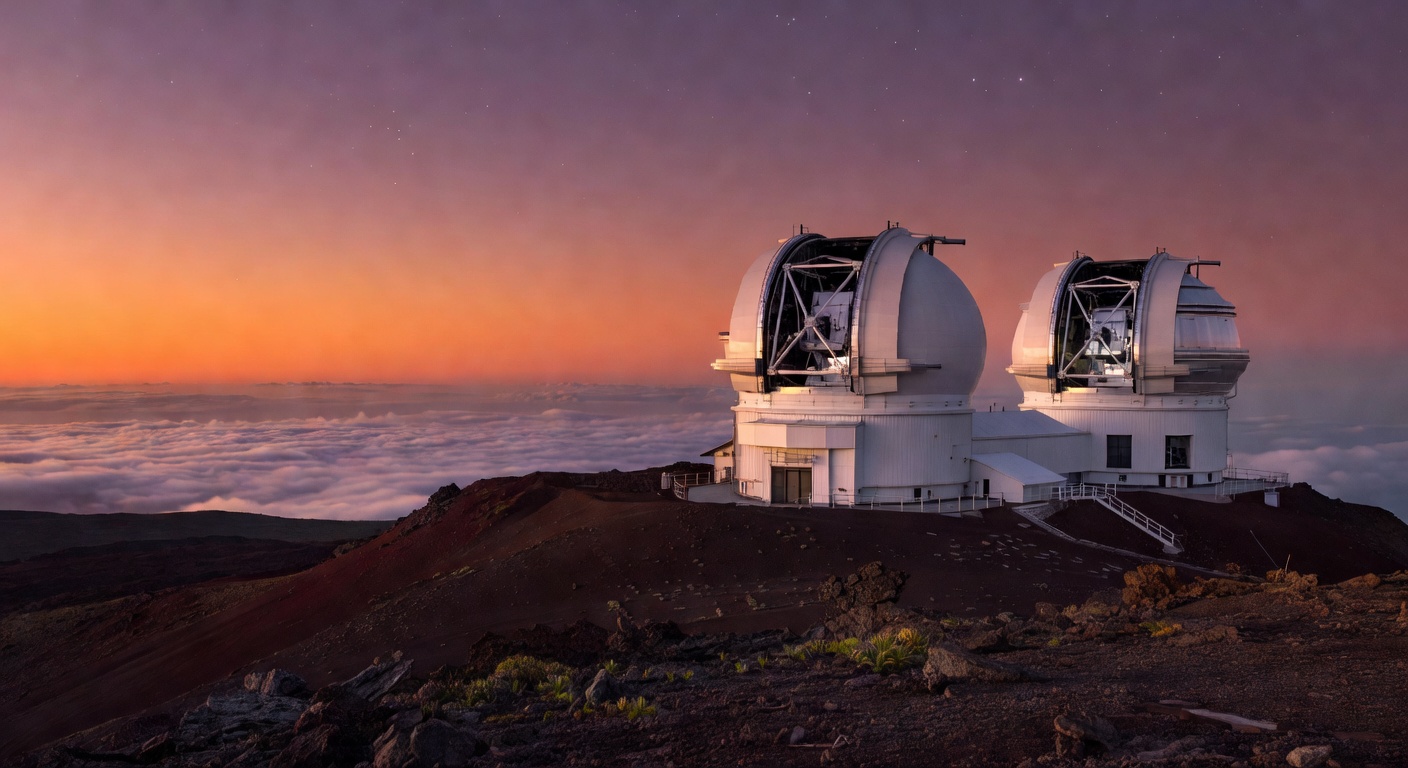
De Pater's team combined infrared observations from the James Webb Space Telescope with archival data from the Hubble Space Telescope and the ground-based W. M. Keck Observatory (a 10-meter telescope on Mauna Kea, Hawaii) to produce the first complete reflectance spectrum of Uranus's mu- and nu-rings. No prior observatory had enough infrared sensitivity to complete this analysis alone. JWST's infrared capability was the missing piece.
The mu- and nu-rings were themselves discovered relatively recently. Mark Showalter of the SETI Institute and colleagues identified both rings using Hubble and Keck data gathered between 2003 and 2005, bringing the total count of known Uranian rings to 13. Those discoveries also added to Uranus's tally of 29 known moons: Showalter found the small, irregular moon Mab during the same observing campaign.
The new study used color as a diagnostic. In planetary ring science, color is not decorative. Blue rings indicate very small particles; redder, dustier rings indicate larger ones. The mu-ring came back blue. The nu-ring came back reddish. Both colors now have compositional explanations, and both raise new questions.
The Science Behind It
The mu-ring's reflectance spectrum is a close match for water ice, confirmed through the combined JWST, Hubble, and Keck dataset. That result makes it only the second known blue ring in the solar system. The first is Saturn's E-ring, which is continuously replenished by cryovolcanic geysers erupting from the moon Enceladus. Mab, the 12-kilometer irregular moon whose orbit sits within the mu-ring, appears to be the Uranian equivalent of Enceladus in this context, though nothing about Mab currently suggests it has geysers or any active geology. Why a body that small is predominantly water ice while the neighboring inner moons of Uranus are predominantly rocky and dusty remains unexplained.
The nu-ring presents a different compositional fingerprint. Its spectrum shows that between 10 and 15 percent of the ring material consists of carbon-rich organic compounds, the kind of chemistry typical of the outer solar system. The source, according to the research team, is not a single known moon but a population of unseen rocky bodies.
As de Pater stated: "By decoding the light from these rings, we can trace both their particle size distribution and composition, which sheds light on their origins, offering new insight into how the Uranian system and planets like it formed and evolved."
Uranus's rings were not even known to exist until 1977, when astronomers noticed that background starlight dimmed in a precise, symmetrical pattern as the planet passed in front of a distant star - a technique called stellar occultation. The 13 rings confirmed to date are dark and faint, nothing like Saturn's bright, intricate structure. That faintness made compositional analysis nearly impossible for decades, until JWST extended the observable wavelength range into the infrared.
- 13 known rings orbit Uranus, the outermost two being mu and nu
- The mu-ring is composed of water-ice particles, making it the only blue ring known outside Saturn's system
- The nu-ring contains 10 to 15 percent carbon-rich organic compounds
- The nu-ring's organic material is consistent with micrometeorite impacts on unseen rocky bodies between known moons
- The mu-ring shows subtle, unexplained brightness variations over time
Why This Mission Matters
The nu-ring's organic composition is what makes this study more than a spectroscopic exercise. De Pater's team concludes that the ring material is being generated by micrometeorite impacts onto and collisions between rocky bodies that have not been catalogued. "The nu-ring material is sourced from micrometeorite impacts on and collisions between unseen rocky bodies rich in organic materials, which must orbit between some of the known moons," de Pater said. "One interesting question is why the parent bodies sourcing these rings are so different in composition."
The implication is that Uranus's 29 known moons are not the complete inventory. The nu-ring is being fed by objects that have so far evaded detection - most likely small, dark moonlets whose sizes and orbital parameters remain unknown.
Mab is a useful reference point. Discovered by Showalter in 2003, it measures just 12 kilometers across. The moons of Uranus follow a naming convention established by the astronomer John Herschel, drawing on characters from the works of William Shakespeare and the poetry of Alexander Pope. Mab is named for the fairy queen from Romeo and Juliet. Whether any of the inferred hidden moonlets eventually receive names depends first on someone finding them.
The only spacecraft to visit Uranus was NASA's Voyager 2, which flew past in January 1986. That flyby returned the first direct images of the ring system but lasted only hours, and the geometry of the encounter limited what could be observed about ring composition. Forty years of telescope work have filled in pieces of the picture, but the picture remains incomplete.
What Comes Next
Showalter, who discovered both Mab and the mu- and nu-rings, was direct about the limits of remote observation. "I suspect we will need close-up images from a future spacecraft mission to Uranus in order to answer that question," he said, referring to the compositional difference between Mab's icy environment and the rocky, organic-rich material sourcing the nu-ring.
The scientific community has already registered that demand formally. The National Academy of Sciences Decadal Survey on Planetary Science and Astrobiology ranked a Uranus orbiter and probe as the top flagship mission priority for the coming decade. No launch date has been set, and the mission remains subject to funding decisions, but the ranking carries significant weight in how NASA allocates resources for large planetary science projects.
The team's analysis of existing data is not exhausted. The mu-ring displays subtle brightness variations over time whose cause has not been determined. Whether those changes are periodic, linked to Mab's orbital dynamics, or indicative of some other process is an open question. JWST's continued availability for planetary science observations means additional infrared data on Uranus's rings is achievable before any spacecraft arrives.
De Pater framed the broader stakes clearly: decoding ring spectra connects directly to understanding how the Uranian system assembled and how planets like Uranus - the ice giants (a class of planet composed primarily of water, methane, and ammonia ices rather than rock or gas) - form across the solar system and beyond.
-- Zara Velez, Emerging Technology Editor
Sources: Space.com · NASA Science / JWST · UC Berkeley News
More on Revuzia
SpaceX launches Cygnus XL with 11,000 pounds of cargo to ISS
USC Roboticist Maja Mataric Turns Autism Therapy Robots Toward Campus Mental Health
Suniva Plans 564-Job Solar Manufacturing Facility in South Carolina