VicOne Reports 28 Robotics Zero-Days, Mostly in Build and Test Tools
November 16, 2026
VicOne, a Tokyo-headquartered Physical AI security company, says AI-assisted research turned up an "initial set" of 28 zero-day findings in less than two days across the software that supports robots, including projects developed or maintained by Google, NVIDIA, and Meta. The

VicOne, a Tokyo-headquartered Physical AI security company, says AI-assisted research turned up an "initial set" of 28 zero-day findings in less than two days across the software that supports robots, including projects developed or maintained by Google, NVIDIA, and Meta. The headline count is striking only until the breakdown: 75% of the findings involve development, training, simulation, or validation tools, meaning the exposure sits in the pipeline that builds and tests a robot, not in the machine on the factory floor. That matters now because a compromised upstream tool could shape what a robot learns and which test results engineers trust before a unit ships.
What It Does
The source for all of this is a Sponsored Article ("This article is brought to you by VicOne") on IEEE Spectrum. It is vendor marketing, not independent reporting, and it also promotes VicOne products and a white paper. Every number below comes from that single document, and none has been independently corroborated.
VicOne describes a zero-day (a security flaw unknown to the party responsible for fixing it) research effort that used AI-assisted analysis across software and tools "supporting the Physical AI ecosystem." Discovery, in the company's description, involves "examining code, tracing how systems communicate, and testing whether a suspected weakness can actually be exploited." The article says AI speeds parts of that work.
The findings span three lifecycle stages:
- Development and training: tools teams use to build and train robot models.
- Simulation and validation: tools used to test robot behavior in virtual environments.
- Deployment and runtime: software that operates robots and sends them instructions.
VicOne says that, based on initial validation, all 28 findings are classified as zero-day vulnerabilities.
The Technical Achievement
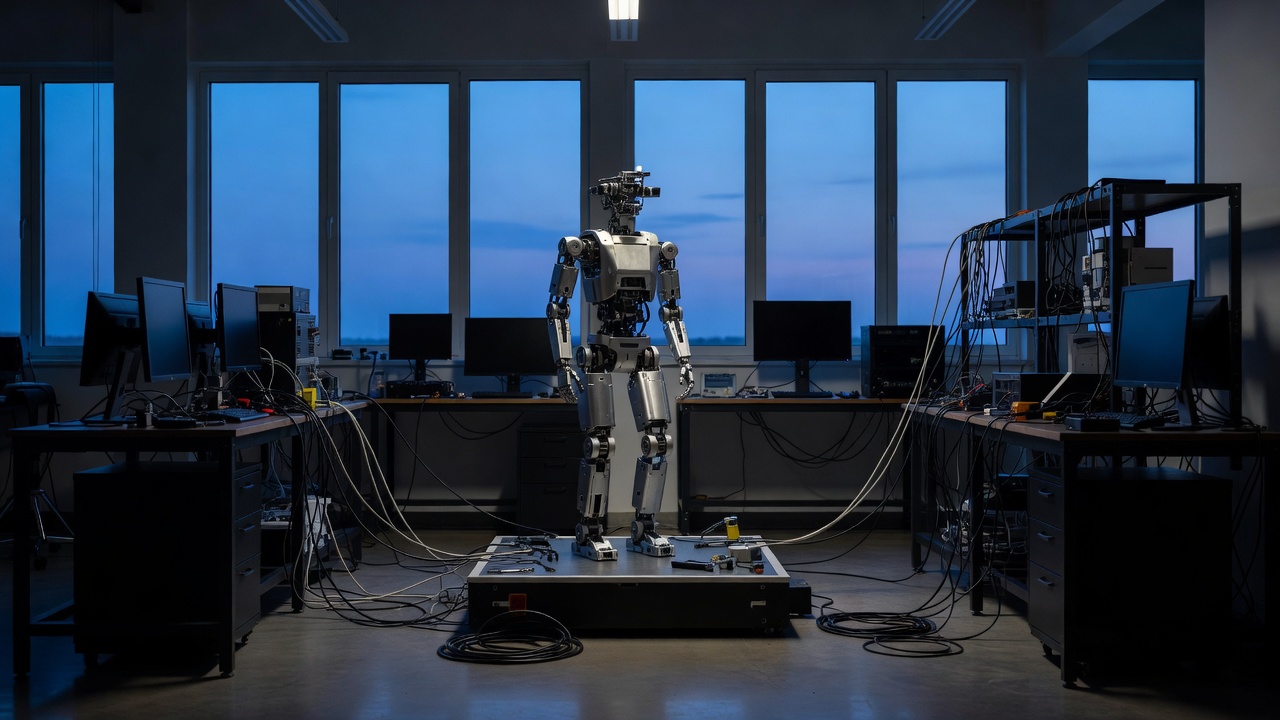
The figure that shapes the story is in the caption of the article's Figure 1: "75% of findings involved development, training, simulation, or validation tools, highlighting risks that can arise before a robot is deployed." That number is our arithmetic.
The claimed consequence is that the weaknesses "could influence the models teams build, the test results they trust, and the instructions sent to robots." VicOne adds a caution: "These are potential consequences and not demonstrated outcomes for every finding." Actual effects, it says, "depend on the attacker's access, the system's design, and whether other safeguards prevent the changes from reaching physical behavior."
Real-World Impact
The one concrete demonstration is a video in which VicOne researchers "exploited a vulnerability to prevent a robot's remote-stop command from working."
The pre-deployment angle is the substantive concern. A simulator, for example, is a tool that lets teams test robot behavior in a virtual environment. NVIDIA's own documentation describes Isaac Sim as an open source framework, licensed under Apache 2.0, for robotics simulation, testing, and synthetic data generation. That description is general context, and the VicOne article does not say Isaac Sim is affected. The point is the category: if a flaw in such a tool alters outputs, an earlier successful test, in the article's words, "remains useful evidence," but "a newly discovered weakness may reveal conditions that test never examined."

VicOne frames the stakes in its white paper, "Why Robot Safety Depends on Cybersecurity: Protecting the Information That Safety Decisions Rely On." The source quotes no individual people and does not report any exploitation of the findings. VicOne itself says the exposure "does not necessarily mean an attack has occurred."
Competitive Landscape
VicOne describes itself as "a Physical AI cybersecurity company protecting vehicles and robots," so the research doubles as a product pitch. The article promotes two offerings:
- Radeis: finds potential zero-days, assesses AI model and system security, and uses simulation to evaluate risk to robot behavior before deployment.
- Rthena: threat detection and response "within approved policies during operation."
No competing robotics-security vendor appears in the brief, so no ranking is possible. For scale, other trackers count zero-days differently: Google's analysis tracked 90 zero-day vulnerabilities in 2025, and Google's Threat Analysis Group and Mandiant tracked 97 exploited in the wild in 2023, up from 62 in 2022. Those counts cover exploited flaws and are not comparable to VicOne's newly discovered findings.
What's Next
After a patch, the article says, teams must "identify affected systems, check compatibility, and verify that the update preserves intended behavior." An interim mitigation example is "restricting access to an affected service."
Regulation adds a clock, though this context comes from the regulation's published text, not from the VicOne article. The EU Cyber Resilience Act (Regulation (EU) 2024/2847) entered into force on 10 December 2024. Per that text, its reporting obligations, which require manufacturers to report actively exploited vulnerabilities, apply from 11 September 2026, and its main obligations apply from 11 December 2027.
Readers should watch for:
- Vendor advisories naming the affected Google, NVIDIA, and Meta projects.
- CVE assignments and any change to the count of 28.
- Independent replication of the findings.
On the headline question, whether robotics security is keeping pace, the evidence supports only a limited verdict. The data suggests the build-and-test toolchain deserves scrutiny, but it comes from a vendor, is preliminary, and has no outside validation. The article also notes that "attackers could use similar capabilities," so faster AI-assisted discovery is not a defender-only advantage.
The most telling detail is where the flaws sit: not in the robot, but in the workshop that builds it. If a stop command can be defeated on a machine, the quieter risk is a pipeline nobody thinks to attack. Until vendors confirm or contest the 28, the number is a prompt for scrutiny, not a verdict.
For a robotics engineer or security lead at a company building on open simulation and training tools, the practical takeaway is to inventory those tools like production software. Track which versions the training pipeline uses, restrict network access to simulation services, and plan for re-running validation tests after any patch, since a passed test does not cover a newly found flaw.
-- Zara Velez, Emerging Technology Editor
Sources: Ed · Cuny · IEEE Spectrum (VicOne sponsored article) · VicOne Reports